Programmatic SEO for SaaS: How to Build Thousands of Pages That Actually Rank
Most founders who try programmatic SEO end up with thousands of thin pages and zero traffic. Here's the data-backed framework for building pSEO pages that survive Google updates — with real examples from Zapier, Wise, and Nomad List.
Rori Hinds··10 min read
Zapier has 50,000+ programmatic pages generating 5.8 million organic visits every month. Wise has 250,000+ currency pages driving 60 million monthly visits. Nomad List — built by a single founder — pulls 50,000 organic visits from 25,500 city pages.
You see those numbers and think: I should do programmatic SEO.
You’re probably right. But here’s what nobody tells you: for every Zapier success story, there are a hundred sites sitting in Google’s “Discovered — currently not indexed” purgatory. 67% of programmatic SEO failures come down to thin content, and those sites lose up to 80% of their traffic when Google catches on.
The difference between pSEO that compounds traffic for years and pSEO that tanks your entire domain isn’t the tech stack. It’s whether you have real data behind every single page.
This post is the framework. No fluff — just the data types you need, the steps to build it, and the mistakes that get sites penalized.
What Programmatic SEO Actually Is (And What Gets You Penalized)
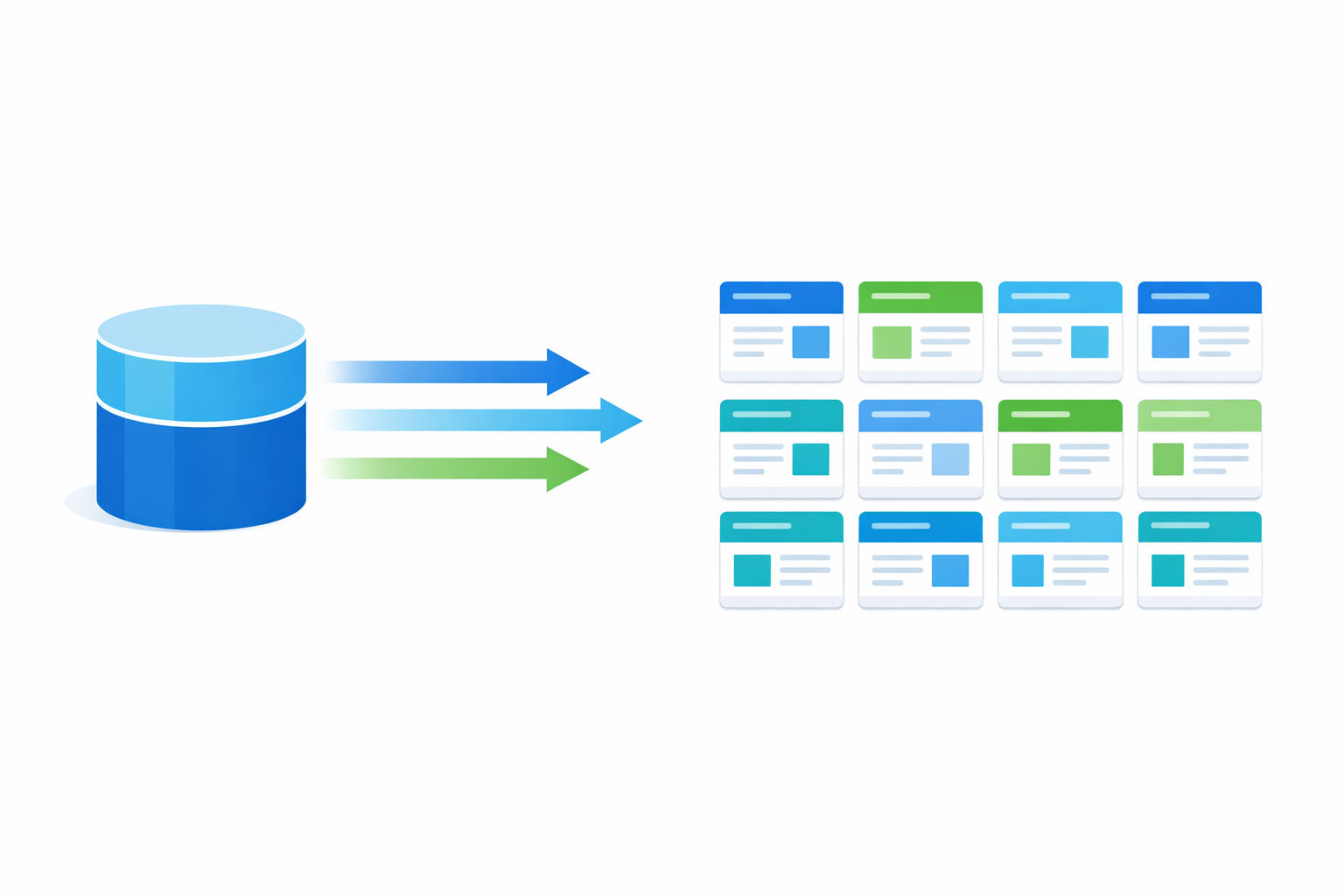
Programmatic SEO is generating hundreds or thousands of pages from structured data plus a template, where each page targets a specific long-tail keyword. You build the template once, plug in the data, and your site scales to cover an entire keyword category.
The concept is dead simple. The execution is where founders get wrecked.
Here’s the critical distinction most guides skip: there’s a hard line between legitimate pSEO and template spam. Google’s John Mueller put it plainly — “one low-quality part of your site can impact the ability of the high-quality parts to rank organically.”
Template spam is creating “Best [X] in [City]” pages for 10,000 cities with the same generic copy and a city name swapped in. Google’s been penalizing this since the Helpful Content Update. The pages don’t help anyone.
Legitimate programmatic SEO is creating pages like Wise’s “Convert USD to EUR” that pull real-time exchange rates, historical charts, fee comparisons, and transfer options. The template provides structure. The data provides value.
The test is simple: strip away the template chrome and look at just the unique data on each page. Would a human find that page useful on its own? If the answer is no, you don’t have programmatic SEO — you have an indexed spreadsheet.
The 40% Boilerplate Rule
Google measures duplicate content at the paragraph level, not the page level. Testing across multiple pSEO deployments shows pages with more than 60% shared content almost never get indexed. Keep your boilerplate ratio below 40% — meaning at least 60% of each page should be unique, data-driven content. A healthy pSEO system maintains an indexed-to-published ratio above 85% in Google Search Console.
The 3 Data Types That Power Programmatic SEO
Every successful pSEO project is built on one of three data types. If you don’t have at least one of these, stop here — you’re not ready for programmatic SEO yet.
1. Internal Product Data
This is data your product generates that nobody else has. It’s the strongest foundation for pSEO because it’s inherently unique and defensible.
Zapier is the textbook example. Their integration pages (“Connect Slack to Google Sheets”) aren’t just keyword pages — each one lists real triggers, actions, popular workflows, and step-by-step setup guides specific to that exact app combination. They have 50,000+ pages because they have 50,000+ real integration pairs with real data behind each one.
Zapier’s “Gmail integrations” page alone drives 60,000 monthly organic visits. Their “Google Sheets integrations” page pulls 34,000. That’s not content marketing — that’s product data doing SEO work.
How to apply this: If your SaaS has integrations, templates, use cases, or features that vary by customer segment, each variation is a potential pSEO page. The question is whether you have enough unique data per variation to fill a useful page.
2. User-Generated Data
This is data your users create — reviews, ratings, contributions, activity metrics. It scales naturally because your users produce it for you.
Nomad List nails this. Pieter Levels built a database with 50+ data points per city — internet speed, cost of living, safety ratings, weather, nomad community size — much of it crowdsourced from the digital nomad community. Each city page has six template variations (overview, cost of living, pros/cons, digital nomad guide) that target different search intents.
The result: 25,500 indexed pages, 50,000+ monthly organic visits, and 49.5% of all traffic coming from organic search. All from a bootstrapped product built by one person.
How to apply this: If your users leave reviews, create projects, submit data, or interact in any way that generates structured information, that’s your pSEO dataset. Think G2’s software review pages or Product Hunt’s tool listings.
3. Public Datasets (Enhanced With Your Perspective)
This is publicly available data that you aggregate, clean, and present better than anyone else. It’s the most accessible option for founders who are just starting out, but it’s also the riskiest — because if five other sites have the same data, your pages won’t rank.
The key word here is enhanced. You need to add a layer of value that doesn’t exist elsewhere.
Wise does this brilliantly with currency conversion pages. Exchange rate data is public — anyone can get it. But Wise adds real-time fee comparisons, historical rate charts, transfer time estimates, and direct calls-to-action for their own product. Each of their 250,000+ pages has genuinely useful context around the raw data. The result: 60 million monthly organic visits, with roughly 90% driven by programmatic pages.
Another approach: comparison pages. “[Tool A] vs [Tool B]” keywords have massive long-tail volume. If you can pull real feature data, pricing, and ratings into structured comparison templates, you’re adding value to publicly available information.
Real SaaS examples of the three programmatic SEO data types
Data Type
Example Company
Page Count
Monthly Organic Traffic
Key Advantage
Internal Product Data
Zapier (integration pages)
50,000+
5.8M visits
Fully unique, impossible to replicate
User-Generated Data
Nomad List (city pages)
25,500+
50,000+ visits
Scales with community, defensible
Public Data (Enhanced)
Wise (currency pages)
250,000+
60M+ visits
Accessible, but requires added value
The 5-Step Framework for Founders
You don’t need a team of 10 to run programmatic SEO. Here’s the step-by-step process a solo founder or small team can follow.
Building Your pSEO System
Step 1
Find Your Template Angle
Look at your product and ask: what's the repeating keyword pattern? For SaaS, the most common patterns are **[Your Tool] + [Integration]**, **[Category] for [Industry]**, **[Tool A] vs [Tool B]**, and **[Feature] in [Location]**. You need a head term with modifiers that create hundreds of unique combinations. Check Ahrefs or Semrush's Matching Terms report — filter for your seed keyword and look for patterns with at least 100+ keyword variations.
Step 2
Validate Search Demand
Don't build pages nobody searches for. For each keyword pattern, check that individual long-tail variations have at least 10-50 monthly searches. The math is simple: 1,000 pages × 30 visits/month each = 30,000 monthly visitors. Even low-volume keywords compound when you have thousands of pages. Use Ahrefs Keywords Explorer or even Google's free Keyword Planner to validate. Kill patterns where most variations show zero search volume.
Step 3
Build Your Data Source
This is where most founders skip ahead and fail. Your data source needs to provide **unique value per page** — at minimum 3-5 differentiated data points per row. Start with Airtable or a simple Postgres database. Map every data field to a section of your template. If a row doesn't have enough data to fill a useful page, don't publish that page. Quality floor > page count.
Step 4
Set Your URL Structure
Clean, logical URLs matter for both SEO and crawl efficiency. Use patterns like `/integrations/[app-name]`, `/compare/[tool-a]-vs-[tool-b]`, or `/[category]/[modifier]`. Keep URLs shallow (max 3 levels deep). Create a hub page that links to all your programmatic pages — this internal linking graph is the #1 factor that determines whether pages get indexed or ignored.
Step 5
Scale Production (Gradually)
Don't publish 5,000 pages on day one. Start with 50-100 pages, monitor indexation rates in Google Search Console for 2-4 weeks, then scale in batches of 200-500. Watch your indexed-to-published ratio — if it drops below 85%, stop and fix quality issues before adding more pages. A sudden spike of thousands of URLs burns crawl budget and signals low quality to Google.
Tech Stack Options for Small Teams
You don't need custom infrastructure to start. No-code path: Airtable (database) → Webflow or Framer (template rendering) → Zapier or Make (automation). Low-code path: Google Sheets (data) → Next.js or Astro (static site generation) → Vercel (hosting). Custom path: Postgres + your framework of choice + a headless CMS. The tooling doesn't matter as much as the data. Pick whatever gets you to your first 50 pages fastest.
The Mistakes That Get Sites Penalized
I’m going to be direct here: programmatic SEO done badly doesn’t just fail to rank — it actively damages your domain. Here’s what kills pSEO projects.
Programmatic SEO: What Works vs What Gets You Penalized
Programmatic SEO Execution
Each page has 60%+ unique, data-driven content
Pages answer a specific search query with real data
Gradual rollout with indexation monitoring
Strong internal linking between programmatic pages and hub pages
Quality floor enforced — pages without enough data don't get published
Programmatic SEO Execution
Pages are 80% template with a city/name swapped in (thin content)
Publishing 5,000+ pages at once without monitoring
No unique data per page — just keyword permutations
Duplicate-ish pages that cannibalize each other's rankings
Ignoring Google Search Console indexation warnings
The numbers are stark. According to practitioner data, 93% of penalized programmatic sites lacked differentiation beyond their templates. 54% of pSEO failures involved duplicate content issues that led to up to 98% deindexation — imagine publishing 50,000 pages and having 49,000 of them removed from Google’s index.
Keyword cannibalization is another silent killer. When your programmatic pages target overlapping keywords without clear differentiation, they compete against each other instead of against competitors. This can cause a 40-60% traffic drop across the affected pages.
The recovery timeline is brutal: 6-12 months for thin content penalties, 3-6 months for duplicate content issues. And Gaetano DiNardi of AirOps points out that once Google marks your domain as low-quality, the damage can be long-lasting.
Internal linking is your best defense. Programmatic pages that are well-connected to hub pages and to each other get indexed at dramatically higher rates than orphaned pages. Build your linking graph before you scale.
When Programmatic SEO Is NOT the Right Move
I’d rather save you three months of wasted work than hype you into a strategy that doesn’t fit.
Don’t do pSEO if you don’t have unique data. This is non-negotiable. If the only thing changing between pages is a keyword swap, Google will catch it. The data is your moat — without it, you’re building on sand.
Don’t do pSEO if your keyword patterns don’t have search volume. Some product categories simply don’t generate enough long-tail search variations. If your Ahrefs research shows 50 viable keywords instead of 500+, write those pages manually — they’ll be better for it.
Don’t do pSEO if you haven’t established brand authority. Gaetano DiNardi, Head of Growth at AirOps, warns that programmatic SEO is “a bad move for startups who have not yet established a brand base.” If your domain is brand new with zero backlinks, thousands of auto-generated pages will signal spam, not scale. Build your SEO foundation first.
Don’t do pSEO if you can’t maintain data quality. Stale data kills pSEO pages. If your exchange rates are from last year or your integration data is outdated, the pages lose their value. You need a process to keep your data source fresh — or an automated pipeline that handles it.
The Honest Litmus Test
Before you commit to programmatic SEO, answer these three questions:
Do I have a unique data source with 3+ differentiated data points per page?
Do at least 500 keyword variations in my pattern show search demand (10+ monthly searches each)?
Does my domain have some existing authority (50+ referring domains, some organic traffic)?
If you answered yes to all three, pSEO is likely a strong fit. If you answered no to any of them, fix that gap first.
The Bottom Line: Data First, Pages Second
“Programmatic SEO” gets about 880 searches per month in the US, with a CPC of $11.84 and a rising trend. Founders are actively looking for this strategy. Most of them will fail — not because the concept is broken, but because they skip the data question and jump straight to building templates.
The formula that actually works is boring: 1 template × 1 rich data source = thousands of useful pages. Zapier, Wise, and Nomad List didn’t get lucky. They had real data, validated search demand, and rolled out gradually.
If you’re a solo founder or a team of two, here’s your move: pick one keyword pattern, validate it has demand, build a data source with genuine unique value per row, publish 50 pages, and monitor your results. If those 50 pages get indexed and start pulling traffic, you’ve found your pSEO angle. Scale from there.
Don’t build 5,000 pages and hope for the best. Build 50 pages and know they work.
The only thing that separates pSEO that compounds traffic for years from pSEO that gets deindexed in weeks is this: every page has to earn its spot in Google’s index by being genuinely useful. No shortcuts. No template spam. Just good data, structured well.
Too Busy to Write Even Your Regular Blog Posts?
Programmatic SEO handles your long-tail pages. But you still need editorial content to build domain authority. Vibeblogger handles the entire blog operation — from keyword research to published post — so you can focus on building your product.