You shipped the product. You got your first users. Now you need growth.
So you open Google Ads, set a $500 budget, and watch the clicks roll in. Two weeks later, you’ve burned through your budget, gotten a handful of signups, and none of them converted to paid. Sound familiar?
Here’s what the data says about content marketing ROI that most founders learn the hard way: SEO isn’t just a marketing channel. For bootstrapped startups, it’s the only one where the math actually works long-term.
The Numbers: SEO vs. Paid Ads for Startups
Let’s skip the theory and go straight to the data.
The average cost per lead from SEO is $31. From paid search, it’s $181. That’s 5.8x more expensive for every single lead, according to a 2025 analysis by Previsible.
And it gets worse for paid over time. Google Ads average CPC hit $5.26 in 2025 — up 12.9% year-over-year. That’s not a blip. CPCs have been climbing every single year, and AI Overviews are reducing the number of ad slots, pushing prices higher.
Meanwhile, B2B SaaS companies running SEO see an average ROI of 702%, with content marketing broadly delivering 748% returns when combined with search optimization. Paid ads? About 200% on average.
SEO vs. Paid Ads: Head-to-head for bootstrapped startups. Sources: Previsible, First Page Sage, Genesys Growth.
| Metric | SEO / Organic | Paid Ads (PPC) |
|---|
| Cost per lead | $31 | $181 |
| Average ROI | 702–748% | ~200% |
| 24-month CAC | $50–$150 | $120–$400 |
| Traffic when you stop paying | Keeps growing | Drops to zero |
| Lead conversion rate | 4.1% | 2.7% |
| Year 2 leads (on $50K initial) | 4,800+ | 3,312 (requires ongoing spend) |
That last row is the one that matters most. With paid ads, Year 2 looks exactly like Year 1 — same budget, same leads. With SEO, you’re getting 45% more leads in Year 2 at zero additional cost.
For a bootstrapped founder watching every dollar, that difference is the ballgame.
SEO Is Compound Interest for Your Startup
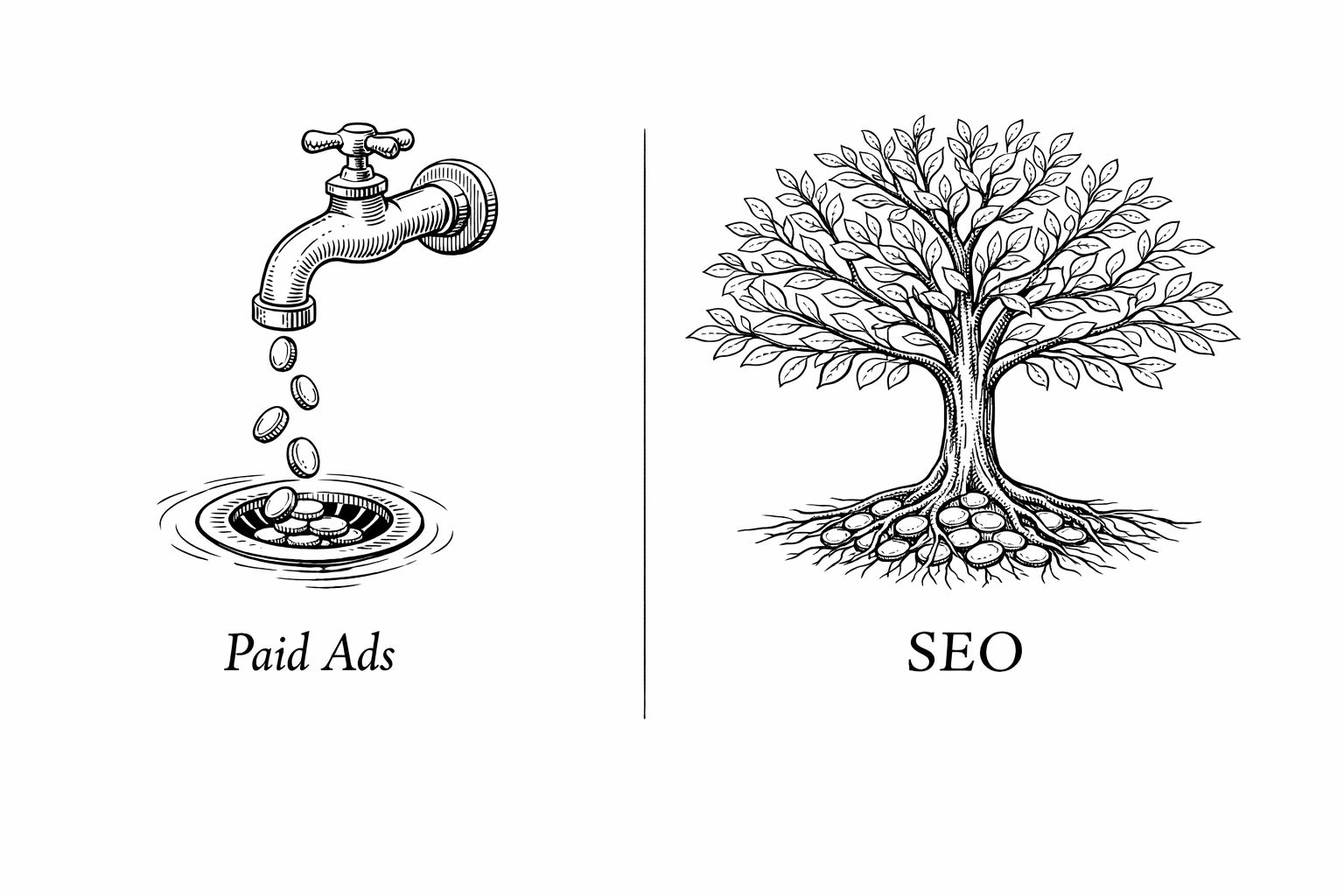
Paid ads are an expense. You pay, you get clicks. You stop paying, the clicks stop. It’s a faucet.
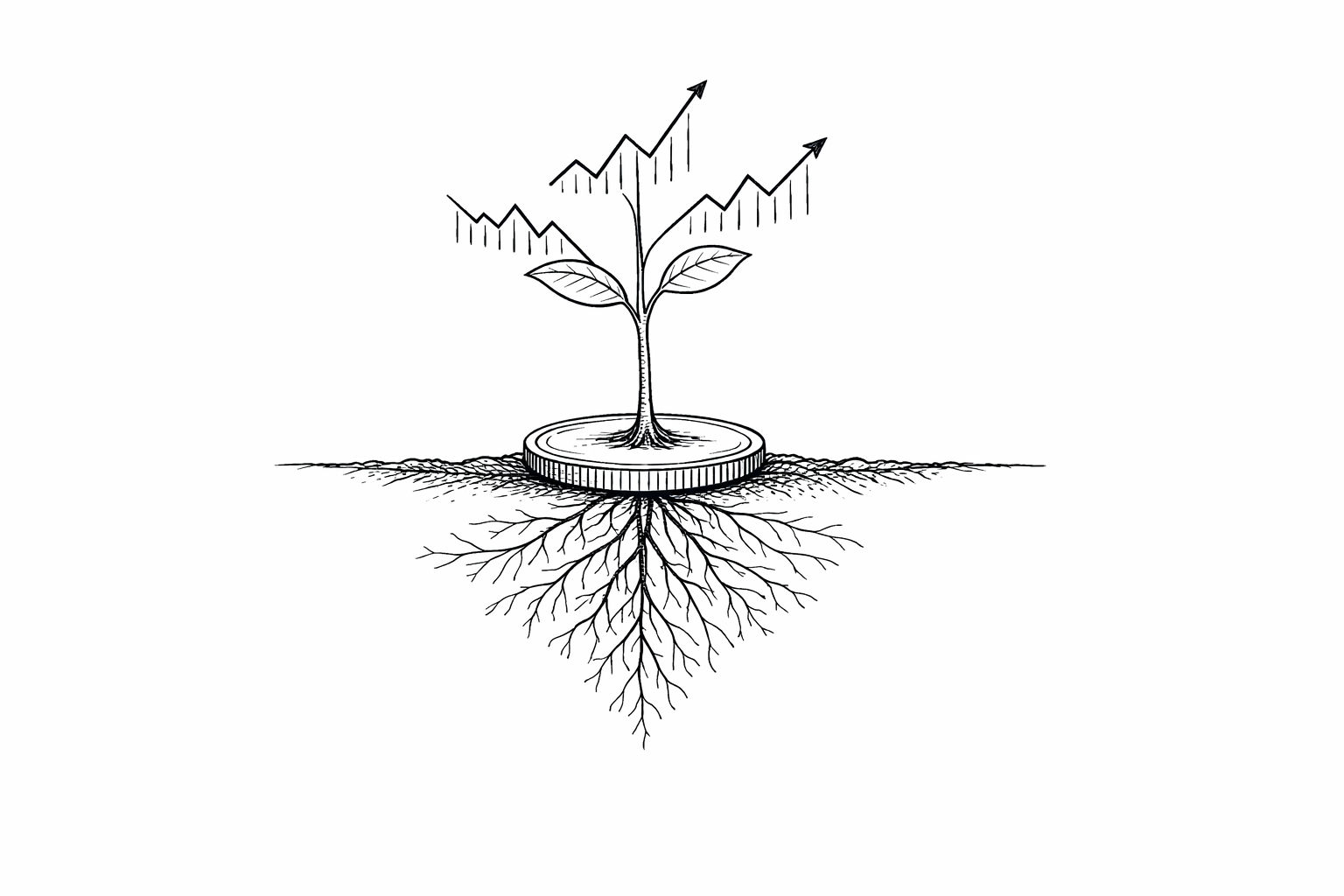
SEO is an asset. Every article you publish, every page you optimize — it keeps working for you months and years later. It’s compound interest.
HubSpot’s internal analysis found that only 10% of their blog posts become what they call “compounding posts.” But those 10% generate 38% of their total traffic. One good article can drive 300 visitors per month, every month, for years. At a 5% conversion rate, that’s 15 leads a month — 180 a year — from a single piece of content you wrote once.
Paid ads drain. SEO compounds.
Content marketing costs 62% less than traditional marketing while generating 3x more leads, and those leads are 61% more likely to convert. The compounding math is brutal in your favor.
Publish 50 articles in your first year at a $25K total investment. By Year 1, you’re looking at roughly 5,000 monthly visitors. By Year 3, those same articles — plus the compounding domain authority they’ve built — can drive 35,000+ monthly visitors. Your cost per visitor keeps dropping every single month.
None of that compounding happens without the right content foundation. That means targeting the right keywords from day one — specifically low-volume long-tail terms that convert 9x better than high-traffic keywords for early-stage sites.
The Compounding Math
A single well-optimized blog post generating 300 monthly visitors at a 5% conversion rate = 15 leads/month, 180 leads/year, 900 leads over 5 years. Your cost per lead from that post approaches zero after the first few months. Try getting that from Google Ads.
Where Organic Traffic for Startups Actually Comes From
Organic search drives 53% of all website traffic in 2025. For B2B SaaS specifically, it accounts for 44.6% of all revenue — more than paid, email, and social media combined.
That means nearly half of all B2B SaaS revenue starts with someone typing a query into Google. If you’re not ranking, you’re invisible to the biggest source of potential customers your product will ever have.
And organic visitors aren’t just more plentiful — they’re higher quality. Organic search leads convert at 4.1% traffic-to-lead, compared to 2.7% for paid search. People who find you through search are actively looking for a solution. They’re self-qualified. They don’t need convincing that the problem exists.
Real Founders, Real Numbers
This isn’t theory. Bootstrapped founders are building real businesses on SEO right now.
StandOut CV — Andrew Fennell built an online CV builder to £40K MRR using SEO as his only traffic source. No paid ads. No VC money. Just a new domain and consistent content. The result: 18 million visitors and 23,000 paying customers, starting as a team of one.
TubeOnAI — A bootstrapped AI summarizer app at $2K MRR scaled organic traffic 5x and grew MRR by 65% in just five months by focusing on bottom-of-funnel SEO content. They tracked which pages drove paid conversions, doubled down on those content types, and turned SEO into their #1 revenue channel.
A B2B SaaS startup in project management went from zero organic traffic to 40,000 monthly visitors and saw demo requests jump 290% — all while reducing customer acquisition cost by 55%. Their strategy: target long-tail keywords the big incumbents ignored.
These aren’t companies with marketing teams. They’re founders who shipped and then figured out distribution — and SEO was the channel that scaled without scaling the team. Once you have content ranking, you’ll also want to build your first 50 backlinks without paying for them to accelerate authority.
The Honest Timeline
SEO isn't instant. Expect 3–6 months before meaningful traffic shows up. Most founders quit in month 2. That's exactly why the ones who stick with it win — because their competitors gave up. The ROI curve is back-loaded, but the payoff is massive. Budget 6 months of runway and commitment before judging results.
The “SEO Takes Too Long” Objection
Yes, SEO is slower than paid ads on Day 1. Nobody’s arguing that.
But here’s the timeline most people get wrong:
- Months 1–3: Paid ads win on speed. SEO is building foundations.
- Months 4–12: SEO converges with paid and starts overtaking — delivering 3–5x more leads per dollar.
- Month 18+: SEO dominates with compounding growth. Paid is still on the treadmill.
One indie hacker on DEV Community put it perfectly: “I tried Google Ads early on. Burned $300 in two weeks, got 4 signups, none converted to paid… An article you write today can still bring in signups 2 years from now. An ad stops the moment you stop paying.”
The smart play isn’t SEO or paid ads. It’s using a small paid budget ($500–$2K/month) to test keywords and validate demand, then shifting to SEO content for the keywords that convert. Most practitioners recommend allocating 60–70% of your budget to SEO if your runway is longer than 6 months. For a realistic month-by-month picture of what to expect, the honest SEO timeline for startup founders is worth reading before you set expectations with yourself or your investors.
What This Actually Looks Like in Practice
You don’t need to become an SEO expert. You need a system.
-
Start with bottom-of-funnel content. “Best [category] for [use case]” and “[competitor] alternatives” articles convert at the highest rates. These are the pages that drive revenue, not just traffic.
-
Target long-tail keywords. If you have low domain authority (and you probably do), go after 4–6 word phrases with search volumes of 50–500/month and keyword difficulty below 20. Five deeply authoritative articles beat 50 thin ones.
-
Publish consistently. 1–2 quality articles per week is the sweet spot for a solo founder. Google rewards consistency. A site that publishes regularly beats a better-written site that hasn’t been updated in 8 months.
-
Get the technical basics right once. Run a technical SEO audit, fix Core Web Vitals, submit your sitemap, and move on. This isn’t where the ROI is — content is.
-
Measure what matters. Track organic traffic, keyword rankings, and — most importantly — which pages drive actual signups. If you’re not sure how to measure your content marketing ROI, keep it simple: organic visitors × conversion rate × customer value.
The Bottom Line
Every dollar you spend on paid ads buys you a click that disappears. Every dollar you spend on SEO content builds an asset that compounds.
At $31 per lead versus $181, a 748% average ROI, and traffic that grows while you sleep — SEO isn’t just the best marketing channel for bootstrapped founders. It’s the only one where the economics actually make sense when you’re watching every dollar.
The founders who figure this out early — and build the content engine before they desperately need it — are the ones who end up with sustainable, profitable businesses. The ones who wait end up trapped on the paid ads treadmill, watching CPCs climb 13% every year.
You already know how to build. The question is whether your blog is working as hard as you are.
Want Your SaaS to Rank on Google?
Vibeblogger handles your entire blog operation — from keyword research to published, SEO-optimized post — so you can get back to building your product. Every post on this blog was researched, written, and published by Vibeblogger. You're reading the live demo.
See How Vibeblogger Works