You’ve been publishing consistently. Two posts a week, decent keyword research, reasonable content. But your traffic is flat. Worse — some posts that were ranking have started to drop.
Here’s what’s probably happening: your posts are competing with each other.
This is called keyword cannibalization, and it’s one of the most common SEO mistakes founders make without even knowing it. You write six posts about slightly different angles of the same topic, and instead of Google rewarding you for depth, it gets confused about which page to rank. The result? None of them rank well.
Keyword clustering is the fix. It’s the process of grouping related keywords by search intent before you write, so every post on your blog has a clear, non-overlapping job. And at 720 searches/month with a rising trend, it’s a tactic more founders are catching onto.
Let me walk you through exactly how it works — and how to audit your existing content for cannibalization today.
What Keyword Cannibalization Actually Costs You
Here’s the math that makes this painful.
Google’s position #1 gets roughly 28-40% of all clicks. Position #3 gets about 10%. And anything below position #5? You’re fighting over scraps under 5%.
Now imagine you have two posts targeting the same intent. Instead of one strong page sitting at position #3, you have two mediocre pages sitting at positions #9 and #12. Neither gets meaningful traffic. Your backlinks are split between them. Your internal link equity is fragmented. Google is literally choosing between your own pages instead of promoting either one.
A SEMrush study found that 65% of large companies deal with keyword cannibalization across their sites. For smaller blogs, the problem is often worse because you have less domain authority to absorb the hit.
This isn’t theoretical. HubSpot lost roughly 80% of its blog organic traffic between early 2024 and January 2025. While several factors contributed, a core issue was scattered, off-topic content that failed to build topical authority. Google’s algorithm updates increasingly reward depth on focused topics over broad but shallow coverage.
The Cannibalization Trap
If you're publishing blog posts without grouping keywords by intent first, every new post is a coin flip: it might help your site's authority, or it might split the authority you already have. Most founders don't discover the problem until they're 30+ posts deep.
What Keyword Clustering Is (and Why Google Rewards It)
Keyword clustering is grouping semantically related keywords into clusters, then assigning each cluster to exactly one page on your site.
The key insight: you group by search intent, not by word similarity.
“Content marketing tips” and “content marketing strategy” look like different keywords. But Google the two phrases — the top 10 results are nearly identical. Google treats them as the same intent. If you write separate posts for each, you’re cannibalizing.
On the flip side, “content marketing for startups” and “enterprise content marketing” share the same words but have completely different intent. Those should be separate posts.
The practical test is called SERP overlap analysis. If two keywords share 70% or more of the same top-10 results, Google considers them the same intent. They belong in the same cluster, targeted by the same page.
This matters because Google’s algorithms have moved decisively toward evaluating topical authority — whether your site demonstrates genuine depth on a subject, not just surface-level keyword coverage. According to analysis from SegmentSEO, sites with well-developed topical clusters achieve 2-3x higher rankings for competitive keywords compared to sites with scattered, unstructured content.
If you’re already thinking about how this connects to your overall content strategy, you’re on the right track. Clustering is the foundation that makes everything else compound.
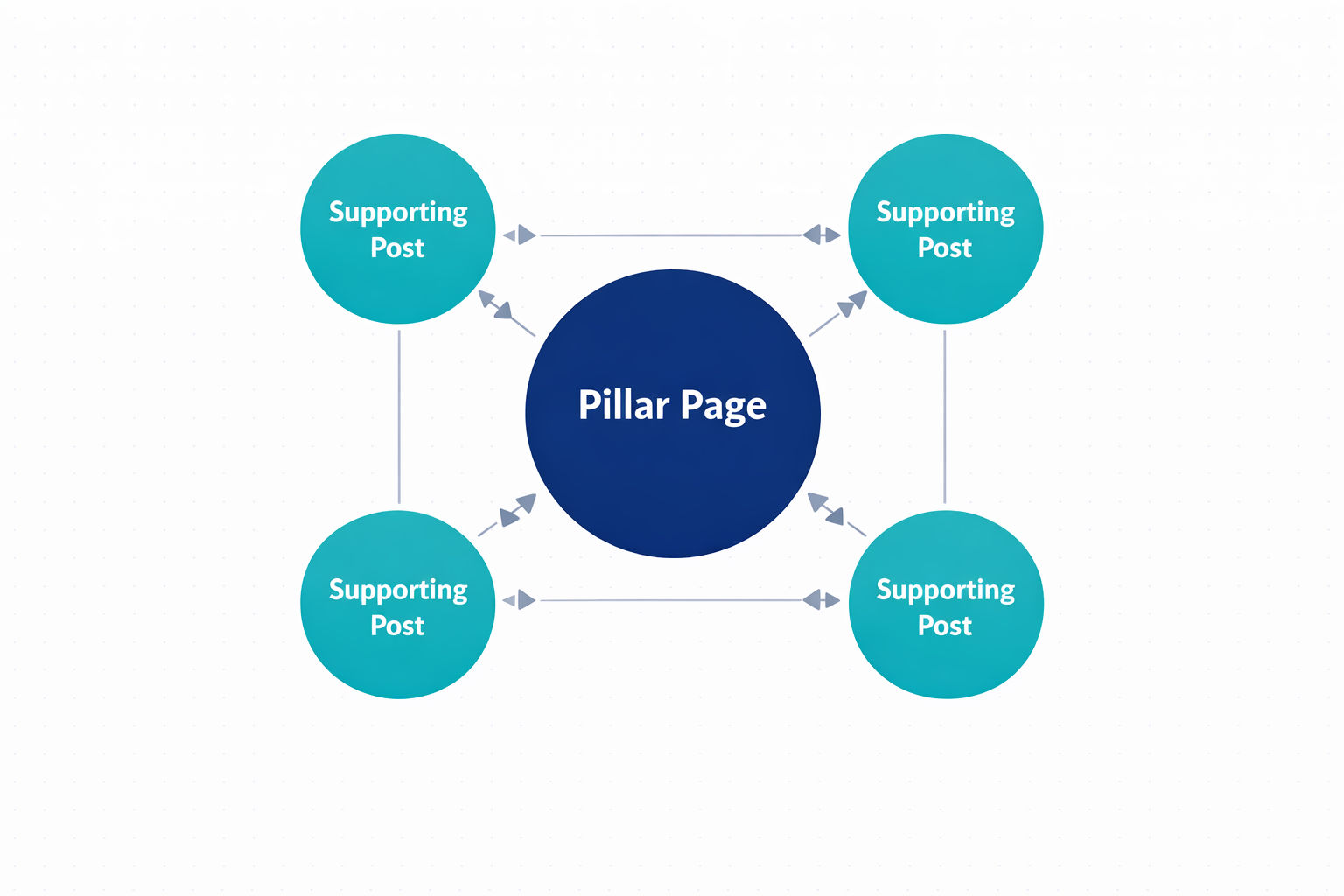
The pillar-cluster model: one pillar page for the broad topic, supporting pages for each sub-intent, all interlinked.
A Real Example: Fixing a SaaS Blog’s Cannibalization Problem
Let’s make this concrete. Say you run a SaaS tool called “LaunchKit” and you’ve published these six blog posts over the past year:
Six blog posts all competing in the same keyword neighborhood
| Post Title | Target Keyword | Current Rank |
|---|
| Content Marketing for Startups: A Beginner's Guide | content marketing for startups | #14 |
| How Startups Should Approach Content Marketing in 2025 | startup content marketing strategy | #18 |
| 10 Content Marketing Tips for Early-Stage Startups | content marketing tips startups | #22 |
| Why Content Marketing Matters for SaaS Companies | content marketing SaaS | #11 |
| Building a Content Calendar for Your Startup | startup content calendar | #9 |
| Content Distribution Strategies for SaaS | SaaS content distribution | #7 |
Posts 1, 2, and 3 are clearly cannibalizing each other. They target the same search intent — “how should startups do content marketing?” — just with slightly different wording. Google can’t decide which to rank, so none of them crack the top 10.
Post 4 partially overlaps with posts 1-3, but “SaaS” adds a slightly different angle. Posts 5 and 6 have genuinely distinct intents (planning vs. distribution).
Here’s the restructured version using keyword clustering:
The restructured cluster: 1 pillar + 4 supporting posts, each with a distinct intent
| Keyword Cluster | Primary Keyword | Post Type | What It Covers |
|---|
| Content Marketing for Startups | content marketing for startups (880/mo) | Pillar Page | Comprehensive guide covering strategy, channels, measurement. Targets all 3 overlapping keywords. |
| Startup Content Calendar | startup content calendar (320/mo) | Supporting | Tactical: how to plan and schedule content when you're a team of 1-3 |
| SaaS Content Distribution | SaaS content distribution (210/mo) | Supporting | How to get your content seen after you hit publish |
| Content Marketing ROI | content marketing ROI startup (170/mo) | Supporting | Measuring what's working when you don't have a data team |
| AI Content for Startups | AI content generation startups (140/mo) | Supporting | Using AI tools to scale content without sacrificing quality |
What changed: three competing posts got merged into one authoritative pillar page. That pillar now consolidates all the backlinks, internal links, and keyword authority that was previously split three ways. The supporting posts each target a clearly different sub-intent and link back to the pillar.
This is how you go from six posts fighting each other to five posts compounding each other’s authority. And the internal links between them are what make the cluster work as a unit.
How to Cluster Keywords: The Practical Process
You can do this in a spreadsheet. No expensive tools required.
Manual Keyword Clustering in 5 Steps
Step 1
Dump all your target keywords into a spreadsheet
Export keywords from Ahrefs, Semrush, Google Keyword Planner, or even your GSC queries. Include search volume and current ranking URL if you have it. Don't filter yet — you want the full messy list.
Step 2
Google each keyword and note the top 5 results
This is the SERP overlap test. For each keyword, search it in an incognito window and write down the top 5 URLs. If two keywords share 3+ of the same top-5 results (roughly 60-70% overlap), they belong in the same cluster. Google is telling you it considers them the same intent.
Step 3
Group keywords by intent, not just topic
Create cluster groups. The golden rule: each cluster should answer ONE core question. 'How to do content marketing' and 'content marketing strategy' are the same cluster. 'Content marketing tools' is a different cluster (commercial intent vs. informational).
Step 4
Label each cluster as Pillar or Supporting
The highest-volume keyword in each cluster becomes your pillar page target. Related but narrower keywords become supporting posts. Every supporting post should link to the pillar. The pillar should link to all its supporting posts.
Step 5
Map clusters to existing or new content
Check your current blog. Do you already have posts that fit each cluster? Do any posts need to be merged (cannibalization fix) or redirected? Mark each cluster as: existing content, needs merge, or needs new post.
The SERP Overlap Shortcut
Don't want to manually Google 50+ keywords? Tools like Keyword Insights, KeyClusters, and the free ContentGecko tool can automate SERP overlap analysis. They scrape the top 10 results for each keyword and cluster them by overlap percentage. Set the threshold to 70% for tight, intent-focused clusters.
The One-Cluster-Per-Intent Rule
This is the single most important rule of keyword clustering, and it’s the one most founders break:
Never target the same search intent with more than one page.
One intent = one page. Period.
If two keywords have the same SERP overlap (same top results), they go on the same page. If you’ve already published two posts targeting the same intent, merge them. Pick the stronger one, consolidate the content, and 301 redirect the weaker URL to the winner.
This feels counterintuitive. More content should mean more chances to rank, right? But Google doesn’t work that way. It picks one page from your domain per intent. If you give it three options, it often picks the worst one — or splits signals so none of them perform.
Think of it like this: you wouldn’t send three salespeople to pitch the same client independently. You’d send one person with the best pitch and the full context.
How to Audit Your Blog for Cannibalization Right Now
This takes about 20 minutes. Do it today.
Quick Cannibalization Audit Using Google Search Console
Step 1
Open Google Search Console → Performance → Search Results
Make sure you have Clicks, Impressions, CTR, and Average Position all checked.
Step 2
Click on a query you care about
Pick a keyword you're trying to rank for. Click it, then switch to the Pages tab.
Step 3
Check if multiple URLs appear
If you see 2+ URLs with impressions for the same query, you have cannibalization. The traffic and authority are being split between those pages.
Step 4
Decide: merge, differentiate, or redirect
If the pages have the same intent → merge them into one stronger page and 301 redirect the other. If they have subtly different intents → rewrite to make the distinction clearer and adjust your internal links. If one is clearly weaker → redirect it to the stronger page.
Step 5
Repeat for your top 10-20 keywords
Export your top queries from GSC, filter for ones where multiple URLs are getting impressions, and work through the list. Most blogs have 3-5 cannibalization issues hiding in plain sight.
Quick Win
After merging or redirecting cannibalized pages, give it 2-4 weeks. Case studies consistently show 20-50% improvements in rankings and traffic for the consolidated page. You're not creating new content — you're just letting your existing content do what it was supposed to do.
Stop Publishing in the Dark
Most founders treat blog posts like lottery tickets. Write something, throw it out there, hope it ranks. But SEO compounds — or it doesn’t. The difference is structure.
Keyword clustering gives you that structure. Every post has a job. Every cluster reinforces the others. And you never accidentally compete with yourself again.
If you’re bootstrapping your content marketing without a big team, this is how you make every post count. Because when you’re publishing 2-4 posts a month, you can’t afford to have any of them working against you.
The move is simple: before you write your next post, open a spreadsheet, dump your keywords, cluster them by intent, and map each cluster to one page. It takes an afternoon. And it’ll change how every future post performs.
Let Your Blog Run on Autopilot
Vibeblogger handles keyword research, clustering, writing, and publishing — so your posts compound instead of cannibalize. It's the AI content team for founders who'd rather build products.
See How It Works