Content Marketing for Bootstrapped Startups: How to Outrank Competitors With a Fraction of Their Budget
VC-funded competitors have 10x your content budget. Here's why that's actually their weakness — and the exact niche-down strategy bootstrapped founders use to outrank them on organic search.
Rori Hinds··9 min read
You’re a solo founder spending $2K/month on content marketing for your startup. Your VC-funded competitor just hired a five-person content team with a $30K/month budget. They’re publishing 20 posts a week. You can barely manage four.
You’d think you’re dead in the water. You’re not.
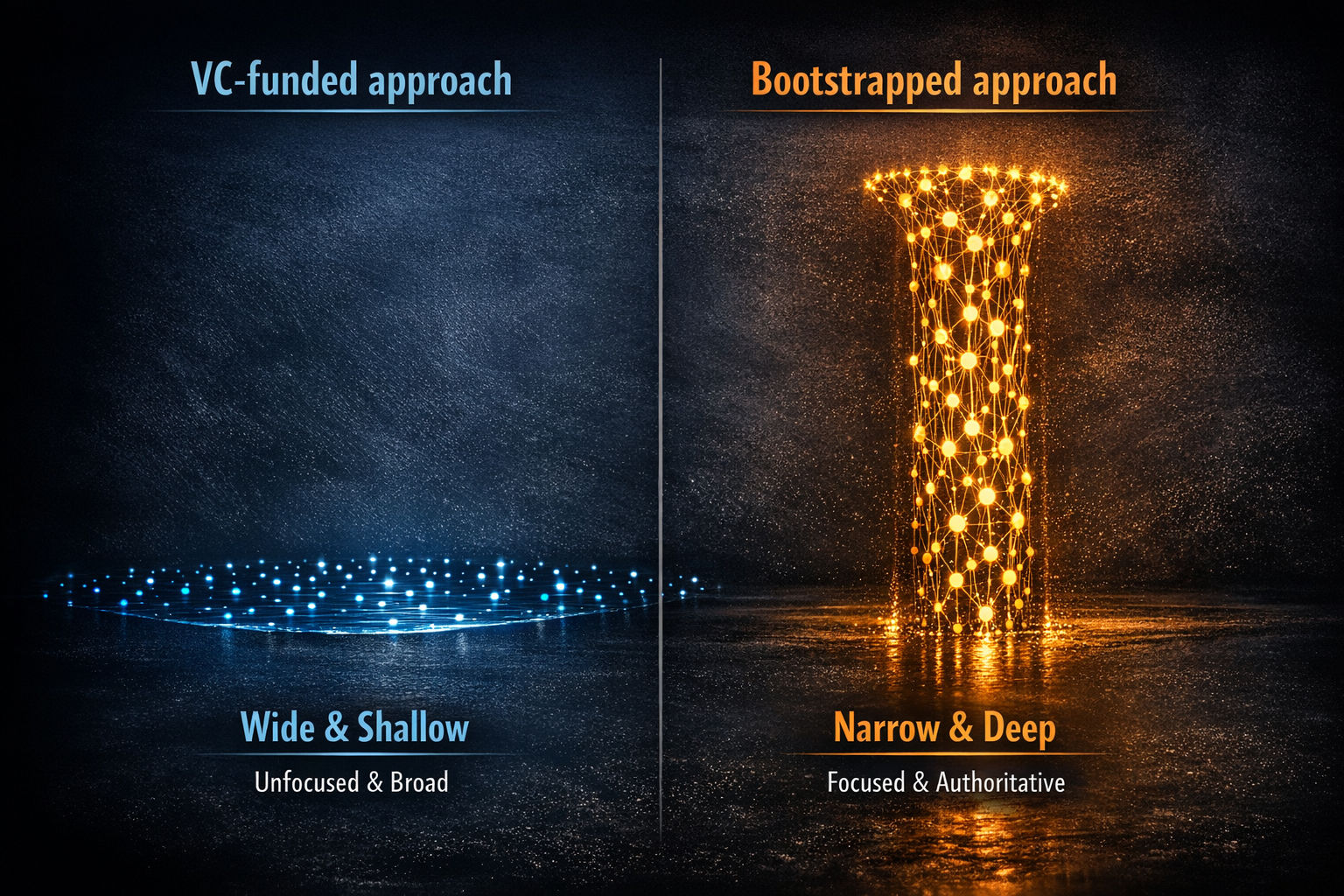
Here’s the thing nobody tells bootstrapped founders: that massive content budget is actually your competitor’s biggest weakness. VC-funded content teams produce generic, surface-level content at scale. They cover everything and own nothing. And Google — especially in 2025 — rewards depth over volume.
The data backs this up. A study by Graphite across 12 websites and 332 URLs found that pages with high topical authority get their first impressions and clicks significantly faster than pages without it. Google publicly confirmed in 2023 that topical authority directly impacts rankings. And across 400 SEO campaigns, sites that built 25-30 interlinked articles per topic consistently outranked sites focused solely on domain authority.
This is your playbook. Go narrow and deep instead of broad and shallow.
VC-funded teams go wide. You go deep. Guess which one Google rewards.
Why VC-Funded Content Teams Have a Structural Weakness
Here’s how most funded SaaS companies do content marketing: they hire a head of content, two writers, an SEO specialist, and a designer. Budget runs $15K-$30K/month. The mandate? “Cover all the keywords in our space.”
So they crank out blog posts. Project management tips. Productivity hacks. Remote work guides. “What is [obvious term]?” articles. The content is competent but interchangeable — you could swap the logo and it’d fit on any competitor’s blog.
This approach has a fatal flaw. When you try to cover everything, you signal to Google that you’re a generalist. Your site has 300 posts touching 50 different topics, but you’ve only written 6 posts about any single one. There’s no depth. No real expertise signal.
As ClickRank’s SEO team puts it: “Smaller sites outrank big brands by focusing deeply on one topic instead of spreading content across many areas. When a smaller site covers every subtopic, question, and use case, Google identifies it as the best match.”
VC-funded SaaS companies spend roughly 58% more on marketing as a percentage of revenue than bootstrapped startups. Bootstrapped companies typically operate on $1K-$5K/month for marketing in the early stage, while funded competitors run $15K-$30K/month content operations.
But the growth rate difference? Only 2 percentage points (25% YoY for funded vs. 23% for bootstrapped), per SaaS Capital benchmarks. Money doesn't buy proportional results.
The Niche-Down Strategy: Own a 30-Post Content Cluster
Forget trying to compete across your entire category. Pick one specific topic within your space and absolutely dominate it.
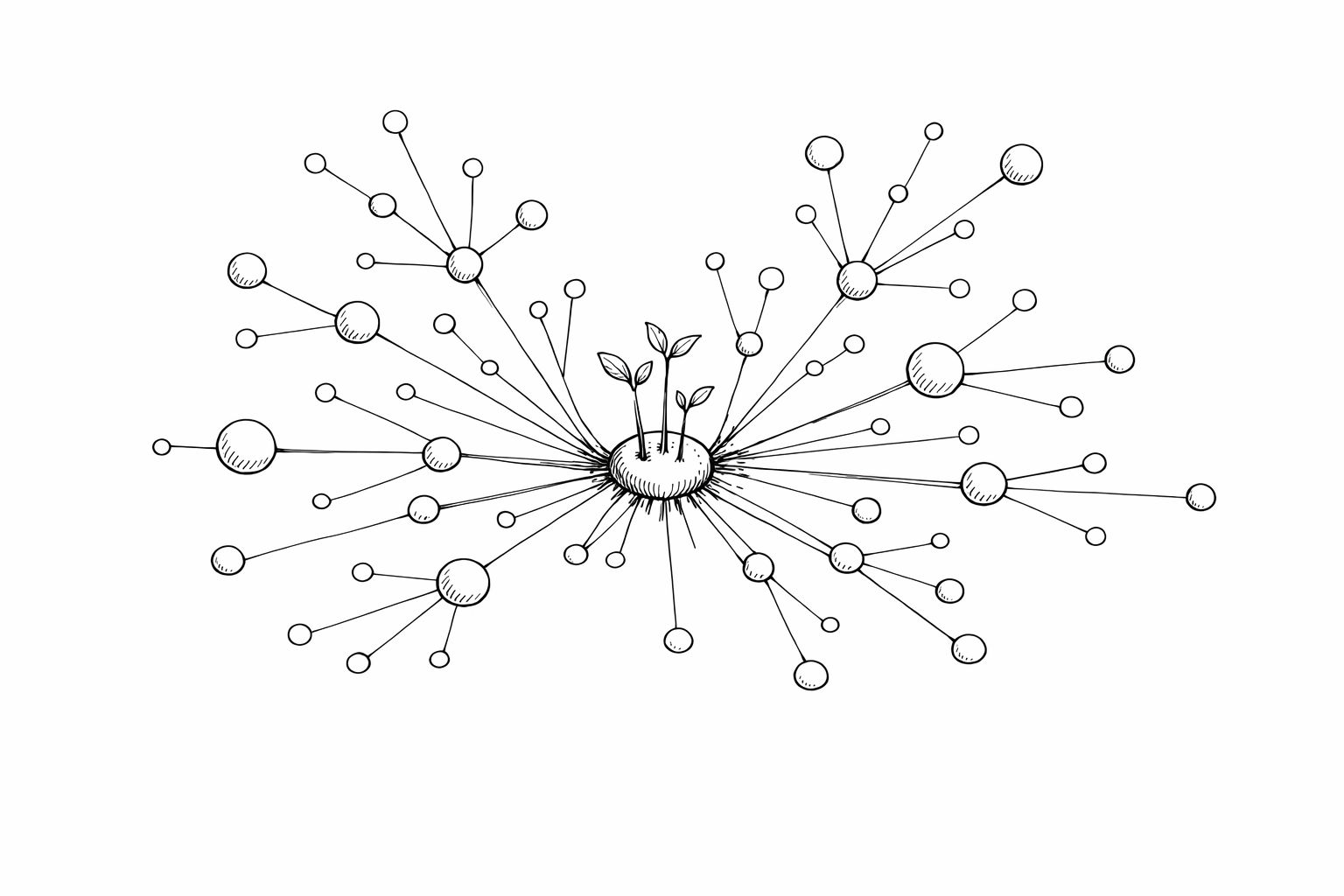
The structure is simple: one pillar page + 25-30 supporting articles, all interlinked. This is called a content cluster, and it’s how a DA-2 travel blog outranked DA-66 sites on a niche topic — with just 30 focused posts generating 70% of total site traffic, per a Moz case study.
Here’s how to pick your cluster topic:
How to Pick Your 30-Post Content Cluster
Step 1
Start with your product's sharpest edge
What's the one thing your product does better than anyone? Not your whole category — your specific angle. If you're a project management tool, maybe it's "project management for agencies" or "async project management for remote teams." That's your cluster seed.
Step 2
Validate the search volume exists
Use a free tool like Google Keyword Planner or Ubersuggest. Your pillar keyword needs at least 500-1,000 monthly searches. The supporting long-tail keywords can be as low as 50-100 each — that's fine. Combined, 30 articles targeting 50-200 searches each adds up to 1,500-6,000 monthly potential visits.
Step 3
Check that competitors are thin
Google your pillar keyword. If the top 10 results are all 500-word posts, listicles, or generic guides — you've found gold. If there are already deep, comprehensive resources from high-DA sites, pick a more specific angle.
Step 4
Map out every subtopic, question, and use case
Use 'People Also Ask,' AnswerThePublic, or just ChatGPT to brainstorm every question someone might have about your topic. You need 25-30 distinct but related article ideas. Every article links back to the pillar page and to 2-3 sibling articles.
Step 5
Publish in batches, not drips
Don't publish one article a week for 30 weeks. Publish 8-10 articles in your first month. Google needs to see enough content to recognize your cluster. Then publish 3-4 per week until you hit 30. Topical authority compounds — the 20th article will rank faster than the 5th.
A 30-post content cluster map — one pillar page connected to supporting articles covering every angle of a single topic.
How to Find the Long-Tail Keywords Big Competitors Ignore
Funded content teams chase high-volume head terms. “Project management software” (22K searches/month). “Best CRM” (40K). They fight over these because their bosses want big traffic numbers on the dashboard.
This creates a goldmine of ignored long-tail keywords with real buying intent. A solid long-tail keyword strategy is how bootstrapped founders punch above their weight — those terms convert at 9x the rate of high-volume head terms.
Let me walk you through a real example. Say you’re building a time-tracking SaaS for freelancers. Here’s what a 10-minute keyword hunt looks like:
Example long-tail keyword opportunities in the freelance time-tracking niche — each one ignored by major competitors.
Keyword
Monthly Volume
Keyword Difficulty
Why Competitors Ignore It
time tracking for freelance designers
210
Low (8)
Too niche for broad content teams
how to track billable hours in retainer contracts
140
Low (5)
Requires domain expertise to write well
freelance time tracking spreadsheet template
390
Medium (15)
Templates take effort to create
time tracking app that works with FreshBooks
170
Low (7)
Integration-specific — generalists skip this
how to bill clients for time spent on revisions
90
Low (3)
Too specific, low volume scares funded teams
automatic time tracking vs manual for freelancers
120
Low (6)
Comparison niche they don't bother with
See the pattern? Each keyword is too small for a funded team to justify. Their cost-per-article is $300-500, so they need high-volume keywords to hit ROI targets.
But you’re not paying $500 per post. And those “small” keywords convert at 2.5x the rate of head terms because the search intent is razor-sharp. Someone searching “time tracking app that works with FreshBooks” is ready to buy today.
Here’s the tactical move: grab all these long-tail keywords, group them into your cluster, and write articles that are genuinely the best answer on the internet for each one. When you own 25-30 of these in a tight niche, Google starts treating your site as the authority on that topic.
Wave, a bootstrapped accounting SaaS, did exactly this. They created targeted landing pages like “free accounting software for nonprofits” and ranked top 3 for 25+ long-tail keywords — beating funded competitors who never thought to go that specific.
At our first startup BriefBid, we were a tiny team with virtually no content marketing budget. Yet through smart SEO practices, we managed to outperform massive target keyword incumbents like Hootsuite and HubSpot on some of the most competitive target keywords. We were showing up above them on the first page of Google.
How AI Tools Change the Equation for a One-Person Team
Two years ago, the strategy above was theoretically sound but practically brutal. Writing 30 high-quality, SEO-optimized articles as a solo founder? That’s 60-90 hours of writing alone — before keyword research, image creation, formatting, and publishing.
AI tools have obliterated that bottleneck.
Solo-founded startups surged from 23.7% to 36.3% of all new companies between 2019 and 2025, according to Carta’s Founder Ownership Report. The main driver? AI tools making one-person operations viable. Businesses using AI report 25-55% productivity increases, with some content tools delivering 5x efficiency gains.
But here’s the nuance: generic AI output won’t cut it. Pasting “write me a blog post about time tracking” into ChatGPT gives you the same bland content everyone else produces. The competitive edge comes from using AI tools that handle the entire pipeline — keyword research, structured content, internal linking, SEO optimization — while you stay focused on your actual product.
The math is straightforward. A freelance writer charges $300-500 per post. A 30-post cluster costs $9,000-$15,000. An AI-powered content workflow can produce the same cluster for a fraction of that, often under $500 total.
That’s not a marginal improvement. That’s a category shift in what a bootstrapped founder can accomplish.
Content Production: Bootstrapped Solo Founder vs. Funded Content Team
Metric
Solo Founder + AI Tools
Funded Content Team (5 people)
Monthly content budget
$100-500
$15,000-30,000
Articles per month
12-20
15-25
Time to publish 30-post cluster
4-6 weeks
6-10 weeks
Cost per article
$5-25
$300-600
Depth of expertise per article
High (founder-written angle)
Medium (generalist writers)
Topical focus
Tight cluster, one niche
Broad coverage, many topics
Speed to topical authority
3-6 months
6-12 months (if ever)
The Real Timeline: When to Expect Results
Let’s kill the fantasy that you’ll rank on page one in 30 days. SEO doesn’t work like that. But it also doesn’t take as long as most people fear — especially with the content cluster approach.
Here’s what “early traction” actually looks like, based on data from multiple SaaS case studies and industry benchmarks:
Bootstrapped Content Marketing Timeline: What to Expect
Month 1-2
Foundation & First Posts
Fix technical SEO basics. Publish your first 8-10 cluster articles. Minimal traffic — Google is still discovering and indexing your content. Don't panic. Focus on publishing, not checking analytics.
Month 3-4
First Signs of Life
You'll start seeing impressions in Google Search Console (but few clicks). Long-tail articles begin appearing on pages 2-3 of search results. Your cluster is 15-20 articles deep. Google recognizes the pattern.
Month 5-6
Early Traction
Long-tail articles start hitting page 1 for low-competition keywords. Traffic grows 20-40% quarter over quarter. You're getting 500-2,000 organic visits/month. First inbound leads trickle in.
Month 7-9
Compounding Kicks In
Your cluster has 25-30 articles. Topical authority is established. New articles rank faster. You're hitting 2,000-5,000+ visits/month. Organic becomes a real lead channel. CAC drops noticeably.
Month 10-12
Authority Established
You're outranking funded competitors on your niche topic. 5,000-15,000+ visits/month. Consistent MQLs from organic. You can start a second cluster. This is where Chanty was when they hit 400K visits and Groove reached $500K MRR — all from content.
The #1 Reason Founders Quit Too Early
Only 1.74% of new pages rank in the top 10 within their first year (Ahrefs, 2025). But that stat is misleading — it includes every random blog post published without a strategy. Pages built as part of a topical cluster with proper internal linking, targeting low-competition long-tails, perform dramatically better. The compound effect of topical authority means your 20th article will rank 3-5x faster than your 5th.
Most founders quit at month 3 when they don't see traffic. The ones who win are still publishing at month 6.
The Bootstrapped Content Marketing Playbook (Summary)
You don’t need a massive budget. You don’t need a content team. You need a focused strategy and the discipline to execute it.
Here’s the short version:
Pick one niche topic your product is uniquely positioned to own
Don’t quit before month 6 — that’s when topical authority starts compounding
The case studies are clear. A B2B SaaS startup went from zero to 40K monthly organic visitors by targeting gaps incumbents missed — reducing CAC by 55%. Groove built a $500K MRR business entirely through content, no sales team. Chanty reached 400K visits and 10K leads in two years on a bootstrapped budget.
None of them outspent their competitors. They outfocused them.
SEO is the highest-ROI channel for bootstrapped founders precisely because it rewards the thing you already have: deep, specific knowledge about your niche. The funded teams can’t buy that. You already own it — you just need to publish it.
Stop Losing to Competitors Who Outspend You
Vibeblogger builds your entire content cluster — from keyword research to published, SEO-optimized posts — without you writing a word. It's the AI content team built for bootstrapped founders who'd rather build products than blog posts.