The Best Discord and Slack Communities for Indie Hackers in 2026
An opinionated, data-backed guide to the Discord servers and Slack groups actually worth joining as a solo founder — with real member counts, pricing, and signal-to-noise ratings.
Rori Hinds··9 min read
Building alone is the hardest part of being an indie hacker. Not the code, not the marketing — the silence. No one to gut-check a pricing page at 11pm. No one who gets why you’re excited about hitting $200 MRR.
The right indie hacker communities fix that. The wrong ones waste your time with motivational quotes and link drops.
The Hive Index now tracks 48 indie business communities. Discord hit 260 million monthly active users and 32.6 million active servers in 2025. Slack founder groups range from 60 members to 26,000+. You have too many options, not too few.
This isn’t a directory dump. It’s an opinionated guide based on real member counts, pricing, and signal-to-noise ratios — so you can pick 2-3 communities that actually match where you are right now and skip the rest.
How to use this guide
Don't join 10 communities and lurk in all of them. As Foti Panagiotakopoulos (founder of GrowthMentor) puts it: "The mistake is joining ten and lurking in all of them. Pick one or two rooms that match where you actually are this year, show up every week, and let the rest go." A community only works once people start to recognize your name.
Discord vs Slack: Which Platform for What
Before you pick a community, pick a platform. They serve different purposes.
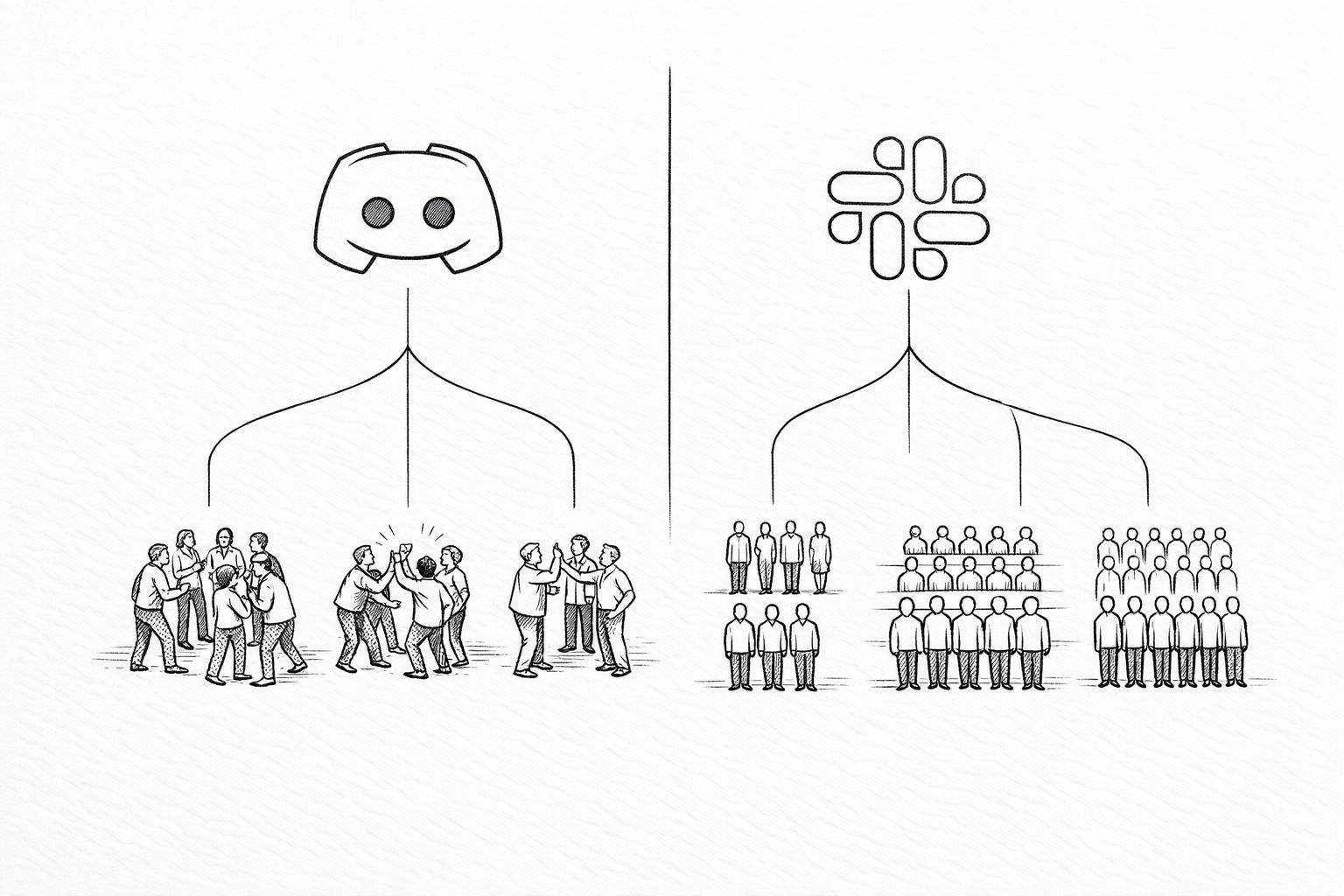
Discord is where the energy lives. It’s free, real-time, and built for high-volume chat. The average Discord user spends 94 minutes per day on the platform (117 minutes for 18-24 year olds), according to SQ Magazine’s 2025 data. 54% of Discord’s user base is now non-gamers. For indie hackers, Discord is best when you need a quick answer — a landing page review, a technical unblock, or a sanity check on an idea.
Slack feels more professional. Founders already have it open for work, so there’s less context-switching. Slack communities tend to be smaller, quieter, and higher-signal. They’re better for ongoing relationships and structured conversations — think weekly check-ins, async advice threads, and curated introductions.
The practitioner consensus from multiple Indie Hackers threads: Slack for professional, high-signal, curated groups. Discord for broad, energetic, builder-heavy communities with more real-time chatter.
Discord communities tend to be larger and faster. Slack groups tend to be smaller and higher-signal.
Best Discord Communities for Indie Hackers
These are the Discord servers worth your time in 2026, ranked by quality — not member count.
1. Indie Hackers Discord
Members: Large (exact count not public) · Cost: Free · Best for: Technical founders building SaaS or dev tools
Talk Shop’s 2026 community guide gave this an A grade after spending six weeks inside every major indie hacker Discord. They tested response times by asking the same five questions across communities — Indie Hackers Discord answered real technical and strategic questions in under 30 minutes during US/EU daytime.
Channels are split by stage (idea, validating, launched, growing, scaling), there’s a co-founder matching channel that actually produces matches, and the audience skews technical-but-business-minded. If you’re building SaaS, this is still the first community you should join.
2. Small Bets
Members: 6,149 · Cost: $120 lifetime · Best for: Experienced solo builders and creators
Small Bets is the case study for why paid indie hacker communities work. Founded by Daniel Vassallo (who left a $500K/year Amazon job), the community generated $400K+/year in revenue and was acquired by Gumroad for $3.5 million in 2025.
The philosophy is ship cheap experiments, find one that earns $1K/month, then scale or start another. The one-time $120 fee keeps the noise out. Member quality is unusually high — these are people who’ve already shipped, not aspiring builders posting motivation quotes.
3. Early Stage Founders
Members: ~3,000 · Cost: Free + paid tiers · Best for: SaaS and service founders finding first customers
Ranked #2 in the Hive Index’s indie business communities list and #7 in their SaaS communities list. The server combines growth systems, coaching, and community. It’s one of only 9% of SaaS communities that offers 1:1 member pairing — which means you get matched with another founder at a similar stage for accountability.
4. MicroConf Connect
Members: Application-based · Cost: Included with MicroConf · Best for: Bootstrapped SaaS founders past the idea stage
MicroConf has been the home of bootstrapped SaaS since 2012. Their community arm is more structured than typical Discords — mastermind matching, stage-based groups, and regular hot-seat calls where you get an hour of focused feedback on a specific problem. If you’re past $1K MRR and want peers who actually understand churn, pricing, and positioning, this is the room.
Discord Communities at a Glance
Community
Members
Cost
Best For
Signal-to-Noise
Indie Hackers Discord
Large
Free
SaaS & dev tools
High
Small Bets
6,149
$120 lifetime
Experienced builders
Very High
Early Stage Founders
~3,000
Free + paid
First customers
High
MicroConf Connect
Application
With MicroConf
Bootstrapped SaaS
Very High
Clarity
~3,000
Free
General networking
Medium-High
Best Slack Communities for Indie Hackers
Slack communities for startups tend to be smaller and more focused. That’s a feature, not a bug.
Small by design. Ramen Club focuses on getting founders to “ramen profitable” — enough revenue to cover living expenses. The paid model keeps it tight. Philip Baretto, founder of Tiiny Host, credits the community directly: “The accountability, advice and deeper bonds I get from Ramen Club have been pivotal to me reaching $3.5K MRR.”
Weekly check-ins and peer mentorship are the core loop. If you want accountability with people who know your name, this is it.
2. Pigeon Hack
Members: ~700 · Cost: Free · Best for: Micro-preneurs focused on audience-first growth
A community of 600+ micro-preneurs and indie makers focused on audience-first growth and sales. It’s free, informal, and practical. Good if you’re building a personal brand alongside your product and want tactical distribution advice.
3. Public Lab
Members: ~100 · Cost: Paid · Best for: Building in public practitioners
The only private Slack community dedicated entirely to building in public. It brings together indie hackers, creators, and solopreneurs who care about transparency in their building journey. If “build in public” is your growth strategy, not just a hashtag, this is your room.
4. AIMidUs
Members: ~1,000 · Cost: Free · Best for: Solopreneurs building with AI
The #1 indie business Slack on the Hive Index, with 116 views/month. Focused on the intersection of solopreneurship and AI — which, in 2026, is basically everyone. Chat, events, newsletter, and job listings all in one workspace.
Slack Communities at a Glance
Community
Members
Cost
Best For
Signal-to-Noise
Ramen Club
~120
£25/mo
Getting to ramen profitable
Very High
Pigeon Hack
~700
Free
Audience-first growth
High
Public Lab
~100
Paid
Building in public
Very High
AIMidUs
~1,000
Free
AI + solopreneurship
Medium-High
Indie Women
~221
Free
Women indie hackers
High
The "dead Slack" problem is real
Many Slack communities spike early and then go silent. Multiple Indie Hackers threads flag this pattern — founders create a workspace, get 200 signups, and within 3 months it's a ghost town. Before you join any Slack group, check: Are there messages from the last 48 hours? Is there a dedicated moderator? Are there structured rituals (weekly threads, AMAs, check-ins)? If the answer to all three is no, keep looking.
How to Actually Get Value From These Communities
Joining is the easy part. Getting value is a different game. Here’s what the data and practitioner experience show actually works.
The Indie Hacker Community Playbook
Step 1
Answer questions before you ask them
Talk Shop's 2026 community guide calls this "the single highest-leverage move in any community." Answering builds your reputation faster than asking. Spend your first two weeks helping others — it's how people start recognizing your name.
Step 2
Share real numbers
MRR, traffic, conversion rates, failed experiments. Communities run on transparency. The founders who get the most value are the ones who post "here's my actual dashboard" — not vague wins or motivational updates.
Step 3
Pick one free and one paid
Free communities (Indie Hackers Discord, Pigeon Hack) are great for fast, broad feedback. Paid communities (Small Bets, Ramen Club) are smaller, higher-signal, and better once you have a specific problem. One of each gives you coverage without overwhelm.
Step 4
Set a 30-day trial for yourself
Give any community 30 days of active participation. If you haven't had one meaningful conversation or one piece of feedback that changed a decision, move on. Most communities reveal their value (or lack of it) within a month.
Step 5
Use communities as a distribution channel
Every community has a show-and-tell or launch channel. When you ship something, these are your first 50-100 eyeballs. Don't spam — build relationships first, then share your work when it's genuinely relevant.
The Bigger Picture: Communities Are a Growth Channel
The best SaaS founder communities aren’t just emotional support (though that matters). They’re distribution.
When you’re active in a 3,000-member Discord and you ship a new feature, that’s 3,000 potential beta testers who already know your name. When you share a blog post in a Slack with 700 micro-preneurs, that’s 700 people in your exact target market.
But here’s the thing — the distribution only works if you’ve built the reputation first. And you can only build reputation in 2-3 communities at once. More than that and you’re spread too thin.
Content works the same way. Your blog is your 24/7 community member — it shows up in Google, answers questions, builds trust, and drives traffic while you sleep. If you’re spending time in indie hacker communities but not publishing content, you’re missing the other half of the organic growth equation.
SEO leads close at a 14.6% rate vs 1.7% for outbound. Companies that blog get 67% more leads. The math is clear. The problem is finding time to write when you’re already the CEO, engineer, and support rep.
That’s the same wall we hit. So we built a tool that handles the entire blog operation — research, writing, images, publishing — on autopilot.
Free Discord servers are best for real-time peer help, unblocking technical problems, and fast feedback on a landing page or launch copy. They're noisy by nature, but the noise is the price of the speed. Use them when you need an answer in the next hour.
Pick Your Stack and Show Up
Here’s the recommendation, stripped down:
Pre-revenue or idea stage? Start with Indie Hackers Discord (free) + AIMidUs Slack (free). Get fast feedback, find your first users, spend nothing.
Have paying customers but under $5K MRR? Join Ramen Club (£25/mo) or Early Stage Founders (Discord, free tier). You need accountability and tactical growth advice from people at your stage.
Past $5K MRR and scaling?MicroConf Connect or Small Bets ($120 lifetime). Higher-signal rooms with founders who understand churn, pricing, and the difference between growing and scaling.
Stop joining communities. Start participating in one or two. The value isn’t in the membership — it’s in the relationships you build by showing up consistently.
And while you’re building those relationships, make sure your SEO is working in the background. Communities give you bursts of attention. Content gives you compounding traffic. You need both.
Want Your SaaS to Rank on Google While You Focus on Building?
Vibeblogger handles your entire blog — keyword research, writing, images, and publishing — so you can spend time in communities, not wrestling with content. It's the AI content team for founders who'd rather ship product than write blog posts.