Startup Content Marketing: How to Get Real Organic Traffic Without a Marketing Budget
Most startup content fails because founders chase the wrong keywords. Here's the exact 20-post framework bootstrapped founders use to build compounding organic traffic — with real timelines, specific content types, and distribution tactics that work before Google kicks in.
Rori Hinds··11 min read
Here’s the uncomfortable truth about startup content marketing: 96.55% of all web pages get zero traffic from Google. That’s not a typo. Ahrefs analyzed 14 billion pages and found that almost everything published online is invisible.
And yet, organic search drives 44.6% of all B2B SaaS revenue. SEO-sourced leads convert from MQL to SQL at 51% — roughly 4x better than any other channel.
So content works. It just doesn’t work the way most founders are doing it.
If you’re a bootstrapped founder publishing blog posts and getting nothing back, this isn’t a “keep going, it’ll work eventually” pep talk. This is the specific framework — with real numbers, timelines, and content types — that turns a zero-budget blog into your best acquisition channel.
Why Most Startup Content Fails (It’s Not About Quality)
Most founders make the same three mistakes with content marketing. And none of them have anything to do with writing quality.
Mistake #1: Chasing high-volume keywords too early. You see a keyword with 10,000 monthly searches and think that’s the move. But those keywords are dominated by sites with domain ratings of 70+ and content teams of 20. Your blog post isn’t going to outrank HubSpot. Not yet.
Mistake #2: No topical depth. You publish one post about pricing, one about productivity, one about remote work, and one about your product launch. Google looks at your site and has no idea what you’re about. You’ve built a random collection of pages, not a content authority.
Mistake #3: No distribution plan. You hit publish and wait for Google to send traffic. But Google takes 3-6 months to rank new pages, even for low-competition terms. Without a plan to get initial eyeballs on your content, you’re staring at a flatline in your analytics for months.
The real cost of these mistakes
OpsGrid, a bootstrapped SaaS, hired a part-time marketer who published 6 generic blog posts over 3 months. The result: 340 total views in 6 months. The effort was abandoned. When they switched to a targeted keyword strategy with topical depth, they hit 34,000 monthly organic visitors with just 12 focused articles.
The Bootstrapped Content Stack: 3 Post Types That Actually Drive Traffic
Forget “ultimate guides” and “thought leadership.” When you have zero budget and zero domain authority, you need content that targets buyers who are already looking for a solution.
After studying bootstrapped founders who’ve built real organic traffic — from the Time Doctor team that grew to $10M ARR through SEO to indie devs hitting 15K visits in 8 weeks — three content types show up again and again.
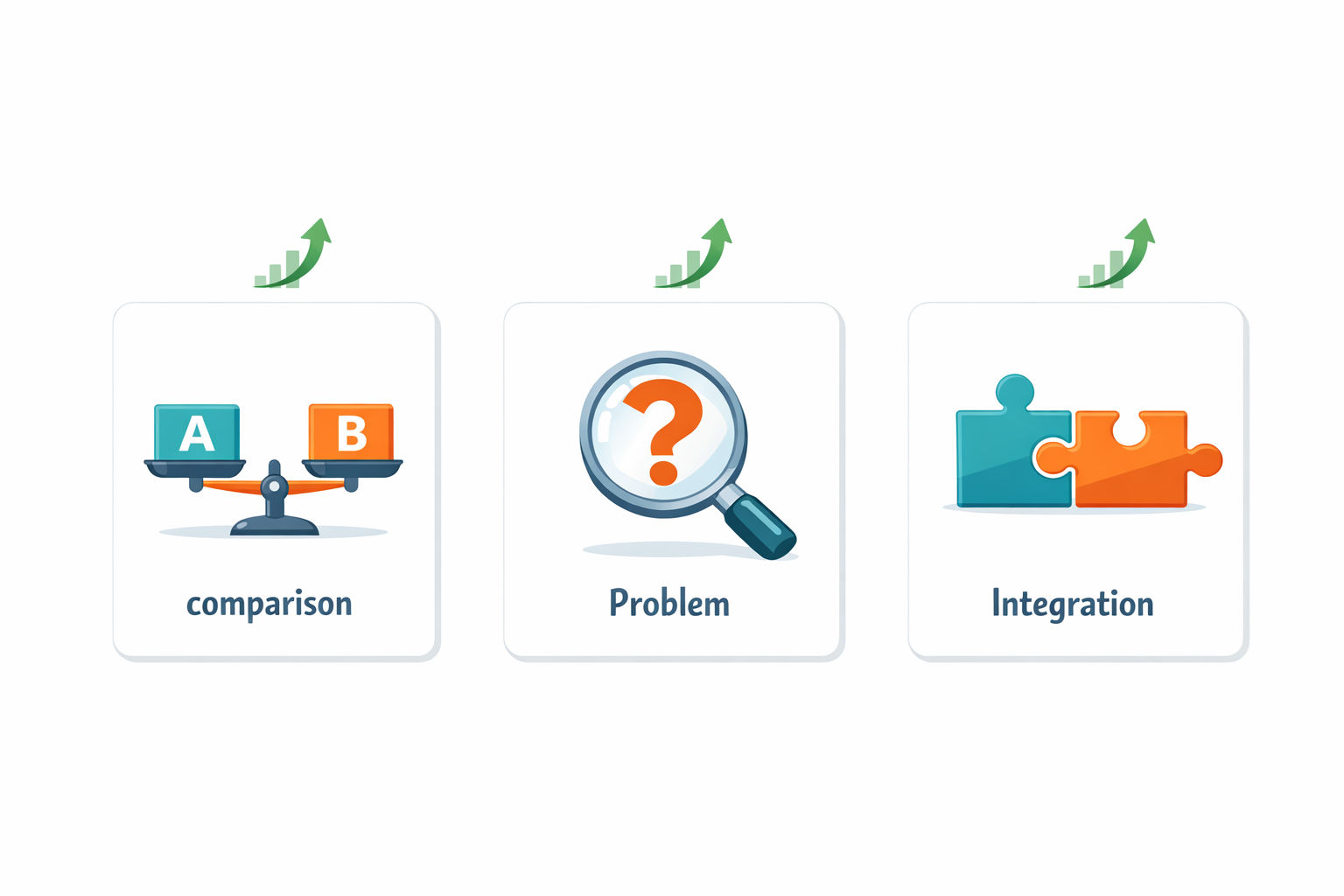
The three content types that drive disproportionate results for bootstrapped startups
1. Comparison and Alternative Posts
These are your highest-converting pages. Period.
Greg Digneo, who helped grow Time Doctor from $700K to $10M+ ARR, said their breakout moment came from a single post: “Toggl Alternatives.” They didn’t think much of it when they published. Then it started driving organic trials within weeks.
The logic is simple: someone searching “[Competitor X] alternatives” is actively shopping. They’re past the awareness stage. They have their credit card nearby.
Examples: “Best [Competitor] Alternatives,” “[Tool A] vs [Tool B] for [Use Case],” “[Competitor] Pricing — Is It Worth It?”
One indie developer published just 7 pages — mostly comparison and alternative posts — and hit 15,000 organic visits in 8 weeks. That’s 7 targeted pages outperforming 50 generic blog posts.
2. Problem-Aware Posts
These target the specific pain your product solves, written from the searcher’s perspective. Not “what is project management” — more like “how to stop losing client emails across 5 different tools.”
The key is matching the exact language your users type into Google. These posts catch people at the moment they realize they have a problem but haven’t started shopping for solutions yet.
Examples: “How to [solve specific pain point],” “Why [common frustration] keeps happening,” “[Specific workflow] is broken — here’s what to do”
3. Integration and Use-Case Posts
These target long-tail keywords that bigger competitors ignore because the search volume looks small. But “how to connect [Your Tool] with Slack” or “using [Your Tool] for [specific workflow]” converts at insane rates because the searcher is already a potential user.
These posts also build topical authority around your product name and category, which helps everything else rank faster.
The bootstrapped content stack — prioritized by impact for zero-budget founders
Content Type
Search Intent
Typical Competition
Conversion Rate
Priority
Comparison/Alternative
Bottom-of-funnel (buying)
Low-Medium
High (3-5%)
Write first
Problem-Aware
Middle-of-funnel (exploring)
Low
Medium (1-3%)
Write second
Integration/Use-Case
Bottom-of-funnel (evaluating)
Very Low
Very High (5-8%)
Write third
How to Find Low-Competition Keywords Your Funded Competitors Ignore
You don’t need expensive SEO tools to find keywords you can actually rank for. Google itself gives you the data — for free.
Here’s a concrete workflow using search operators that takes about 30 minutes per week.
Step 1: Check actual competition with allintitle:
Type allintitle:your target keyword into Google. This shows you how many pages have all of those words in their title — a rough proxy for how many pages are specifically optimized for that term.
Under 50 results? Low competition. You can rank here.
50-200 results? Moderate. Doable with a strong post.
200+ results? Move on unless you have something truly unique to add.
Step 2: Find gaps your competitors aren’t covering
Search site:competitor.com allintitle:"your keyword" to see if specific competitors have optimized for a term. If the result count is zero, they’re leaving that keyword wide open.
Step 3: Use Google’s own suggestions for long-tail ideas
Start typing your core topic into Google and look at autocomplete suggestions. Each suggestion is a real query real people search for. Run the allintitle: check on each one to find the low-hanging fruit.
The Keyword Golden Ratio (KGR)
If the allintitle: result count divided by the keyword's monthly search volume is less than 0.25, it's a golden keyword — one you can typically rank for within weeks, not months. Focus your first 10 posts entirely on KGR-qualifying terms. This is how you build early wins that compound.
The 20-Post Topical Authority Sprint: Zero to Trusted Source in 90 Days
Here’s where the strategy comes together. Instead of publishing random posts whenever you feel like it, you’re going to build a content cluster — a tightly connected set of posts that tells Google you’re the authority on your specific niche.
Content clusters can increase organic traffic by ~40% compared to disconnected blog posts, according to recent SEO research. And with just 20 well-planned posts, you can dominate a narrow topic.
A topical cluster gives Google a clear signal: you're the expert on this topic
The 20-Post Sprint Framework (90 Days)
Step 1
Week 1: Map your topic cluster
Pick ONE core topic tightly aligned to your product. Build a topical map with subtopics using Google autocomplete, 'People Also Ask,' and competitor analysis. Group them into BOFU (buying), MOFU (exploring), and TOFU (awareness) buckets.
Step 2
Weeks 2-4: Publish 8 BOFU posts
Start with bottom-of-funnel. Write 4 comparison/alternative posts and 4 integration/use-case posts. These have the highest conversion potential and often the lowest competition. Target keywords with allintitle counts under 50.
Step 3
Weeks 5-8: Publish 8 MOFU posts
Write problem-aware content: 'How to' guides, workflow breakdowns, and framework posts. Each one should link to at least 2 of your BOFU posts. This layer builds the topical depth Google needs to see.
Step 4
Weeks 9-11: Publish 4 TOFU + pillar posts
Write your comprehensive pillar page — the 'Ultimate Guide to [Your Topic]' — plus 3 awareness-stage posts. The pillar links out to every cluster post, creating a hub-and-spoke structure.
Step 5
Week 12: Audit, interlink, and optimize
Review Search Console data. Update internal links across all 20 posts so every page connects to at least 3 others. Refresh any posts that are already getting impressions but not clicks — tweak titles and meta descriptions.
The pace: ~2 posts per week
20 posts in 90 days means roughly 2 posts per week. At 1,500-2,000 words each, that's about 4-6 hours of writing per week. Tight but doable for a solo founder. If that pace sounds unsustainable, an AI content tool can handle the heavy lifting while you focus on product.
Realistic Traffic Benchmarks: What to Actually Expect
Let’s kill the fantasy that you’ll be swimming in organic traffic next month. Content marketing is a compounding asset, not a slot machine. Here’s what the data says you should realistically expect.
Traffic benchmarks based on aggregated SaaS SEO data — expect the compounding curve to kick in around months 4-6
Timeline
What Happens
Realistic Traffic (New Domain)
What to Focus On
Month 1-2
Posts get indexed. Minimal rankings. Most pages sitting on page 3-5.
100-500 organic visits/month
Keep publishing. Share on communities. Don't check analytics daily.
Month 3-4
Low-competition posts start climbing to page 1-2. First compounding posts emerge.
500-2,000 organic visits/month
Double down on what's getting impressions. Update titles and metas.
Month 5-6
Topical authority kicks in. Older posts start ranking for secondary keywords.
2,000-5,000 organic visits/month
Start writing more competitive keywords. Your domain can handle it now.
Month 9-12
Compounding effect is real. Each new post ranks faster because of existing authority.
5,000-15,000+ organic visits/month
Content overtakes paid ads in monthly lead volume around this point.
These aren’t guesses. Research from multiple SEO studies shows that low-competition keywords on new domains typically start ranking in 1-3 months, with stable positions forming at 3-6 months. And at the same monthly spend, content overtakes paid ads in lead production around month 8-11 — then keeps compounding while paid stays flat.
HubSpot’s study of 15,000+ companies found that only 10% of blog posts become “compounding” posts — but those 10% generate 38% of all blog traffic. A single compounding post produces as much traffic as six regular posts over its lifetime.
The whole game is building those compounding posts. And you do that by targeting the right keywords with topical depth — not by publishing more stuff and praying.
Distribution Without an Audience: Get Traction Before Google Kicks In
The biggest mistake founders make after publishing: they do nothing. They wait for Google. But Google is slow, especially for new domains.
You need a distribution strategy to get initial signals — clicks, time on page, backlinks — that tell Google your content is worth ranking. Here’s the playbook that works without an existing audience.
Reddit (Your Highest-Leverage Free Channel)
Don’t just drop links. That gets you banned. Instead:
Rewrite the core insights as a native Reddit text post in relevant subreddits (r/startups, r/SaaS, r/Entrepreneur, r/SideProject, niche-specific subs)
Put your blog link at the bottom as “full breakdown here”
Follow the 1:9 ratio — for every self-promotional post, make 9 genuine contributions (comments, answers, discussions)
Cap yourself at 2 self-promotional posts per day across all of Reddit
Both communities reward transparency and specific numbers. Frame your content as a case study or experiment, not a guide. “I published 20 blog posts in 90 days — here’s what happened” will outperform “How to do content marketing” every time.
On Indie Hackers especially, posts with real revenue or traffic numbers get the most engagement. Share your journey, link the full write-up.
LinkedIn and X (Twitter)
Turn each blog post into a short thread or carousel with 5-8 key takeaways. Tag relevant people or companies you mentioned. The post should be valuable on its own — the blog link is bonus context.
Founder-led content on LinkedIn is particularly effective for B2B SaaS. Research shows 84% of B2B marketers say LinkedIn delivers the best value among organic social platforms.
The compounding distribution loop
Each community post that gets traction sends a trust signal back to Google: clicks to your site, time spent reading, occasionally a backlink from someone who references your article. This accelerates the ranking timeline. Distribution isn't just about immediate traffic — it's SEO fuel.
Let’s get concrete about why startup content marketing beats paid ads for bootstrapped founders.
At the same $3,000/month spend over 12 months:
Paid ads produce ~270-470 total leads. Stop paying, leads drop to zero.
Content produces ~300-900 total leads, with lead volume accelerating each month. Stop publishing, and existing content keeps working.
The break-even point — where content’s cumulative leads surpass paid — typically hits around month 8-11. After that, the gap just widens.
But here’s the kicker for bootstrapped founders: you don’t need $3K/month. With AI tools handling the writing heavy-lift, your real investment is time (4-6 hours/week) and maybe $50-100/month for an AI content stack. The ROI math gets absurd at that cost basis.
Content Marketing vs Paid Ads for Bootstrapped Startups
Paid Ads (PPC)
Immediate traffic and leads from day one
Highly predictable at a given budget
Easy to test messaging and positioning quickly
Good for validating demand before investing in content
Paid Ads (PPC)
$181 average CPL for B2B SaaS
Linear economics — stop paying, leads stop
CPCs trend upward as competition increases
No compounding effect — every dollar is a one-time spend
Your First Week: Start Here
You’ve read the framework. Here’s what to do in the next 7 days:
Pick your niche. What’s the one specific problem your product solves? That’s your content cluster topic.
Find 5 competitor keywords. Look at the 3 indie tools closest to yours. What are they ranking for that you’re not? Start with comparison and alternative keywords.
Run the allintitle: check. For each keyword, search allintitle:"your keyword" on Google. Prioritize anything with under 50 results.
Write your first comparison post. “[Your Tool] vs [Competitor]” or “Best [Competitor] Alternatives.” Be honest, be detailed, include screenshots.
Share it. Post the key insights on one relevant subreddit and on your LinkedIn. Link the full article.
That’s it. One post. One distribution pass. Repeat next week.
The founders who win at startup content marketing aren’t the ones who write the most. They’re the ones who pick the right 20 keywords and execute consistently for 90 days. Everything else is noise.
Don't have 4-6 hours/week for content?
Vibeblogger handles the entire content pipeline — keyword research, writing, images, and publishing — so you can focus on building your product. Every post on this blog was written by Vibeblogger as a live demo.