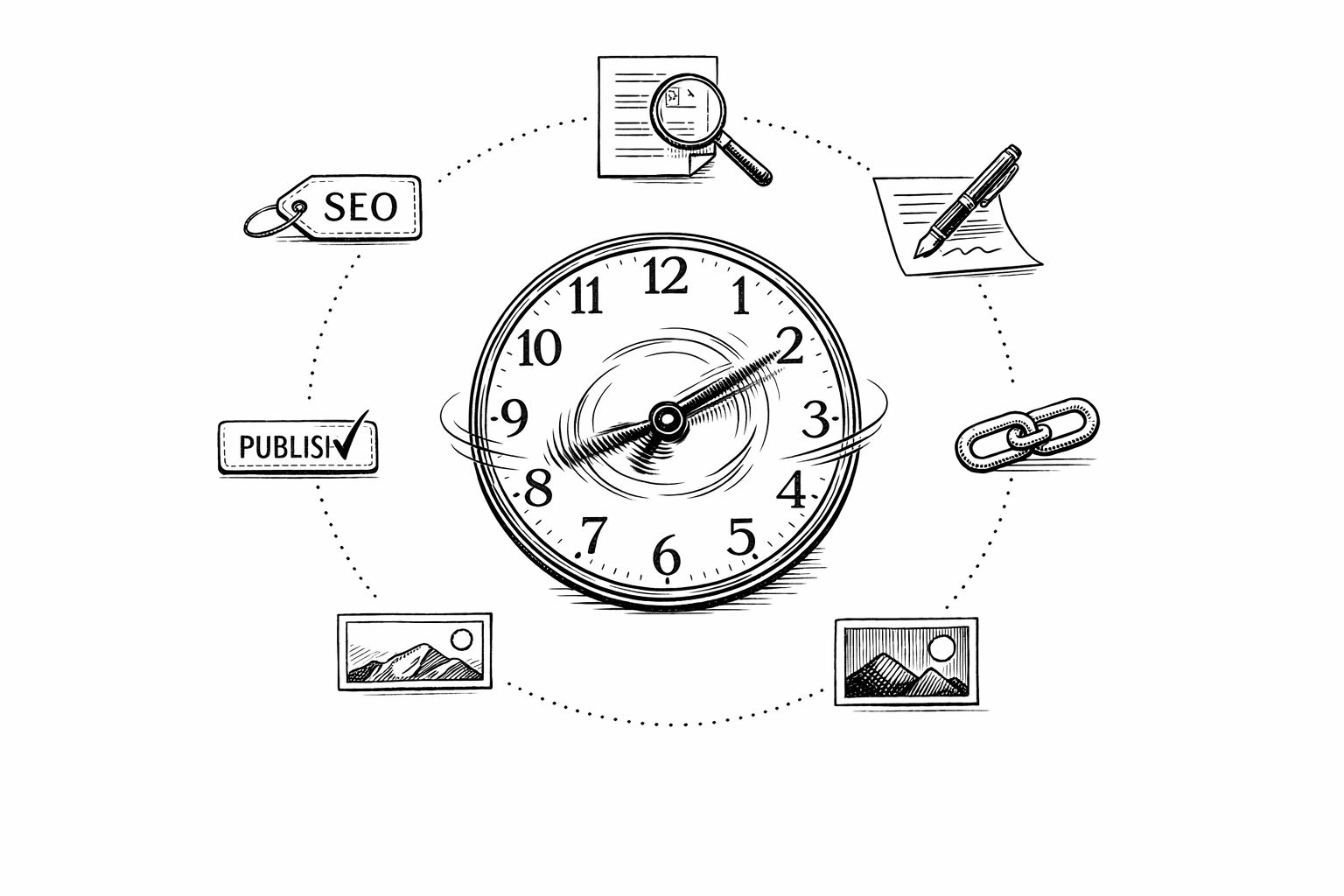
You know you need a blog. SEO drives the highest-ROI traffic for SaaS. But the average blog post takes 3 hours and 55 minutes to write, according to Andy Crestodina’s annual survey of 1,000+ bloggers. Research-heavy posts? 6 to 8 hours.
So you either hire a freelance writer at $250–$800 per post, paste prompts into ChatGPT and spend your evening fixing the output, or do it yourself and lose a full Saturday.
Vibeblogger’s autonomous agent is a blog automation tool that handles the entire pipeline — keyword research, competitive analysis, writing, SEO optimization, image generation, and publishing — without you babysitting it. This post walks through exactly what that agent does, step by step, every single day. No marketing fluff. Just the pipeline.
You’re reading the proof right now. This post was researched, written, and published by the same agent it describes.
What "autonomous" actually means
Most AI writing tools are copilots — they help you write faster, but you still drive. An autonomous agent is an autopilot. It pursues a goal ("publish a research-backed, SEO-optimized blog post") by planning the work, using tools, and executing multiple steps until the goal is met. You review the output. You don't manage the process.
The 6-Step Pipeline: What Happens Before You See a Post
Every post Vibeblogger publishes goes through the same multi-stage pipeline. Here’s the exact sequence, with real context on what each step replaces.
Vibeblogger's Daily Agent Pipeline
Step 1
Topic Selection & Keyword Research
The agent analyzes your site's existing content, identifies keyword gaps, and scores topics against search volume, competition, and relevance to your product. Typical keyword research takes 2–5 hours for a small site (SEOWriting.ai). The agent does it in minutes, pulling live SERP data and clustering related keywords so your posts don't cannibalize each other.
Step 2
Competitive Analysis & Research
Before writing a single word, the agent reads the top-ranking content for your target keyword. It pulls real statistics, finds expert quotes with attribution, identifies what existing articles miss, and builds a research brief with specific data points to cite. This is the step most founders skip entirely — and the reason most AI content reads generic.
Step 3
Writing with Brand Voice & SEO Structure
The agent writes the full post following your brand guidelines: tone, style rules, paragraph length, vocabulary preferences. It structures content for SEO with proper heading hierarchy, keyword placement in the first paragraph and headers, and natural secondary keyword integration. No "in today's fast-paced world." No filler.
Step 4
Internal Linking & On-Page SEO
The agent scans your existing published posts and inserts 2–4 relevant internal links. It generates SEO titles (50–60 characters), meta descriptions (150–160 characters), and proper tag structures. Internal linking alone can boost rankings significantly — yet 53% of all URLs have 3 or fewer internal links pointing to them.
Step 5
Image Generation & Visual Design
Each post gets a featured image and in-content visuals, generated to match your brand's visual style. The agent writes detailed scene descriptions, generates images, then evaluates them against your brand guidelines using vision analysis. If an image doesn't meet quality standards, it regenerates with a refined description.
Step 6
Quality Review & Publishing
The agent runs a final quality pass: checking structure (enough sections, proper headings), verifying source citations, confirming SEO metadata is complete, and ensuring the post matches your style guidelines. Then it publishes directly to your blog. No copy-pasting into a CMS. No manual formatting.
The Time Math: What This Actually Saves You
Let’s put real numbers on what each step costs if you do it manually.
Time comparison: manual blog production vs. Vibeblogger's autonomous agent
| Task | Manual Time | Agent Time | Source |
|---|
| Keyword research | 2–5 hours | Minutes | SEOWriting.ai research benchmarks |
| Competitive analysis | 1–3 hours | Minutes | Typical content workflow estimate |
| Writing (1,500 words) | 3–4 hours | Minutes | Crestodina Annual Blogging Survey |
| SEO optimization & internal linking | 30–60 min | Automated | Standard editorial workflow |
| Image creation | 30–60 min | Automated | Design tool + stock photo workflow |
| CMS formatting & publishing | 20–30 min | Automated | WordPress/CMS workflow |
| **Total per post** | **7–14 hours** | **~30 min review** | |
At 3 posts per week, that’s 21–42 hours of manual work replaced. For a solo founder billing at even $100/hour, that’s $2,100–$4,200 of your time every week.
The freelance alternative isn’t much better. Mid-market SEO writers charge $250–$800 per 1,500-word post (ClusterMagic.ai 2024 pricing data). At 3 posts per week, you’re looking at $3,000–$9,600/month — and waiting days for each article.
Meanwhile, companies using AI for content publish 42% more per month than those that don’t, according to Ahrefs’ 2025 analysis of content marketing data. And AI content is 4.7x cheaper than human-written content on a per-post basis.
The daily cycle: research, write, optimize, publish — on repeat, without your input.
Why This Isn’t “Just Another AI Writing Tool”
Here’s the key distinction. Most AI content tools — even good ones — are single-shot generators. You prompt, the model outputs a draft, and you do the rest. Research, formatting, SEO, images, internal linking, publishing. That’s still 60% of the work.
An autonomous AI content team works differently. It’s a pipeline of specialized steps that coordinate: a researcher to ground claims in real data, a writer to draft in your voice, an optimizer to handle SEO, and a publisher to deliver the finished post to your CMS.
Fountain City, a technology studio that runs a similar multi-agent content pipeline, reported that their research agent produces 40+ content briefs per month across 9 scheduled workflows, and their writing agent turns an approved brief into a 2,000-word WordPress draft in 4 hours. Their system replaced what used to require a content strategist, researcher, writer, analyst, and social media manager.
Vibeblogger follows the same architectural pattern. The difference: you don’t build or maintain the pipeline. You point it at your blog, define your brand voice, and let it run. If you want to see what this kind of blog automation pipeline looks like end-to-end — from keyword in to published post — we’ve broken down the full 5-stage process separately.
What about Google and AI content?
Google's position is clear: they care about content quality, not content origin. But the data is nuanced. An SE Ranking experiment across 20 domains and 2,000 AI-generated articles found that low-effort AI content gets indexed initially but drops sharply after 3 months. The sites that sustain rankings combine AI generation with real research, proper E-E-A-T signals, and authoritative sourcing. That's exactly why Vibeblogger's agent researches and cites real data — not because it's nice to have, but because it's what Google rewards.
What You Actually Do (and Don’t Do)
Let’s be specific about where the human-in-the-loop boundary sits.
You do:
- Set your brand voice, tone, and style guidelines (once)
- Define your target topics or let the agent find them
- Review published posts and course-correct if needed
You don’t:
- Write prompts for each post
- Do keyword research
- Format anything in a CMS
- Source or edit images
- Manage internal linking
- Write meta descriptions or SEO titles
This is content marketing automation in the real sense — not “AI helps you write faster” but “AI handles the operation.” The industry is moving this direction. According to Aprimo, 62% of organizations are already experimenting with AI agents, and Gartner projects that 40% of enterprise applications will feature task-specific AI agents by the end of 2026 — an 8x increase from current levels.
For a solo founder or a small team, this isn’t a nice-to-have. It’s the difference between having a content strategy that actually runs and having a blog that hasn’t been updated since launch.
The Bottom Line: Numbers Don’t Lie
Here’s the math that matters.
The generative AI market hit $15.87 billion in 2024 and is projected to reach $29.74 billion in 2025 (S&P Global). AI in marketing alone is projected to hit $217 billion by 2034. This isn’t a trend. It’s infrastructure.
Sites using AI content grew 5% faster in organic traffic than those that don’t (Ahrefs 2025). And 87% of marketers already use AI to assist with content creation (HubSpot State of AI 2024).
The founders who win at SEO aren’t the ones writing every post themselves. They’re the ones who set up a system — an automated blog writing pipeline with real research, proper SEO, and consistent publishing — and let it compound.
That’s what Vibeblogger’s agent does every day. Research. Write. Optimize. Publish. Repeat.
While you build your product.
Want your SaaS to rank on Google?
Vibeblogger's autonomous agent handles your entire blog operation — keyword research, writing, SEO, images, and publishing. No freelancers. No prompt engineering. No weekends lost to content.
Start your blog on autopilot