How to Build a Blog Automation Pipeline That Publishes While You Sleep (Without Sacrificing Quality)
90% of business blogs die within 6 months. Not because of bad writing — because of no system. Here's the exact 5-stage blog automation pipeline that lets founders publish 2-3 quality posts per week with just 30 minutes of oversight.
Rori Hinds··9 min read
You know content marketing works. The data is absurdly clear: it costs 62% less than traditional marketing and generates 3x more leads, according to DemandMetric. For SaaS founders, a blog is the single highest-ROI marketing channel you can build.
But knowing it works and actually doing it are two different things. And if you’re being honest, your blog is probably a graveyard.
You published a few posts when you launched. Maybe you kept it up for a month. Then product work took over, and the blog went dark. You’re not alone — 90% of business blogs die within 6 months. Not because the founders were bad writers. Because they had no system.
This post is about building the system. A blog automation pipeline for founders that takes you from zero involvement to 2-3 published, SEO-optimized posts per week — with about 30 minutes of your time. Not a tool list. Not a prompt template. The full pipeline architecture.
Full disclosure
This post was researched, written, and published by Vibeblogger's own automation pipeline. It's the system we're describing, running in production. Every blog post on this site is a live demo.
Why Your Blog Keeps Dying (It’s Not a Writing Problem)
Let’s look at the math that kills most founder-led blogs.
According to Orbit Media’s 2024 survey of 1,000+ bloggers, the average blog post takes 3 hours and 48 minutes to write. That’s just the writing. Add keyword research, image creation, formatting, and publishing, and you’re looking at 5-6 hours per post.
If you want to publish twice a week — the minimum for meaningful SEO traction — that’s 10-12 hours per week. On top of building your product, talking to customers, and keeping the lights on.
No wonder blogs die. It’s not a willpower problem. It’s a math problem.
And the cost of stopping is real. Companies that stop blogging see a 39.7% drop in SEO traffic within 12 months, according to Neil Patel’s analysis. Meanwhile, consistent publishers keep compounding. HubSpot found that 76% of monthly blog views come from posts published in previous months. Every post you publish builds on the last one.
The Three Failure Modes (You’ve Tried At Least One)
Before we get to the solution, let’s name the three ways founders typically try — and fail — to solve content marketing.
The three failure modes of founder content marketing
Approach
Time Cost
Money Cost
Failure Mode
Do it yourself
5-6 hrs/post
$0
Unsustainable. You burn out in 4-6 weeks.
Raw ChatGPT
1-2 hrs/post
$20/mo
Generic output. No brand voice. Google can tell.
Hire a freelancer
1 hr/post (reviews)
$300-500/post
Expensive. Voice mismatch. Slow turnaround.
The DIY trap is the most common. You’re a builder, so you think you can just grind it out. And you can — for about a month. Then a product crisis hits, the blog gets deprioritized, and three months later you realize you haven’t published anything.
The ChatGPT trap is newer but just as deadly. You’ve seen those posts: “10 Ways to Boost Your Productivity” with the telltale AI voice. No real data, no original angle, no personality. A Semrush study found that 57% of AI articles and 58% of human articles made it to Google’s top 10 — but only when the AI content had proper research, structure, and editing behind it. Raw GPT output doesn’t cut it.
The outsourcing trap sounds like the smart move until you get the first draft back and it reads like it was written by someone who’s never used your product. You spend an hour rewriting it anyway, and you’re back to square one — except now you’re also $400 poorer.
The solution isn’t doing any of these better. It’s building a system that eliminates the bottlenecks entirely.
The 5-Stage Blog Automation Pipeline
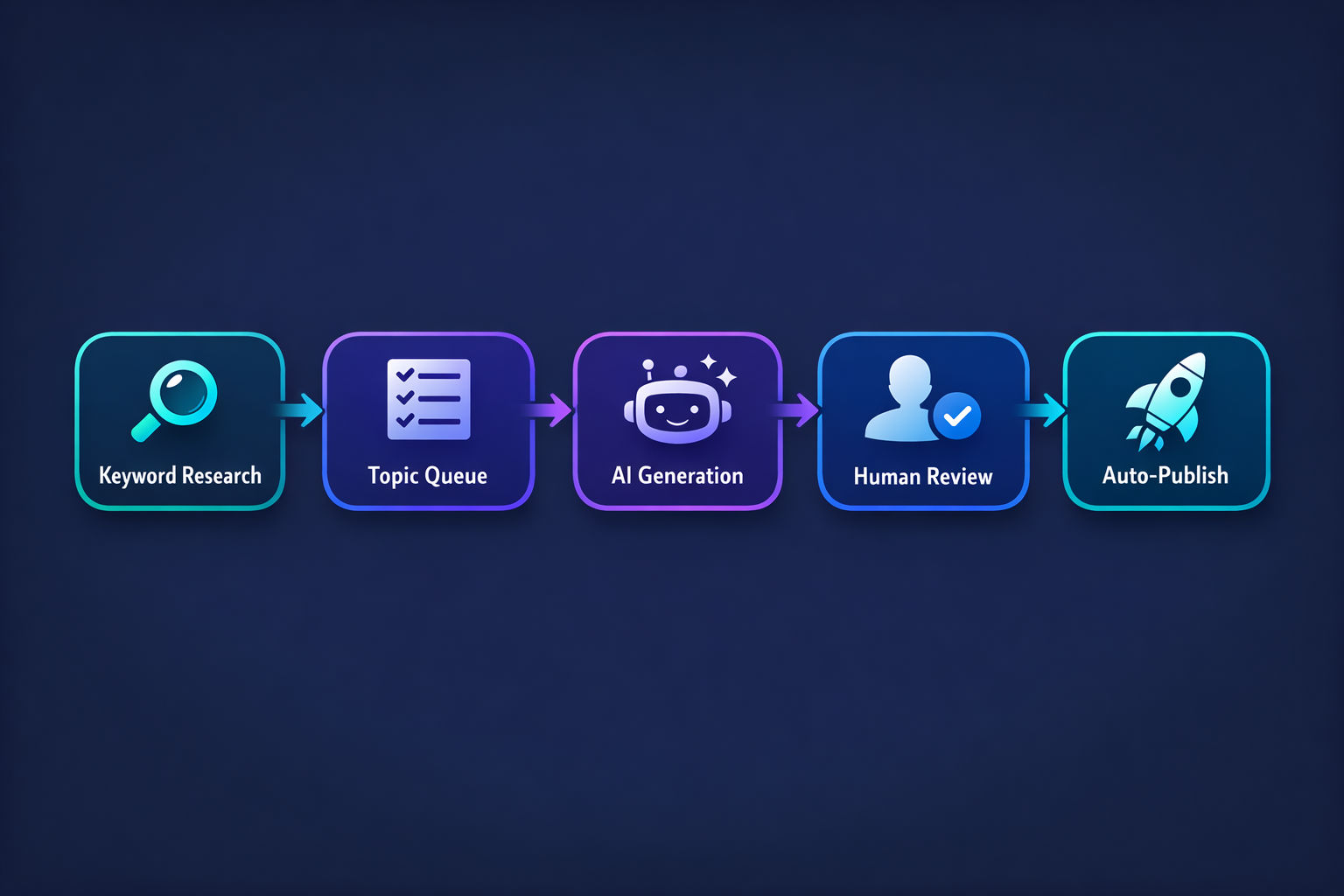
Here’s the blog automation workflow that actually works. Not in theory — this is the architecture running behind every post on this site, and it’s the kind of zero-touch automation workflow we’ve written about before.
The core principle: automate everything that doesn’t require your judgment, and make your judgment the only bottleneck.
The 5-stage pipeline: from keyword to published post with one human checkpoint
The 5-Stage Pipeline
Step 1
Stage 1: Automated Keyword Research
The pipeline monitors your niche for keyword opportunities — low-competition, high-intent terms your competitors haven't covered yet. It pulls from search data, analyzes keyword difficulty, and filters for topics that match your product's domain. **Your time: 0 minutes.** This runs on a schedule (weekly or biweekly). The output is a ranked list of keyword opportunities with estimated traffic and difficulty scores.
Step 2
Stage 2: Topic Queue & Prioritization
Keywords get transformed into specific article topics with search intent mapped. The system builds a queue prioritized by a combination of traffic potential, keyword difficulty, and relevance to your product. Think of this as your editorial calendar — except it fills itself. **Your time: 5 minutes/week** to glance at the queue and veto anything that doesn't fit. You're not creating topics. You're just saying yes or no.
Step 3
Stage 3: AI Content Generation with Brand Voice
This is where most 'AI content' tools stop — and where the real pipeline begins. The system doesn't just generate text. It researches the topic using live web data, structures the article for SEO, writes in your configured brand voice, generates images, and formats everything for your CMS. The key difference from raw ChatGPT: brand guidelines, tone rules, style examples, and real-time research are baked into every generation. **Your time: 0 minutes.** The output is a fully formatted draft with images, internal links, and meta descriptions.
Step 4
Stage 4: Human Review Checkpoint
This is the one stage where you show up. You get a notification that a draft is ready. You read it, check for accuracy, make sure it sounds like you, and either approve or request changes. This is not editing from scratch — it's quality control on a near-finished piece. **Your time: 10-15 minutes per post.** With 2-3 posts per week, that's 20-45 minutes total. This is your entire content marketing time commitment.
Step 5
Stage 5: Auto-Publish & Distribution
Approved posts go live automatically on your scheduled publishing cadence. The system handles formatting, SEO metadata, Open Graph tags, internal linking, and sitemap updates. Some pipelines also handle social media distribution — turning the post into tweets, LinkedIn posts, or newsletter snippets. **Your time: 0 minutes.** Posts publish whether you're awake, asleep, or on a flight.
Where Humans Must Touch It vs. Where AI Handles It
The biggest mistake founders make with content marketing automation is going all-or-nothing. Either they automate nothing (and burn out) or they automate everything (and publish garbage).
The right answer is knowing exactly where the human checkpoint matters.
AI vs. Human Responsibility in the Pipeline
Task
Who Handles It
Why
Keyword research & opportunity finding
AI (100%)
Pattern matching across large datasets — AI is faster and more thorough
Topic selection & queue prioritization
AI proposes, human vetoes
AI can rank by data, but only you know your product roadmap
Research & data gathering
AI (100%)
Web search, source verification, stat collection — pure automation
Writing the first draft
AI (100%)
With proper brand voice config, AI produces a solid 80% draft
Fact-checking & accuracy review
Human (100%)
AI hallucinates. You must verify claims, stats, and sources.
Voice & tone approval
Human (100%)
Does this sound like you? Only you can answer that.
SEO optimization & formatting
AI (100%)
Meta descriptions, headers, internal links, schema — pure rules
Publishing & distribution
AI (100%)
Scheduling, CMS formatting, social posts — no judgment needed
The non-negotiable rule
Never publish AI content without a human reading it first. Google's guidelines are clear: they evaluate content quality, not creation method. But quality requires a human check. The Semrush study found AI content ranks nearly as well as human content — when it's been reviewed and edited. Unreviewed AI content is a different story entirely.
The Math: What 30 Minutes Per Week Actually Produces
Let’s get specific about throughput. Here’s what a properly configured blog automation workflow looks like in practice:
Pipeline generates: 3 fully drafted posts per week (keyword-researched, SEO-optimized, with images)
Your review time: ~10 minutes per post = 30 minutes/week
Monthly output: 12 published posts
Quarterly output: 36 published posts
6-month output: 72 published posts
Compare that to the manual approach. At 3h 48m per post (Orbit Media average), producing 3 posts per week would require 11.4 hours of writing time alone. That’s before research, images, or publishing.
You’re trading 11+ hours per week for 30 minutes. That’s not a marginal improvement. That’s a category change in what’s possible for a solo founder.
If you’re building topical authority for your SaaS blog, this kind of consistent output is what makes it work. You can’t build authority with one post a month.
Here’s where the math gets exciting.\n\nHubSpot’s analysis of compounding blog posts found that just 10% of posts become "compounders" — posts that grow in traffic over time instead of decaying. But those 10% of posts generate 38% of total blog traffic.\n\nSo out of your 72 posts over 6 months, roughly 7 will become traffic machines that keep growing month after month. And the other 65? They still contribute. HubSpot found that 76% of all monthly blog views come from posts published before that month.\n\nAnd in 2026, it’s not just Google rankings you’re building toward. AI Overviews now appear on 13-18% of queries and cut organic CTR dramatically — but sites that get cited in AI answers see a 35% click boost. If you want to understand the full picture of <a href="/blog/how-to-rank-on-google-what-actually-matters-2026">what actually moves the needle in Google rankings today — and how to optimise for AI citation at the same time — that’s worth reading alongside this guide. The same consistent publishing cadence this pipeline creates is exactly what feeds both channels.
Here’s a realistic growth scenario for a SaaS blog using this pipeline:
Month 1-2: 24 posts published. Minimal organic traffic. Google is indexing your content.
Month 3-4: 48 total posts. Early rankings start appearing for long-tail keywords. Organic sessions start trickling in — maybe 500-1,000/month.
Month 5-6: 72 total posts. Topical authority kicks in. Your domain starts ranking for medium-competition terms. Organic traffic could hit 3,000-5,000 sessions/month depending on your niche.
That’s 72 indexed pages working for you 24/7. And unlike paid ads, they don’t stop when you stop paying.
Companies with a documented content strategy see 10x higher organic traffic than those without one. The pipeline IS the strategy — it just runs on its own.
What the Pipeline Needs (Regardless of Tool)
Whether you build this yourself or use an existing tool stack, here are the non-negotiable components of a working SaaS blog automation pipeline:
1. Keyword intelligence layer — Something that finds relevant, low-competition keywords in your niche on an ongoing basis. Not a one-time research session. A continuous feed.
2. Brand voice configuration — Your tone, your style rules, your forbidden phrases, your example posts. Without this, AI output sounds like everyone else’s AI output.
3. Real-time research capability — The AI needs to pull current data, statistics, and expert quotes. This is what separates “content” from “regurgitated training data.”
4. Human review workflow — A clear, low-friction way for you to approve or reject drafts. If reviewing a post takes more than 15 minutes, something’s broken.
5. CMS integration — Draft to published post without copy-pasting HTML. The pipeline should format, optimize metadata, generate images, and publish directly.
6. Scheduling and cadence control — Consistent publishing on a predictable schedule. Not “whenever I get around to it.”
The winning formula isn't AI instead of human judgment. It's AI accelerating human strategy.
Why This Works (And Why Generic AI Doesn’t)
Let’s address the elephant in the room. You’ve probably tried ChatGPT for blog content and hated the result. Flat tone, generic advice, no real data, and that unmistakable “AI voice” that makes everything sound like it was written by a committee.
The difference between that experience and a proper blog automation pipeline comes down to three things:
Research, not regurgitation. A pipeline that searches the web in real-time, finds current statistics, and cites actual sources produces fundamentally different content than an LLM pulling from stale training data.
Brand voice, not default voice. When you feed the system your writing style, your opinions, your tone guidelines, and examples of posts you like — the output stops sounding generic. It sounds like you on a good day.
System, not session. A ChatGPT session is a blank page every time. A pipeline carries context: your keyword strategy, your content calendar, your internal linking structure, your publishing schedule. Each post builds on the one before it.
This post is the proof
Every post on this blog — including this one — is produced by Vibeblogger's automation pipeline. It researched the topic, found the statistics you just read, wrote this draft, generated the images, and formatted everything for publishing. A human reviewed it before it went live. That's the pipeline in action.
The Bottom Line
Content marketing is the highest-ROI channel for SaaS. But only if you actually do it consistently. And the data is clear: most founders can’t sustain manual content production beyond a few months.
Blog automation for founders isn’t about replacing your voice with AI. It’s about building a system that does the 95% of work that doesn’t require your expertise — research, drafting, formatting, publishing — so you can focus on the 5% that does: quality control and strategic direction.
30 minutes a week. 2-3 published posts. 72 indexed pages in 6 months. A compounding asset that works while you ship product.
That’s the pipeline. And you’re reading the output.
Want this pipeline for your blog?
Vibeblogger handles the entire content operation — keyword research, writing, images, and publishing — so you can focus on building your product. Every post on this blog is proof it works.