You opened ChatGPT, typed “write a blog post about [your SaaS topic],” and got 1,500 words in 30 seconds. Amazing.
Then you spent the next three hours rewriting the intro, fixing hallucinated stats, adding keywords you had to research separately, formatting headers, writing meta descriptions, and trying to make it sound like something a human would actually want to read.
You’re not alone. A December 2025 survey of professionals using ChatGPT for blog content found that nearly 60% still spend a full workday per post — and 22.5% spend two or more full workdays. (EG Creative Content, 2025)
The AI wrote the words. You did everything else. And “everything else” is where SEO actually lives.
If you’re a founder looking for an AI blog writer for SaaS that actually handles the full pipeline — not just the text generation part — this breakdown will save you a lot of trial and error.
The Problem: ChatGPT Has Zero SEO Awareness
ChatGPT is a general-purpose language model. It’s extraordinary at generating text. But it has no concept of:
- Keyword volume or difficulty — It doesn’t know which terms people actually search for
- SERP analysis — It can’t see what’s currently ranking or why
- Search intent — It doesn’t distinguish commercial queries from informational ones
- On-page optimization — No meta tags, no internal linking, no structured data
- Content structure for ranking — It doesn’t know that comparison pages convert 3.2x higher than feature pages (Oliver Munro, 2025)
As SurferSEO’s team put it: “Tools like ChatGPT are not dedicated SEO content tools. A capable content automation solution pulls data from many sources to create a comprehensive outline. It performs competitor research and analyzes SERPs.”
ChatGPT gives you words. An AI blog writer for SaaS gives you a content strategy with words attached. A solid approach starts with proper keyword research for startups — something ChatGPT simply can’t do on its own.
The hidden tax of ChatGPT blogging
45% of ChatGPT users report no speed gain or slower output compared to writing manually. The bottleneck was never the writing — it was the research, optimization, and formatting that happens around it. (EG Creative Content, 2025)
The Data: Generic AI Content Ranks Fast, Then Dies
Here’s what actually happens when you publish unoptimized AI content.
SE Ranking ran one of the most comprehensive AI content experiments to date: 2,000 AI-generated articles across 20 new domains with zero backlinks and no manual optimization. The results tell a clear story. (SE Ranking, 2024-2025)
In month one, things looked promising. 71% of pages got indexed, generating 122K impressions and 244 clicks. By months 2-3, impressions had grown to 526K with 782 clicks.
Then the cliff.
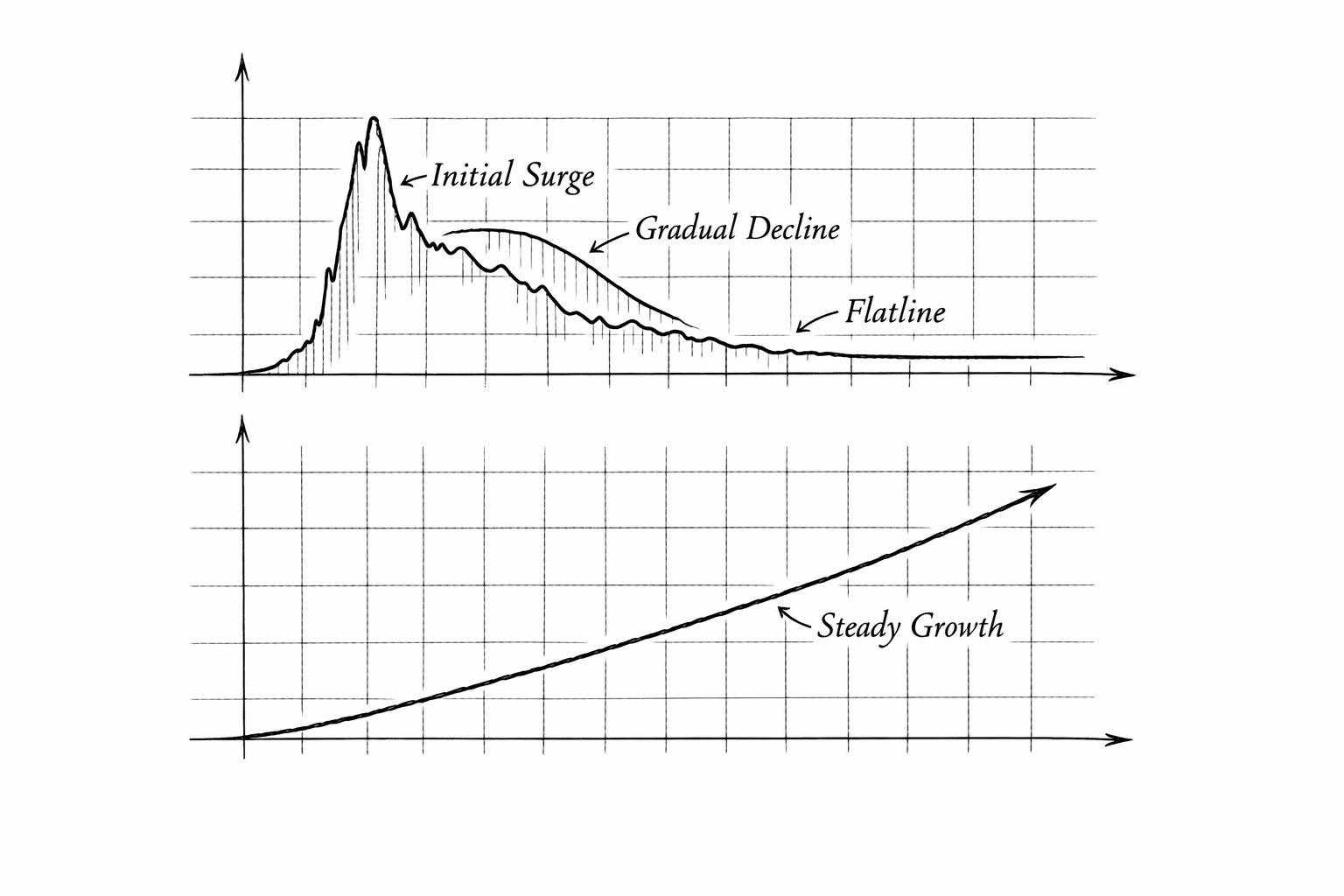
Generic AI content spikes early, then decays. SEO-optimized content compounds.
Pages ranking in Google’s top 100 dropped from 28% to just 3% between month 1 and months 3-6. That’s a 90% decline in visibility. The content got indexed, got some initial traction, and then vanished.
Why? Because Google measures information gain — whether your content adds something new to the conversation. Generic AI output that reorganizes existing top results gets demoted fast. Understanding what Google’s Helpful Content Update actually targets is key to building AI content that holds its rankings.
A separate 2025 study of 487 search results found that 83% of top #1 positions were held by human-generated content (ALM Corp, 2025). Not because Google penalizes AI — it doesn’t — but because unoptimized AI content simply doesn’t satisfy the ranking signals that matter.
The takeaway: the problem isn’t AI. It’s unoptimized AI.
What a Purpose-Built AI Blog Writer for SaaS Actually Does
The difference between ChatGPT and a dedicated AI content generation tool isn’t the quality of the prose. It’s everything that happens before and after the writing.
A purpose-built blog automation tool handles the entire pipeline:
ChatGPT vs. Purpose-Built AI Blog Writer
| Capability | ChatGPT | Purpose-Built AI Blog Writer |
|---|
| Keyword research | None — you do this separately | Built-in with volume + difficulty data |
| SERP analysis | None — can't see current rankings | Analyzes top results for content gaps |
| Search intent mapping | Generic guess based on prompt | Classifies commercial, informational, transactional |
| Content structure | Generic H2/H3 based on prompt | Optimized headers based on SERP data |
| Meta titles & descriptions | Only if you ask (and edit) | Auto-generated, SEO-optimized |
| Internal linking | None — doesn't know your site | Links to existing content automatically |
| Image generation | Separate tool (DALL-E) | Integrated into the workflow |
| Publishing | Copy-paste into CMS | Direct to your blog or CMS via API |
| Time per post | 2-4+ hours with editing | 10-20 minutes end-to-end |
| Cost (your time included) | $20/mo + hours of labor | Higher subscription, near-zero labor |
When Semrush analyzed AI content that does rank well, they found 57% of optimized AI content reached Google’s top 10 — essentially matching human-written content at 58%. (Writesonic/Semrush, 2025)
The gap isn’t between human and AI writing. It’s between optimized and unoptimized content. An automated blog writing tool closes that gap by baking optimization into every step.
This is exactly why SEO is the highest-ROI channel for bootstrapped founders — but only when the content is built to rank, not just built to exist.
The Real Cost: Do the Math on Your Time
Let’s put numbers on this.
B2B SaaS companies that publish 9+ blog posts monthly see 35.8% year-over-year organic traffic growth (Oliver Munro, 2025). Organic search drives 44.6% of B2B SaaS revenue. The ROI on SEO content is documented at 702% with a 7-month break-even (Position Digital, 2025).
So you need to publish consistently. What does that actually cost?
Monthly cost comparison for different blog content approaches. Founder time valued at opportunity cost.
| Approach | Cost/Month | Time/Post | Posts/Month (realistically) | Effective Cost/Post |
|---|
| Freelance writer | $1,200-$4,000 | Your review time: ~1hr | 4-8 | $300-$500 |
| ChatGPT + manual SEO | $20 | 4-8 hours of your time | 2-4 | $20 + your hourly rate × 6hrs |
| Purpose-built AI blog writer | $49-$149 | 10-20 min review | 8-20+ | $5-$15 |
If your time is worth $100/hour (conservative for a founder), a ChatGPT blog post costs you $20 in subscription plus $400-$800 in time. That’s $420-$820 per post when you account for research, editing, SEO optimization, formatting, and publishing.
A freelancer at $400/post suddenly looks reasonable. A purpose-built tool at $5-$15/post looks like a no-brainer.
One Shopify agency built a fully automated pipeline and published 180 articles in 6 months at $45/month in API costs — driving a 340% increase in organic traffic. (MileDevS case study, 2026)
We went from 0 to 100 blog posts using our own product and saw similar results. The economics of automated blog writing only work when automation covers the whole workflow — not just the text generation.
The Semrush finding that changes the equation
Properly optimized AI content reaches Google's top 10 at 57% — nearly identical to human content at 58%. The differentiator isn't who (or what) writes it. It's whether the content is built on real keyword data, structured for search intent, and published with proper on-page SEO.
What Google Actually Rewards (And Why Generic AI Misses It)
Google’s March 2026 core update made “Experience” the top-ranking signal within E-E-A-T. Sites with verifiable first-hand details — original data, case studies, author credentials — outranked high-authority sites that lacked them. (Digital Applied, 2026)
The helpful content updates have reduced unhelpful content in search results by 40% (Search Engine Land). Sites that lost traffic saw drops of up to 60% overnight.
As Nucleus Marketing put it: “When everyone can produce ‘average’ content for free, ‘average’ no longer ranks. The bar for quality hasn’t been lowered by AI — it’s been raised.”
This is why a solid content strategy for SaaS matters more than ever. Generic AI content doesn’t just underperform — it actively competes against thousands of other generic AI posts saying the exact same thing. The only way to win is with content that’s optimized for specific keywords, structured around search intent, and enriched with real data.
That’s what a purpose-built AI content generation tool does. It doesn’t just write — it researches, optimizes, structures, and publishes. The writing is the easy part.
The Bottom Line
ChatGPT is an incredible tool. We use language models ourselves — Vibeblogger is built on them. But using ChatGPT directly for SEO blog content is like using a car engine to power a bicycle. The raw capability is there. The system around it isn’t.
Here’s what matters:
- 73% of marketers now use AI for blog content (HubSpot, 2025) — which means the bar for standing out is higher than ever
- Unoptimized AI content loses 90% of its rankings within 6 months
- Optimized AI content matches human content in search performance
- Your time is the most expensive input — not the subscription cost
The founders who are winning at content aren’t the ones spending 4 hours per ChatGPT post. They’re the ones using purpose-built tools that handle keyword research, SERP analysis, content optimization, image generation, and publishing in one pipeline.
If you want to measure your content ROI without it becoming a second job, the tool has to do the work — not just start it.
Want your SaaS to rank on Google without the busywork?
Vibeblogger handles the entire pipeline — keyword research, writing, SEO optimization, images, and publishing. Every post on this blog was created by Vibeblogger as a live demo of what it can do.
See how Vibeblogger works