You’re publishing blog posts. Maybe two a week, maybe two a month. You know content marketing ROI is supposed to be good — the data says B2B SaaS companies see an average 420% return on content. But when you open your analytics, all you see are some pageview graphs and a vague hope that someone, somewhere, signed up because of that article you wrote at midnight.
Here’s the problem: every guide on measuring content marketing ROI assumes you have a GA4 analyst, attribution software, a CRM with proper tagging, and maybe a BI dashboard for good measure. You have none of that. You’re a founder who also happens to be the entire marketing department.
This post is the framework I wish existed when I started. Three metrics that actually matter, a 15-minute monthly check-in using free tools, and a formula to know when your content is paying for itself. No expensive tools. No analyst required.
The 3 Metrics That Actually Matter (Forget Vanity Numbers)
Let’s start by throwing out 90% of the content performance metrics people tell you to track. Pageviews, bounce rate, time on page, social shares — these are vanity metrics. They make you feel good but tell you nothing about whether your blog is generating revenue.
For an early-stage SaaS founder running content solo, there are exactly three numbers worth caring about.
The three content performance metrics that actually matter for bootstrapped SaaS founders
| Metric | What It Tells You | Where to Find It |
|---|
| Organic traffic growth (month over month) | Is your content gaining visibility in search? This is your leading indicator. | Google Search Console → Performance → Total clicks (filter by search type: web) |
| Keyword ranking movement | Are your target pages climbing toward page one? Positions 5-15 = striking distance. | Google Search Console → Performance → Queries tab (sort by position) |
| Signup/demo conversion from organic | The only number that directly ties to revenue. Everything else is a proxy. | Plausible or GA4 → Filter by source = organic → Track goal completions |
That’s it. Three metrics. If organic traffic is growing, your content is getting found. If keyword rankings are moving up, your SEO strategy is working. If organic visitors are converting to signups, your content is pulling its weight.
Everything else is noise — especially at your stage. You don’t need to track scroll depth or heatmaps or assisted conversions. You need to know if your blog is bringing in people who become customers. The data backs this up: SEO leads close at a 14.6% rate compared to 1.7% for outbound leads, according to HubSpot research. That’s an 8.6x advantage. The traffic doesn’t need to be massive — it just needs to be the right traffic.
If you’re not sure what kind of content actually drives signups (vs. just traffic), we broke down the content mix formula that converts in a separate post.
The 15-Minute Monthly Review (Free Tools Only)
You don’t need a weekly ritual or a dashboard. Once a month, spend 15 minutes in Google Search Console and your analytics tool (Plausible or GA4 — both work). Here’s the exact process.
Your 15-Minute Monthly Content Review
Step 1
Minutes 1-5: Check topline organic traffic trend
Open Google Search Console → Performance → set date range to last 3 months vs. previous 3 months. Look at total clicks. Are they up or down? A 10%+ increase month-over-month means your content is gaining traction. Flat or declining? Flag it — we'll cover what to do in the 'double down vs. cut' section.
Step 2
Minutes 5-10: Find your striking-distance keywords
Stay in GSC → Queries tab → sort by impressions (high to low). Filter for average position between 5 and 15. These are keywords where you're on page one or close to it. A small improvement here (better title tag, adding a section, internal linking) can jump you from position 8 to position 3 — which roughly doubles your click-through rate.
Step 3
Minutes 10-13: Check organic signup conversions
Open Plausible (or GA4) → filter traffic source to 'organic search' → check goal completions (signups, demo requests, or whatever your primary conversion is). Compare to last month. If you're getting organic traffic but zero conversions, the problem is your page — not your content strategy. If conversions are growing even slowly, you're on the right track.
Step 4
Minutes 13-15: Write down 2-3 actions
Based on what you just saw, pick 2-3 things to do this month: update a striking-distance post, write a new article for a high-impression query you don't have a page for, or fix a CTA on a high-traffic post that isn't converting. Write them down. That's your content to-do list for the month.
Why Google Search Console is your best free tool
GSC added weekly and monthly view aggregations in December 2025, which makes spotting trends way easier. You no longer need to squint at daily noise. Switch to the monthly view for a clean picture of how your content is performing over time. It's the single most underused free tool in a founder's stack.
That’s 15 minutes. No BI dashboard. No SQL queries. No expensive analytics suite. If you want to go deeper into what actually moves the needle for Google rankings, we have a full breakdown — but this monthly review is enough to know if your content engine is working.
How Long Content Actually Takes to Show ROI
Here’s where most founders get discouraged and quit too early. Content marketing has a long payback period compared to paid ads, and the timeline data is sobering.
Ahrefs analyzed over 2 million pages in their May 2025 study and found that only 1.74% of newly published pages reach Google’s top 10 within one year. That’s down from 5.7% in their 2017 study. The average page sitting at position #1 is about 5 years old.
Before you close your laptop and pour your content budget into Google Ads, here’s the nuance: those numbers are dominated by high-competition, enterprise-level keywords. For bootstrapped SaaS founders targeting low-competition, high-intent keywords — which is what you should be doing — the timeline compresses significantly.
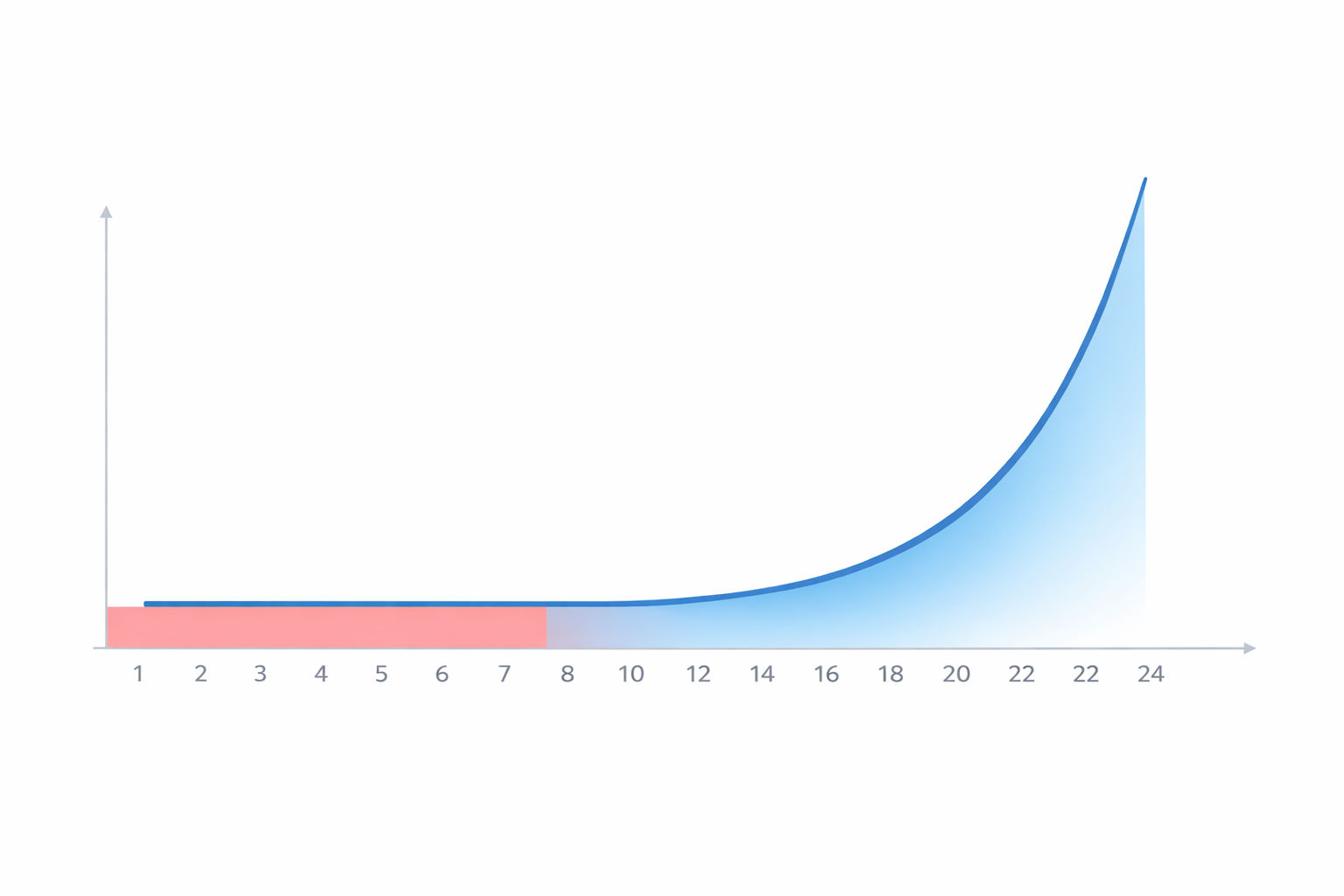
Content ROI follows a compounding curve: flat early, then exponential. Most founders quit in the red zone.
Here’s a realistic timeline for a bootstrapped SaaS blog targeting low-to-medium difficulty keywords:
Realistic Content ROI Timeline for Bootstrapped SaaS
Months 1-3Indexing and initial impressions
Google crawls and indexes your content. You'll see impressions in GSC but minimal clicks. Long-tail keywords may start showing movement. This is normal — not a sign your content failed.
Months 3-6Rankings start moving
Posts targeting low-competition keywords begin climbing to page 2-3. You should see 50-200 organic clicks per month from your content library. Focus on internal linking and updating early posts.
Months 6-12First page rankings and real traffic
Your best-performing posts hit page one for their target keywords. Organic traffic grows 50-200%. You should start seeing your first organic signups. The compounding effect begins as older posts mature.
Months 12-24The compound curve kicks in
Your content library works as a system. Older posts keep generating traffic. New posts rank faster due to domain authority gains. Practitioners report 7-14x ROI at this stage on the original content investment.
The biggest mistake: quitting at month 4
Most content ROI data comes from enterprise studies with $15K-$45K monthly budgets. The median payback period in those studies is 8-18 months. But bootstrapped founders targeting low-competition, high-intent terms can see results faster — often 3-6 months for long-tail keywords. The key is targeting keywords your competitors aren't fighting over. We wrote about how to build topical authority with just 20 posts for exactly this reason.
The Content Payback Period: When Does a Post Pay for Itself?
This is the concept that changed how I think about content ROI. Forget aggregate metrics — calculate the payback period for individual posts.
The formula is simple:
Content Payback Period = Cost per Post ÷ Monthly Revenue per Post
Let’s run a real example for a bootstrapped SaaS founder.
Content payback period calculation for a bootstrapped SaaS founder
| Variable | Value | How to Get This Number |
|---|
| Cost per post | $50-150 (AI-assisted) or $300-500 (freelancer) | Your actual spend including tools and your time |
| Monthly organic visits per post (after 6 months) | 200-500 for a well-targeted post | GSC → filter by page URL → clicks |
| Visitor-to-signup conversion rate | 2-3% (SaaS benchmark for organic) | Plausible/GA4 → organic conversions ÷ organic visits |
| Monthly signups from this post | 4-15 signups | 200-500 visits × 2-3% conversion rate |
| Monthly revenue per signup | $29-99/mo (typical SaaS price) | Your actual ARPU |
| Monthly revenue from this post | $116-1,485 | Signups × ARPU |
Let’s use conservative middle-ground numbers. You spend $100 on a post (AI-assisted, including your time). After 6 months of ranking, it brings in 300 organic visits per month. At a 2% conversion rate, that’s 6 signups. At $49/month ARPU, that’s $294 in monthly recurring revenue.
Payback period: $100 ÷ $294 = 0.34 months. The post pays for itself in about 10 days of a single month’s traffic.
And here’s what makes content fundamentally different from ads: that post keeps generating traffic next month, and the month after that, and the month after that. Compare that to a $100 Google Ads spend that stops producing the second you turn it off.
The math gets even more dramatic when you factor in lifetime value. If your average customer stays for 12 months, that single $100 post could generate $3,528 in lifetime revenue from one month’s worth of signups alone.
The content vs. ads comparison
Content marketing generates 3x more leads than outbound marketing at 62% lower cost. At $0.03 per visit via organic content vs. $8.50 per click for SaaS paid ads, the math is brutal for ads. Content is a depreciating investment that turns into an appreciating asset. Ads are a pure rental.
When to Double Down vs. Cut What Isn’t Working
Not every post will be a winner. That’s fine. The key is knowing which ones to invest more in and which ones to let go. After 6 months of publishing, here’s the decision framework.
Content Decision Framework: What to Do With Each Post
| Signal | What It Means | Action |
|---|
| High impressions, low clicks (position 5-15) | You're ranking but not getting clicked — your title or meta description isn't compelling enough | Rewrite the title tag and meta description. This is a 10-minute fix with outsized impact. |
| Good traffic, zero conversions | People are finding your content but not signing up — the problem is your CTA or the post targets wrong-intent keywords | Add or improve your in-content CTA. Make sure the post targets buyer-intent keywords, not just informational ones. |
| Growing traffic month over month | The post is gaining authority and climbing rankings. This is your winner. | Double down: add internal links to this post, update it with fresh data, build supporting content around the same topic cluster. |
| Zero impressions after 6+ months | Google isn't ranking it for anything. It's either too competitive, poorly optimized, or targeting a keyword nobody searches for. | Either rewrite with better keyword targeting, merge it with a similar post, or delete it. Don't let dead content drag down your site. |
| Rankings dropping after an initial climb | Content decay — your post is getting outranked by newer, more comprehensive content. | Update the post: add new data, expand thin sections, refresh the publish date. This is way cheaper than writing a new post. |
The general rule: give every post at least 6 months before making a call. SEO isn’t instant, and killing a post at month 3 is like pulling a plant out of the ground to check if the roots are growing.
After 12 months with zero organic traffic or rankings, it’s safe to kill it or merge it into a stronger page. The compounding traffic framework we use prioritizes content clusters over one-off posts — which naturally reduces the number of duds because each post supports the others.
The Bottom Line on Content Marketing ROI
Measuring content marketing ROI as a solo founder isn’t complicated. It just requires patience and a simple system.
Track three metrics: organic traffic growth, keyword ranking movement, and organic signup conversions. Spend 15 minutes a month in Google Search Console and your analytics tool. Calculate the payback period for individual posts to see which ones are actually earning their keep.
The data is clear: content marketing delivers a 3:1 return on average for B2B companies, with SEO leads converting at 8.6x the rate of outbound. But it takes 3-6 months to start seeing results and 12+ months for the compounding effect to really kick in.
The founders who win at content aren’t the ones with the biggest budgets or the best attribution models. They’re the ones who publish consistently, measure honestly, and give the compound curve time to do its thing.
Tired of spending hours on content instead of building product?
Vibeblogger handles the full content pipeline — research, writing, images, and publishing — so you can focus on what you actually want to be doing. Every post on this blog was written and published by Vibeblogger itself.
See How It Works