How to Get Backlinks as a Bootstrapped SaaS (Without a PR Budget or an Agency)
Most link building advice assumes you have budget or connections. Here's the exact asset-first playbook bootstrapped SaaS founders use to earn backlinks with 3-5 hours/week and zero budget — HARO pitches, data assets, and directory listings that compound over months.
Rori Hinds··12 min read
Most link building advice is written for people with resources you don’t have. It assumes a $2,500/month agency retainer, a full-time marketing hire, or at minimum the domain authority that comes from being a well-known brand.
You have none of that. You’re a bootstrapped founder trying to ship features, close customers, and somehow also figure out why your site isn’t ranking.
Here’s the thing: link building for startups doesn’t require any of those things. The highest-ROI tactics for early-stage SaaS are asset-based, not outreach-based. You create things that are genuinely useful — data, tools, expert quotes — and the links come to you. No cold emails to strangers. No “let’s swap guest posts” DMs.
This is the exact playbook. It takes 3-5 hours per week, costs nothing, and compounds over months.
Why Most Link Building Advice Doesn’t Apply to You
Open any link building guide and you’ll see the same advice: guest post on high-DA sites, hire a digital PR agency, sponsor conferences and get listed on their pages, run a broken link building campaign at scale.
All of this assumes you have either money or authority. Pre-revenue or sub-$10K MRR, you have neither. And that’s actually fine.
The data tells an interesting story. According to Ahrefs’ study of billions of pages, 66.31% of all pages on the internet have zero referring domains. Zero backlinks. Only 0.015% of pages with no backlinks get more than 1,000 monthly organic visits.
That sounds scary, but flip it around: if you build even a handful of quality backlinks, you’re already ahead of two-thirds of the web. For long-tail keywords — which is where bootstrapped SaaS products should be competing anyway — you don’t need 200 referring domains. You often need 5-15 good ones.
The key insight for any startup content strategy is that you don’t need volume. You need relevance.
The Bootstrapped Reality Check
Before starting any link building, make sure three things are true:
A stranger can sign up and get value. Not "could theoretically use it." Actually does.
You have at least one paying customer who isn't your friend.
You can describe what you do in 10 words. If you can't, no editor can either.
If any of these aren't true, fix the product first. Link building on a broken funnel is wasted time.
The 4 Highest-ROI Link Building Tactics for Bootstrapped SaaS
I’m not going to give you 15 tactics. Most founders barely have time for two. Here are the four that actually move the needle when you have no budget, ranked by return on your time.
Ahrefs’ 2024 analysis of 1,600 bootstrapped SaaS companies found that the fastest-growing ones didn’t rely on outreach. They used content and product-led assets — free tools, original research, and community presence — as their primary link engines.
1. HARO and Journalist Platforms (Highest ROI Per Hour)
HARO — Help a Reporter Out — connects journalists with expert sources. A journalist at Forbes needs a quote about remote work tools. You respond with your perspective as a founder. They quote you, link to your site, and you just earned a DR 90+ backlink for 15 minutes of work.
The original HARO was acquired and rebranded. The ecosystem now includes Featured.com (which runs the HARO brand), Qwoted, Source of Sources, and #JournoRequest on X. You should be on all of them.
Realistic expectations
Let’s be honest about the numbers. According to SERPreach’s 2026 analysis of HARO campaigns:
5-10% of pitches become actual live links for most users
10-25% get some positive response (reply, follow-up, conditional acceptance)
Optimized campaigns can hit ~20% placement rates
One case study from BrandClickX shows what’s possible: they responded to 200+ journalist queries over 90 days and landed 25 HARO links, including placements on DR 80-88 sites. Their domain rating grew from 8 to 71 in six months.
That’s roughly a 12% success rate. Not glamorous, but the links you do land are high-authority editorial mentions — exactly the kind Google values most.
The Exact HARO Workflow
Here’s how to make HARO work in under 30 minutes per day:
Sign up for Featured.com, Qwoted, and Source of Sources. All free.
Set filters for your expertise. Categories like Business/Finance, Technology, and SaaS are typically most relevant.
Check emails 3x daily — morning, midday, evening. Responses sent within 2 hours have a 5x higher selection rate than those sent after 12 hours (per HARO’s internal data).
Only respond to queries you genuinely qualify for. Spraying irrelevant pitches kills your reputation with journalists.
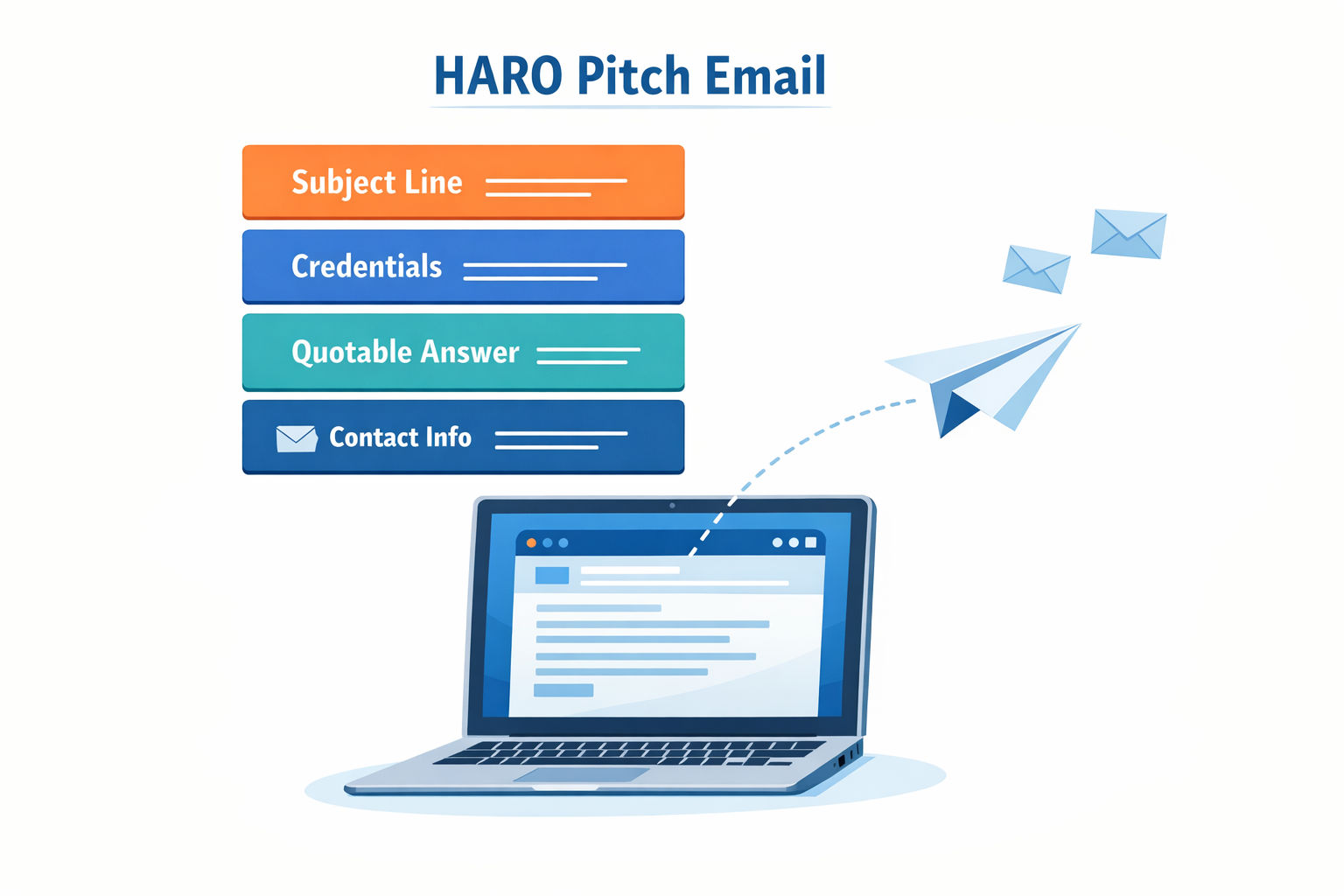
Use the pitch structure below. Keep it under 250 words total.
The 4-part HARO pitch structure that gets founders quoted in major publications
HARO Pitch Template (Copy This)
Step 1
Subject Line — Mirror Their Query
Match the journalist's query exactly. If they wrote "Sources for article on SaaS pricing strategies," your subject is "Re: Sources for article on SaaS pricing strategies." Don't get creative here.
Step 2
Lead With Your Answer (2-3 Sentences)
Skip the intro. Start with your actual quote — specific, concrete, copy-paste ready. Include a number or data point. "We surveyed 400 users and found that usage-based pricing increased trial-to-paid conversion by 23%" beats "Many SaaS companies find that pricing is important."
Step 3
Credentials (1 Sentence)
Your name, title, company, and one sentence of relevant context. "I'm [Name], founder of [Product], a [what it does] used by [X users/companies]." Keep it to 30 words.
Step 4
Close With Availability
"Happy to provide additional context or clarification. You can reach me at [email] or [phone]." That's it. Journalists on deadline need to reach you fast.
The #1 HARO Mistake Founders Make
Writing pitches about your product. Journalists don't care about your SaaS. They care about the insight you can provide as someone building in the space. Your product might get a mention and link, but only as context — never as the pitch.
2. Original Data Assets (Best Long-Term Compounding)
This is the single most powerful SaaS link building strategy, and it’s the one almost nobody does because it requires actual work upfront.
The concept is simple: publish original research — a survey, a data analysis, a benchmark report — and it becomes a citation magnet that earns links for years. Not weeks. Years.
Why does this work? Because journalists, bloggers, and content creators constantly need data to cite. When you’re the source of that data, they link to you every time they reference it.
Ahrefs’ study of top bootstrapped SaaS companies found that the most linked-to pages weren’t product pages or blog posts — they were thought leadership posts with original data: opinions backed by research, predictions grounded in numbers, and benchmark reports.
How to Create a Data Asset (Even With a Small User Base)
You don’t need 10,000 users. You need one interesting dataset.
Survey your users. Even 100-200 responses is enough. Ask questions your industry cares about. “How do bootstrapped SaaS founders handle X?” is more interesting than you think.
Analyze public data. Scrape job boards, app stores, GitHub repos, or public APIs. Find a pattern nobody else has quantified.
Run your own experiment. Test something, measure it, publish the results. “We A/B tested 5 onboarding flows — here’s what happened” is inherently linkable.
Benchmark your category. Compile pricing data, feature comparisons, or performance benchmarks across competitors.
The format matters: publish a summary post with clear charts, headline stats, and methodology. Then host the full dataset on a dedicated page. This gives people two things to link to.
The fastest wins in link building for SaaS come from digital PR, original research, and unlinked brand mentions. The key is to share a method, show the charts, and host the dataset so readers can check your work.
The Pitch After Publishing
Once your data post is live, the promotion workflow takes maybe 2 hours:
Find 20-30 articles that cite outdated stats in your space (use Google: "[stat topic]" + "2023" OR "2022")
Email the authors: “Hey, noticed you referenced [outdated stat]. We just published [your study] with fresh 2025 data — might be a useful update for your readers.”
Share in communities where your audience hangs out — IndieHackers, relevant subreddits, Twitter/X
Respond to HARO queries citing your own data (double-dip on tactics)
One solid data post can earn 10-50+ links over its lifetime. That’s the compounding part — it keeps working long after you stop actively promoting it.
3. Directory and Tool Listings (Easiest Quick Wins)
This isn’t sexy, but it’s the fastest way to build a base layer of 20-60 referring domains with almost zero effort.
Every SaaS product should be listed on relevant directories. The link value here is underrated — many directories carry DR 40-90, and they’re contextually relevant to your product.
Here’s the priority list:
SaaS directory listings ranked by domain authority and effort
Directory Type
Examples
Typical DR
Time to List
Launch platforms
Product Hunt, BetaList, Launching Next
70-90
1-2 hours
Category review sites
G2, Capterra, GetApp
80-93
2-3 hours
AI/SaaS directories
There's An AI For That, OSS Alternatives, AlternativeTo
50-80
30 min each
Marketplace ecosystems
Chrome Web Store, Zapier, Notion integrations
90+
Varies
Indie/startup communities
IndieHackers, Hacker News (Show HN)
80-90
30 min
The Elfsight case study is instructive here. This bootstrapped SaaS grew from 7,657 to 33,610 referring domains in one year — and Ahrefs found that over 60% of their referring domains had anchor text containing the word “widget.” Their embeddable free tool was doing the heavy lifting.
You probably don’t have an embeddable widget. But you might have a free tier, a Chrome extension, or a useful calculator. Anything that lives on its own URL and solves a specific problem can be listed, shared, and linked to.
Block out one afternoon. List your product on every relevant directory you can find. Then move on to tactics that compound. If you’re also building out your content engine, these directory links give your new blog posts the domain authority boost they need to start ranking.
This is the closest thing to free money in SEO. Someone already wrote about your product — they just forgot to include the link.
Unlinked mentions have conversion rates of 30-60% when you ask for the link, because the author has already implicitly endorsed you. They just need a nudge.
The Setup (10 Minutes)
Google Alerts: Set up alerts for "your brand name" -site:yourdomain.com and "your product name" -site:yourdomain.com
Ahrefs’ free tools: Use the Content Explorer to search for your brand, then filter by “Highlight unlinked” to find mentions without backlinks
Weekly review: Every Monday, check your alerts and reach out to anyone who mentioned you without linking
The outreach email is dead simple:
“Hey [Name], thanks for mentioning [Product] in your article about [topic]. Would you mind adding a link to [URL] so readers can find us? Happy to share the post with our audience too.”
That’s it. No elaborate pitch needed. They already like you enough to write about you.
For early-stage products, the supply of unlinked mentions will be small. Set up the alerts now anyway. As your community presence grows from posting on IndieHackers, Twitter, and Reddit, more mentions will start appearing — and your alerts will catch them automatically.
What NOT to Do (Seriously, Don’t)
Let’s be direct about the tactics that waste your time or actively hurt your site.
Link Building Tactics: Worth It vs. Skip It
Worth Your Time
HARO and journalist platforms (high-authority editorial links)
Original data/research posts (compound for years)
Directory and tool listings (quick base layer of 20-60 links)
Community engagement that leads to organic mentions
Skip These
Link exchanges — 59% of SEO experts say excessive exchanges harm SEO (Sure Oak 2024 study)
Paid links — Google actively devalues or penalizes these; not worth the risk at any stage
Low-quality directories — sites with no traffic that exist only to sell links. Check organic traffic before submitting
Mass guest post outreach — emailing 500 strangers "I'd love to write for your blog" gets a ~1% response rate
Link building services under $500/mo — at that price, you're buying spam
Google's Position on Paid Links Is Clear
Google treats buying or selling links that pass PageRank as a spam policy violation. Consequences include loss of trust, lower rankings, and manual penalties. Recovery requires identifying and disavowing every bad link, then filing a reconsideration request — a process that can take months. Not worth it for a bootstrapped startup that can't afford to lose the organic traffic it already has.
Your Month-by-Month Prioritization
You can’t do everything at once. Here’s the order that makes sense for a solo founder spending 3-5 hours per week on link building.
The Bootstrapped Link Building Roadmap
Month 1
Month 1: Foundation
List your product on 30-50 directories (one afternoon). Sign up for HARO/Featured, Qwoted, and Source of Sources. Set up Google Alerts for brand mentions. Start responding to 2-3 HARO queries per day. Expected: 8-15 directory links + first HARO placements.
Month 2-3
Month 2-3: Data Asset
Create your first original research post. Survey users, analyze public data, or run an experiment. Publish with charts and methodology. Pitch it to 20-30 sites citing outdated stats. Continue daily HARO responses. Expected: 10-20 cumulative quality links. First ranking movements for low-competition terms.
Month 4-6
Month 4-6: Compound
Your data post starts earning passive links. HARO placements accumulate. Brand mentions grow from community presence. Start your second data asset. Run weekly unlinked mention reclamation. Expected: 30-50+ cumulative quality links. Pages entering top 10 for target keywords. Organic traffic visibly trending upward.
Month 6+
Month 6+: Flywheel
Existing assets earn links without active promotion. HARO responses become faster (you've built a template library). New content ranks faster because domain authority has grown. Reduce active time to 2-3 hours/week and let compounding do the work.
The Numbers That Matter
Let me set realistic expectations. Based on practitioner benchmarks and case studies across multiple bootstrapped SaaS companies:
At 3-5 hours/week: expect 2-5 quality links per month. Slow, steady foundation.
At 5-10 hours/week: expect 4-10 quality links per month. Competitive in most niches within 6-12 months.
First meaningful ranking movement: 3-6 months
Consistent organic traffic: 6-12 months
SEO as a real growth channel: 12+ months
This isn’t fast. But it compounds. The Awaio case study showed a bootstrapped SaaS going from 88 ranking keywords to 1,000 — with domain authority growing from 15 to 23 — in 11 months. OneCal, another bootstrapped product, outranked VC-backed competitors with higher domain authority by being more strategic with fewer resources.
The founders who win at this aren’t the ones with the biggest budgets. They’re the ones who started six months earlier than they thought they needed to.
The Compound Effect Is Real
One original research post can earn links for 2+ years. One HARO placement on a DR 80+ site permanently boosts your domain authority. Every link makes the next piece of content you publish rank faster. This is why starting now — even at 3 hours per week — matters more than starting "perfectly" in six months.
Start With the Content That Earns Links
Link building doesn’t happen in a vacuum. Every tactic above works better when you have a solid content foundation — blog posts that are worth linking to in the first place.
The founders who struggle with backlinks usually have a different problem: they don’t have enough content worth citing. Fix the content, and the links follow.
If you’re spending your weekends writing blog posts instead of building your product, the math is wrong. The goal is to build a system where content runs on autopilot so you can spend those 3-5 weekly hours on the link building tactics that actually require a human touch — HARO responses, relationship building, and data analysis.
The links will come. Start with the assets.
Need the Content Before You Can Build Links?
Vibeblogger handles the entire blog operation — research, writing, images, and publishing — so you can focus on the link building tactics that actually need a founder's voice. Every post is SEO-optimized and designed to be linkable.