Blog Automation for Founders: How to Get Consistent Content Without Hiring a Writer
Stop writing blog posts manually. Here's the exact 3-part automation system that lets solo founders publish 3+ posts per week with near-zero time investment — and the quality traps to avoid.
Rori Hinds··9 min read
You know you need a blog. SEO is the highest-ROI channel for SaaS. Every growth playbook says the same thing: publish consistently, target long-tail keywords, build topical authority.
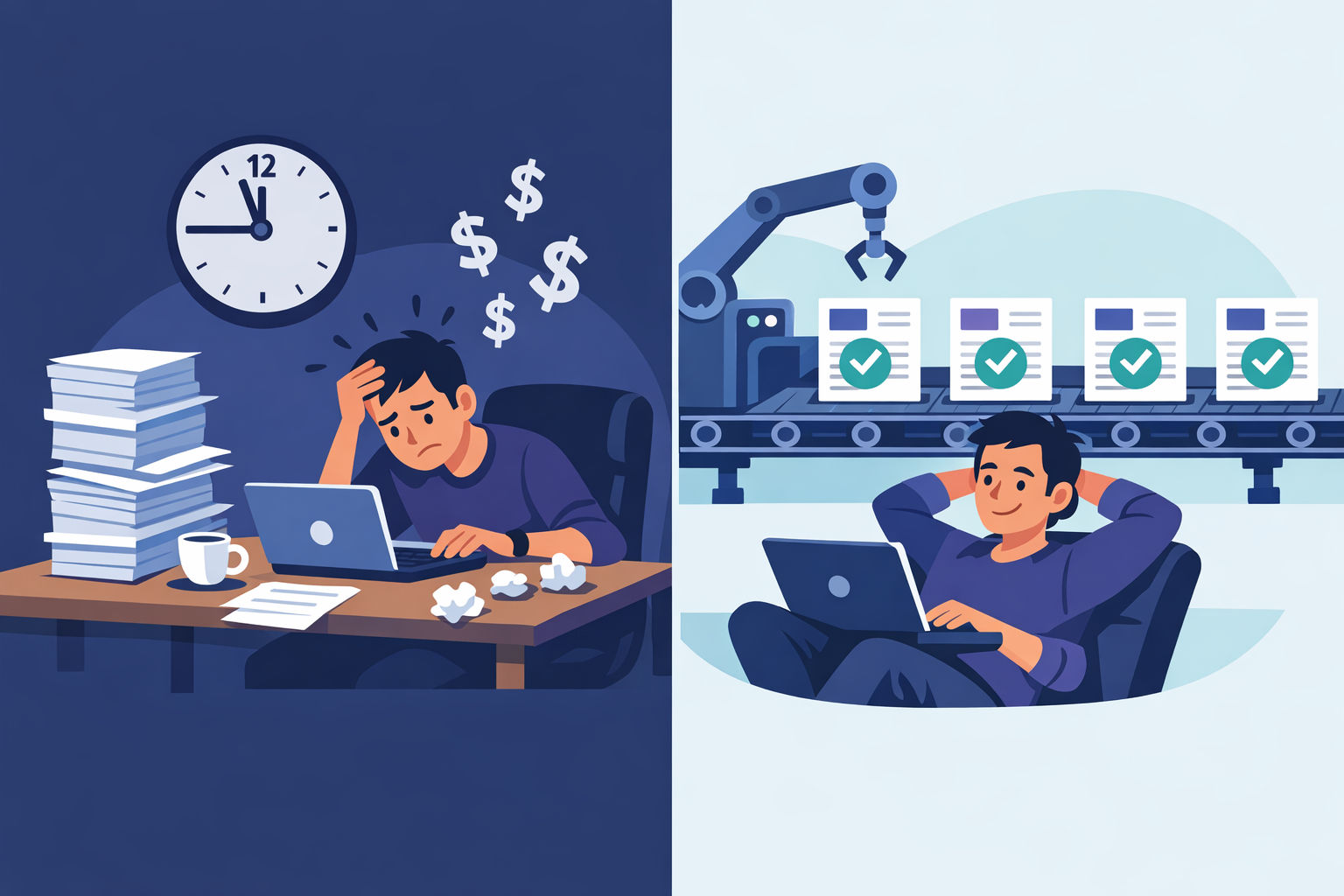
But here’s the part they leave out: blog automation for founders isn’t about writing faster. It’s about building a system that writes for you.
The average blog post takes 3 hours and 48 minutes to write, according to Orbit Media’s latest annual survey. Posts that actually perform well? Those take 5-6+ hours. If you want to hit the publishing frequency that moves the needle — 8-12 posts per month — you’re looking at 40-70 hours of writing per month.
You’re a founder. You don’t have 40 hours to spare. You barely have 4.
Why “Just Write More” Is Terrible Advice
Let’s do the math that most content marketing guides skip.
Say you want to publish 3 blog posts per week — a cadence that data shows starts to compound. A meta-analysis of 13,500 blogs by theStacc found that publishing 11+ posts per month correlates with 3.5× more organic traffic than publishing once a month.
Three posts a week is 12 per month. Right in that sweet spot. Now here’s what that costs:
The real cost of publishing 12 blog posts per month, broken down by approach
Approach
Time Per Post
Monthly Hours
Monthly Cost
Write it yourself
4-6 hours
48-72 hours
$0 (but your product suffers)
Hire a freelancer
1 hour of review
12 hours managing
$3,600-7,200/mo ($300-600/post)
Use ChatGPT manually
1-2 hours prompting + editing
12-24 hours
$20/mo (but quality is a coin flip)
Automated pipeline
0-1 hours setup/review
2-4 hours
Tool cost only
The freelance route sounds great until you do the math. Quality SaaS writers charge $300-600 per post. At 12 posts per month, you’re spending $3,600-7,200 — more than most early-stage founders spend on their entire tool stack.
And the “just use ChatGPT” approach? You’re still spending 1-2 hours per post on prompting, formatting, fixing hallucinations, adding images, and publishing. That’s not automation. That’s a different kind of manual labor.
The only approach that scales without scaling your time is a real blog automation tool — an end-to-end system, not a chatbot you copy-paste from.
The 3 Components of a Real Blog Automation System
After studying how teams like Kalvium Labs (who publish 14 blog posts per week with AI agents) and other content-heavy startups actually operate, a clear pattern emerges. Every working automated blog publishing setup has three parts.
The three-stage pipeline: Ideation → Generation → Publishing
The 3-Part Automated Content Pipeline
Step 1
Ideation Engine
This is your topic queue. Instead of staring at a blank page wondering what to write about, an ideation engine pulls from keyword research data, competitor content gaps, and your product's focus areas to generate a prioritized backlog of topics. It answers: 'What should we write next, and why?' A good system uses real search volume and keyword difficulty data — not just AI guessing at what sounds good. The output is a ranked queue of topics with target keywords, search intent, and estimated opportunity.
Step 2
Generation Pipeline
This is where AI does the heavy lifting. The pipeline takes a topic brief from the queue and produces a complete, publish-ready article: researched content with real data, SEO-optimized headers, internal links, meta descriptions, and generated images. The key difference between this and 'paste a prompt into ChatGPT' is that it's a multi-step workflow — research, outline, draft, optimize, images — not a single prompt. Each step has quality checks built in. Brand voice settings, tone guidelines, and source requirements are baked into the system, not typed fresh each time.
Step 3
Publishing Scheduler
The final piece connects your content pipeline to your actual blog. Posts move from 'draft' to 'published' on a schedule you set — whether that's 3x/week, daily, or whatever cadence you choose. This includes CMS integration, sitemap updates, and (optionally) pushing snippets to social channels or newsletters. Once configured, the scheduler runs without you touching it.
This is not a "set it and forget it on day one" situation
The upfront investment matters. You need to define your brand voice, set topic guidelines, configure your keyword strategy, and review the first batch of outputs. Expect to spend 5-10 hours on initial setup. After that, the system runs — but that first investment is what separates a useful AI content workflow from generic slop.
What a Realistic Automated Content Cadence Looks Like
Let’s get specific. Here’s what publishing 3 posts per week on full autopilot actually means in practice:
Week 1: You spend 5-8 hours on setup. Define your brand voice, target topics, tone, and SEO parameters. Review and approve the first 3-5 posts. This is the heaviest week.
Week 2-4: The system is running. You spend maybe 30 minutes scanning titles and skimming posts. You tweak a prompt or topic setting when something feels off.
Month 2+: Zero hours per week. Posts publish on schedule. You check analytics occasionally.
The data backs this cadence up. HubSpot’s research shows blogs under 1 year old should aim for 6-8 posts per month to build topical authority. Once you’re past 50 published posts, the compounding kicks in — InBlog tracked a blog that saw 29% organic traffic growth even during months with zero new publishing, just from existing posts climbing in rankings.
Here’s where I need to be straight with you. Automation can produce a lot of content. But quantity without quality will hurt you.
NAV43 documented a B2B SaaS company that saw a 23% drop in lead quality over 6 months when they used unstructured AI content creation — generic posts with no editorial oversight, no brand voice, no original insight.
And Semrush’s study of 42,000 blog pages found that 80.5% of position-1 Google results are still human-written. AI content can rank — but only about 10% of top-ranking pages are purely AI-generated.
Google’s March 2024 core update specifically targeted low-quality, unoriginal content and cut 45% of it from search results. The message is clear: generic AI output is increasingly risky for SEO.
Where automation works vs. where it doesn't
Automate these: Keyword research, topic ideation, first drafts, SEO optimization, internal linking, image generation, meta descriptions, publishing to CMS, scheduling.
Keep human judgment on these: Brand positioning, controversial takes, product-specific insights, E-E-A-T signals (experience, expertise), fact-checking critical claims, and deciding which topics align with your business goals.
The winning model is AI-powered with human-configured guardrails — not a human doing the work, but a human who set the rules.
So how do you avoid the quality trap? Three guardrails:
1. Brand voice configuration, not per-post prompting. The best blog automation tools let you define your voice, tone, and style once. Words to use, words to avoid, example content that sounds like you. This eliminates the “prompt bottleneck” — spending time crafting prompts for each article — that NAV43 identifies as a key failure mode.
2. Research-backed content, not vibes. Every post should pull real data, cite sources, and reference actual statistics. If your automated content reads like it could have been written about any company, it’s not good enough. We’ve written about why real keyword data matters more than AI guessing — the same principle applies to the content itself.
3. Quality checks in the pipeline, not after. Build automated validation into the system: minimum word counts, required source citations, readability scoring, AI-tell detection (clichéd phrases, filler language). Kalvium Labs runs a 10-point content review via an independent AI agent before any post goes live. That’s the right approach.
How Vibeblogger Runs This Blog on Autopilot
This isn’t hypothetical. You’re reading the proof.
Every post on this blog — including this one — is researched, written, and published by Vibeblogger’s own automated pipeline. Here’s what that looks like:
Ideation: Topics come from a keyword-researched queue. Each topic has a target keyword, search intent classification, and a content brief with the angle, audience, and key points to cover.
Research: Before writing a single word, the system runs multiple searches — pulling statistics, expert quotes, industry data, and competitive content. Not AI hallucinations. Actual web research with citations.
Writing: The draft is generated following our brand voice settings: conversational tone, short paragraphs, direct address, data-backed claims, no corporate speak. The same guidelines you’d give a senior freelance writer.
Images: Custom images are generated for each post. Not generic stock photos.
Publishing: Posts are formatted, SEO-optimized, and published to the blog automatically.
The result? Consistent publishing at a cadence that would cost $3,600+ per month with freelancers, or 50+ hours of founder time. Instead, it costs us a fraction of that and zero ongoing writing hours.
Think of AI marketing automation as hiring a tireless digital marketer who works 24/7, learns your brand voice, and can produce content at scale — all for a fraction of what you would pay a human team or agency.
That quote captures it well — but with one important caveat. The “learns your brand voice” part only works if you actually teach it. You need to invest the upfront hours to configure your voice, your topics, and your quality standards. That’s the difference between SaaS content on autopilot and an AI content workflow that produces garbage.
Blog automation for founders comes down to a simple question: are you building a system, or are you doing a chore?
If you’re manually writing posts, manually prompting ChatGPT, or manually managing freelancers — you’re doing a chore. Chores don’t compound. They just eat your time.
A system compounds. It publishes while you ship product. It builds your search footprint while you sleep. It turns your blog from a guilt-inducing to-do list into an actual growth channel.
The setup takes a few hours. After that, you never write a blog post again.
Ready to stop writing blog posts?
Vibeblogger handles the entire pipeline — keyword research, writing, images, SEO, and publishing. This blog is the live demo.