Open any bootstrapped founder’s laptop right now and you’ll see the same five or six tabs. Claude or ChatGPT. Cursor. Perplexity. Maybe Bolt or v0 for a quick prototype. An automation tool stitching everything together.
This isn’t a coincidence. The AI tools for developers landscape exploded over the past two years, but in 2025, it quietly converged. Founders stopped experimenting with 30 tools and settled on the handful that actually move the needle.
The numbers back this up. According to JetBrains’ 2025 State of Developer Ecosystem report, 85% of developers now regularly use AI tools for coding and development. Stack Overflow’s 2025 survey found 51% of professional developers use them daily. And 1 in 5 developers reports saving 8+ hours per week — roughly an entire workday — thanks to their AI stack.
But here’s what those surveys don’t tell you: which specific tools are worth paying for, what they actually cost, and where the productivity gains are real versus marketing fluff.
This post breaks down the exact stack that’s become the default for bootstrapped founders. Not a listicle of 47 tools. The five jobs your AI tools need to do, and the best tool for each one.
The convergence is real
Solo-founded startups surged from 23.7% of all startups in 2019 to 36.3% by mid-2025. Nearly 60% of U.S. small businesses now use AI tools — more than double the rate in 2023. The one-person company isn't a meme anymore. It's an operating model.
Job 1: Thinking Partner — Claude or ChatGPT ($20/mo)
Every founder I’ve talked to starts their day in a chat interface. Not to generate code. To think.
Marc Lou — who made $1,032,000 in 2025 as a solo founder with 15 income streams — describes it like this: he walks around with ChatGPT, dumps his thoughts, iterates, and uses the AI to push him toward better ideas. When something feels solid, he writes a detailed prompt for Cursor.
The pattern that’s emerged is clear: Claude for deep reasoning and long-form planning, ChatGPT for quick iterations and broad knowledge. Most founders pay for both ($20/mo each), but if you’re picking one, Claude has become the default for product specs and architecture decisions.
Concretely, this means:
- Writing a one-page product spec before touching code
- Asking the AI to argue against your idea before building it
- Generating user stories and edge cases from a brief description
- Drafting landing page copy, onboarding flows, and support docs
This is the highest-leverage tool in the stack because it compresses the “thinking” phase from days to hours.
Job 2: Writing Code — Cursor ($20/mo)
If there’s one tool that defines the current era of AI tools for developers, it’s Cursor.
The numbers are staggering. Cursor hit $2 billion in annualized revenue by February 2026, making it the fastest B2B software company to reach $1B ARR — faster than Slack, Zoom, or Snowflake. It’s valued at $29.3 billion after a $2.3B Series D. Over 50,000 teams use it globally, including the majority of the Fortune 500.
But what matters to you as a bootstrapped founder isn’t the valuation. It’s this: Cursor Pro costs $20/month, and it fundamentally changes how fast you ship.
The best AI coding tools in this space — Cursor, GitHub Copilot, and Claude Code — all operate differently:
- Cursor is an AI-native code editor that rewrites entire files, understands your full codebase, and works in agent mode to implement features from markdown specs
- GitHub Copilot (also $20/mo, with a free tier) is better for inline autocomplete and has the broadest adoption — 20 million cumulative users and 4.7 million paying customers as of early 2026
- Claude Code is a CLI-based coding agent — powerful for experienced devs, but less visual
Most bootstrapped founders I’ve tracked land on Cursor as their primary, with Copilot as a backup. Marc Lou’s workflow: write a detailed prompt in Claude, hand it to Cursor agent mode, and 90% of the time it works in one shot. Then he spends his time on UI tweaks — the part AI still struggles with.
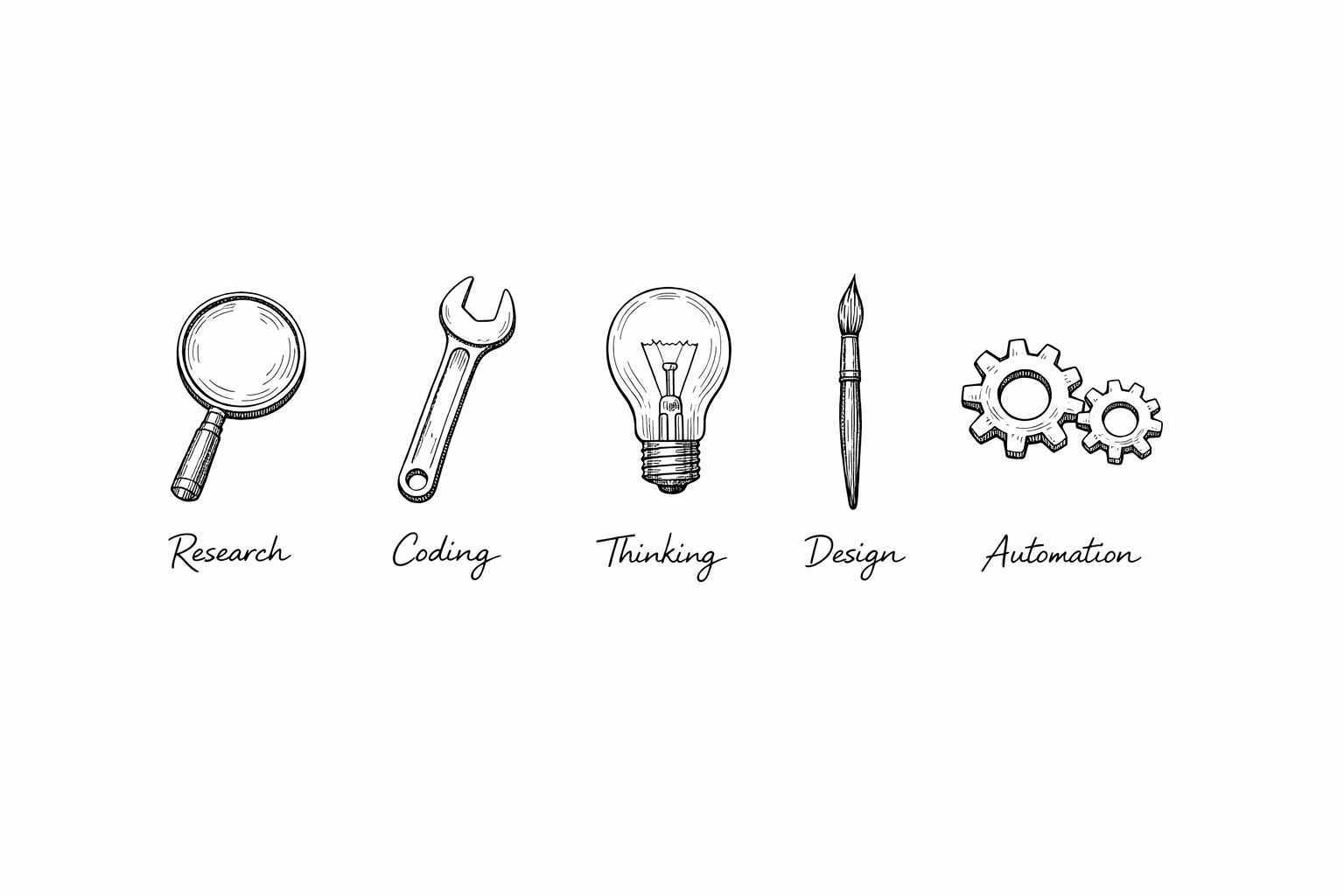
The bootstrapped founder's AI stack covers five jobs: thinking, research, coding, design, and automation.
Job 3: Research — Perplexity ($20/mo or free)
Google is still useful. But for the kind of research bootstrapped founders actually do — competitor analysis, market sizing, technical comparisons — Perplexity has become the go-to.
The practitioner pattern from BuildMVPFast’s founder workflow guide maps it out: Perplexity for market research, NotebookLM for deep document analysis. One founder-educator describes the research phase as “filling in the gaps in your knowledge… identifying things you aren’t aware of as quickly as possible.”
Perplexity’s free tier is generous enough for casual use. The Pro tier ($20/mo) unlocks longer answers and file uploads, which is clutch when you’re analyzing competitor docs or technical specs.
The real shift here isn’t just speed. It’s that founders who used to skip research entirely — because who has time to read 30 articles before building? — now actually validate ideas before writing code. That’s how Marc Lou kills weak ideas in an afternoon instead of wasting a week building something nobody wants.
Job 4: Prototyping & Design — Bolt, v0, or Lovable ($25-29/mo)
This is where the “vibe coding tools” category lives, and it’s the fastest-moving part of the stack.
The AI app builder landscape now has clear tiers:
- v0 (by Vercel) generates marketing pages and dashboard shells from text descriptions — great for landing pages and UI mockups
- Bolt.new ($29/mo) is a browser-based sandbox for spinning up full app experiments without touching your local dev environment
- Lovable ($25/mo) positions itself as a “conversation-first full-stack app builder” — frontend, backend, database, auth, and deployment from a chat interface
The workflow that’s emerged: use one of these vibe coding tools to rapidly prototype, then move into Cursor for the serious build phase. This is exactly how the MindStudio team describes the indie hacker pattern — “ship full-stack apps with AI in days instead of weeks.”
For design assets specifically, Canva ($12.99/mo) handles most marketing visuals, and image generation tools cover the rest. Most bootstrapped founders aren’t hiring designers anymore — they’re generating and iterating.
If you’re building in public, these prototyping tools are especially powerful. You can show progress daily because you’re actually shipping daily.
Job 5: Automation — Zapier, n8n, or Make ($0-20/mo)
The glue layer. Every bootstrapped founder hits a point where they need systems talking to each other: new signup → CRM entry → welcome email → Slack notification.
Zapier ($19.99/mo starter) remains the default for non-technical automation. n8n (free, self-hosted) is the pick for dev-founders who want full control. Make sits somewhere in between.
The real power move is combining automation with an LLM. Founders are building workflows like:
- Customer support email → AI draft response → human review → send
- New blog comment → sentiment analysis → flag if negative
- Competitor pricing page change → AI summary → Slack alert
This is where the “AI replacing early hires” narrative gets real. A solo founder running Zapier + ChatGPT can handle support, monitoring, and basic ops workflows that used to require a part-time VA.
The bootstrapped founder's core AI stack — what it costs and what it replaces
| Job | Tool | Monthly Cost | What It Replaces |
|---|
| Thinking partner | Claude / ChatGPT | $20 | Co-founder brainstorms, consultant calls |
| Writing code | Cursor | $20 | Junior developer (partially) |
| Research | Perplexity | $0-20 | Hours of Googling and reading |
| Prototyping | Bolt / v0 / Lovable | $25-29 | Designer + frontend dev time |
| Automation | Zapier / n8n | $0-20 | Part-time VA or ops hire |
| **Total** | | **$65-109/mo** | **$80K-$120K/yr in early hires** |
What the Productivity Data Actually Shows
Let’s be honest about the numbers, because there’s a lot of “10x productivity” noise out there.
The real data from 2025 tells a more nuanced story. GitClear’s analysis of production repos found AI tools increase development speed by 20-55%, but “sustainable code” — code that stays in the codebase without being rewritten — grows by only ~10%. Developers ship more, but a chunk of it gets refactored later.
Jellyfish’s 2025 data across engineering orgs shows that teams with 100% AI adoption ship 113% more PRs per engineer (1.36 → 2.9) and have 24% faster cycle times (16.7 → 12.7 hours). That’s significant.
But here’s the kicker from the METR randomized controlled trial: experienced open-source developers using AI tools on their own mature projects spent 19% more time on tasks — while believing they were 20% faster. The perception-reality gap is real.
Google’s DORA 2024 report (still the benchmark in 2025) found that a 25% increase in AI usage correlates with a 7.2% decrease in delivery stability.
The honest take on AI productivity
The realistic gain is 25-40% faster on routine engineering work, not 10x. The gains are biggest on boilerplate, unfamiliar libraries, and greenfield code. They shrink on complex, mature codebases. Stack Overflow's 2025 survey found 46% of developers actively distrust AI output accuracy, and 66% say their biggest frustration is solutions that are "almost right, but not quite."
The Marc Lou Case Study: $1M+ With a 5-Tool Stack
Marc Lou is the clearest proof that this stack works. He made $1,032,000 in 2025 running 15 income streams as a solo founder. His flagship products ShipFast and CodeFast each generate ~$20K/month. His SaaS DataFast hit $15.8K MRR with ~1,000 paying customers.
His stack is absurdly simple: ChatGPT for thinking, Claude for specs, Cursor for building. He recently shipped 4 apps in 4 days. His average idea-to-launch time is 5 days.
His own description of the workflow: “AI turned my life into a game. I walk around with ChatGPT, dump my thoughts, we iterate. When an idea feels solid, I write a detailed prompt for Cursor or Codex. 90% of the time, it works in one shot.”
The part AI still can’t do? UI polish and design taste. Marc spends most of his time on the tweak phase — removing the unnecessary elements AI adds (“icons, random colors, extra stuff”) and dialing in simplicity.
That’s the pattern. AI handles the 80% that’s formulaic. You handle the 20% that requires taste and judgment. If you’re thinking about launching your next product, this is the playbook.
The Gap Nobody Talks About: Content and SEO
Here’s what’s interesting about every founder AI stack list out there. They cover coding, design, automation, and research. But almost none of them address the thing that actually drives long-term growth: content marketing and SEO.
The Stack Overflow 2025 survey found that 76% of developers don’t plan to use AI for deployment and monitoring, and 69% won’t use it for project planning. But the gap is even bigger for content. Most founders still treat blog posts as something they’ll “get to eventually” — or they paste a topic into ChatGPT and publish whatever comes out.
That’s a problem, because real keyword data matters more than AI guessing. SEO is still the highest-ROI marketing channel for startups. But researching keywords, writing 2,000-word articles, generating images, and publishing consistently? That’s a second job.
The founder stack needs a sixth tab. One that handles the entire blog operation — from keyword research to published post — the same way Cursor handles code.
Your Move: Start With Three Tools, Not Twelve
If you’re overwhelmed by the tool landscape, here’s the practical takeaway.
Start with Claude ($20/mo) and Cursor ($20/mo). That’s $40/month covering the two highest-leverage jobs: thinking and coding. Add Perplexity’s free tier for research and you’ve got 80% of the stack for $40/month.
Once you’re shipping faster, add a prototyping tool and an automation layer. Your total spend will land somewhere between $100-400/month depending on how many paid tiers you need.
For context, a solo founder agent stack covering code, content, design, support, and automation runs roughly $300-500/month in tool subscriptions — replacing what would cost $80,000-$120,000/year in equivalent hires, according to an analysis by Mean CEO.
Pieter Levels runs $3M+ ARR with zero employees. Marc Lou hit $1M+ with the same approach. The tools exist. The only question is which ones you open first.
If you’re still wondering how to handle content and SEO — the one piece most founders skip — that’s exactly what we built Vibeblogger to solve.
Want your app or SaaS to rank on Google?
Vibeblogger is the AI content team for founders. It handles keyword research, writing, image generation, and publishing — so you can focus on building product. Every post on this blog was researched, written, and published by Vibeblogger itself.
See how it works