You have 2,300 followers. Your competitor has 47,000. And yet your last launch brought in more paying customers than theirs did.
That’s not a fluke. That’s how twitter growth for founders actually works when you optimize for the right metric.
Most founder Twitter advice boils down to “post consistently and engage.” That’s not a strategy. That’s a platitude. The founders who are converting followers into revenue aren’t doing anything magical — they’re just playing a different game than everyone else.
Here’s the game, with real numbers.
The Algorithm Isn’t a Black Box Anymore
X’s algorithm is open source. And buried in the code is something most founders miss: not all engagement is created equal.
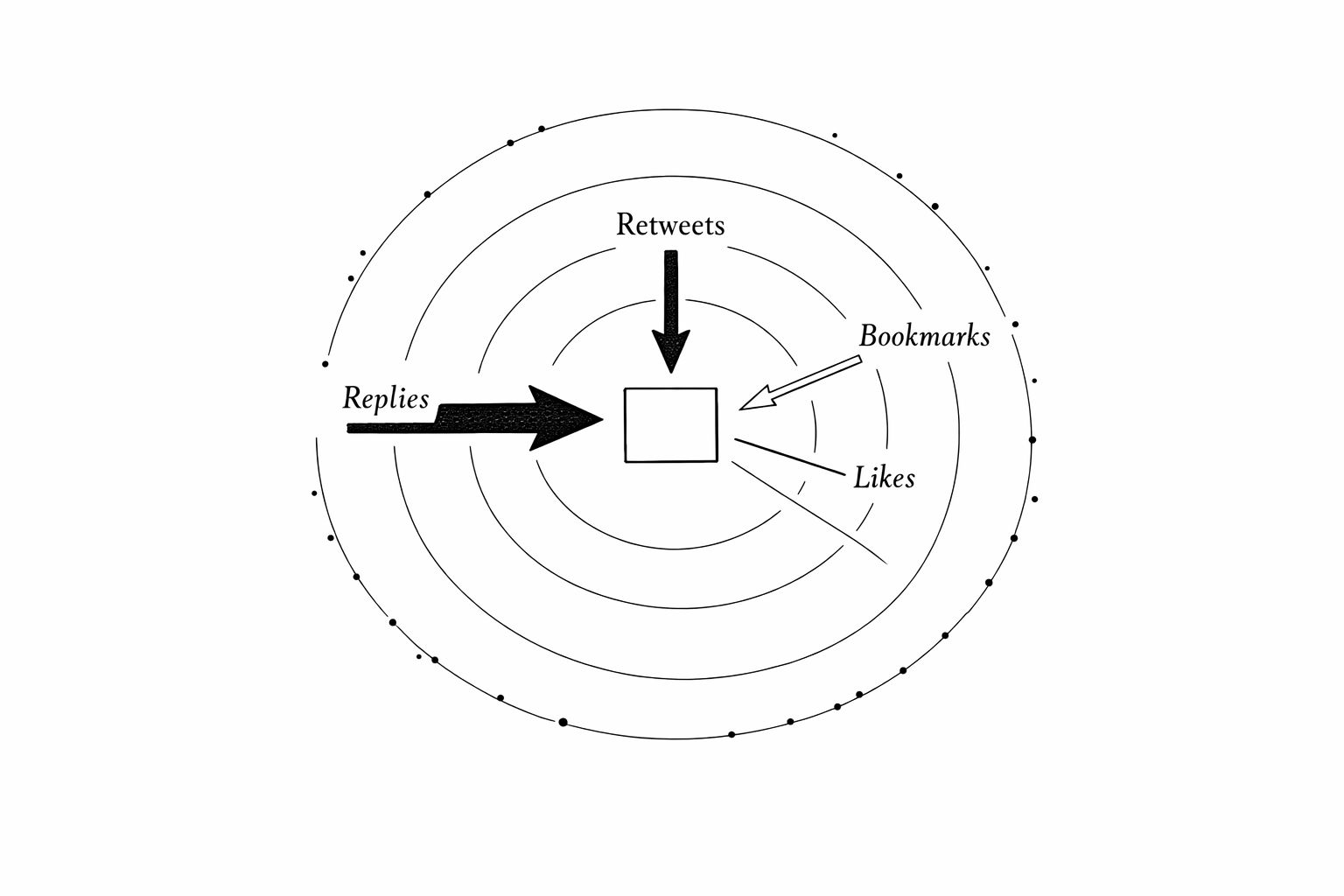
The algorithm assigns different weights to different actions. A like barely moves the needle. A reply is worth 27x more. And if you reply to someone’s reply on your own tweet? That’s weighted at 150x a like.
This isn’t theory. This is from the actual codebase and confirmed by multiple analyses of the platform’s ranking system in 2025-2026.
X algorithm engagement weights — sourced from open-source code analysis and platform studies (OpenTweet, 2026)
| Action | Algorithm Weight | What This Means |
|---|
| Like | 1x (baseline) | Nice, but barely registers |
| Bookmark | 10x | Signals lasting value |
| Profile Click | 12x | Shows genuine curiosity |
| Retweet | 20x | Amplifies to new networks |
| Quote Tweet | 25x | Adds context, sparks discussion |
| Reply | 27x | The gold standard engagement |
| Your Reply to a Reply | 150x | The single biggest signal you can trigger |
The 150x Hack
Every time someone replies to your tweet and you reply back, you're triggering the strongest possible signal in the algorithm — 150x a like. This is why founders who actively respond to replies see dramatically higher distribution. The math is simple: 10 reply conversations on a single tweet = the equivalent of 1,500 likes worth of algorithmic weight.
There’s also a critical timing factor. Posts lose roughly 50% of their visibility score every 6 hours. The first 30 minutes after you post — the “golden window” — determines whether the algorithm shows your tweet to 100 people or 10,000.
Translation: when you post matters almost as much as what you post. And what happens in the replies right after matters more than both.
Different engagement types carry wildly different weight in X's ranking algorithm
Why Small Accounts Win the Conversion Game
Here’s a counterintuitive stat: accounts with 1K-5K followers average a 4.84% engagement rate. Accounts with 1M+ followers? Just 0.76% (per 2025 benchmark data from Social Rails and Tweet Archivist).
That’s a 6x difference. And for tech/SaaS specifically, engagement rates sit around 2.2% — higher than the platform-wide average of 1.7%, according to Hootsuite’s 2025 benchmarks.
What this means for you: a focused audience of 2,000 founders who actually care about your product niche will outperform 50,000 random followers every single time. You don’t need a massive following. You need the right 2,000 people.
The 70/30 System That Actually Works
The most effective founder personal brand strategy on X follows a specific ratio: spend 70% of your time engaging with other people’s content and 30% creating your own.
This sounds backwards. Most founders do the opposite — they blast original tweets and wonder why nobody sees them.
But the algorithm rewards conversation, not broadcasting. Here’s what the daily routine looks like in practice:
The Daily 45-Minute Twitter Routine
Step 1
Morning replies (15 min)
Find 5-10 tweets from accounts in your niche with 10K-100K followers. Leave genuinely useful replies — not "Great post!" but actual insights, data points, or a different angle. These replies put you in front of their audience.
Step 2
Post one original tweet (10 min)
Pick from your content pillars: a build-in-public update, a lesson learned, a specific number or metric, or a hot take on something in your industry. Aim for 70-100 characters for maximum engagement, or 4-8 tweet threads for deeper content.
Step 3
Reply to your replies (10 min)
This is where the 150x multiplier lives. When people reply to your tweet, reply back with substance. Every conversation thread you create triggers the algorithm's strongest signal.
Step 4
One quote tweet with added value (10 min)
Find something relevant, add your unique perspective or data. Quote tweets carry 25x weight and position you as someone who adds to the conversation, not just amplifies it.
That’s 45 minutes a day. Not 3 hours. Not “always be online.” Just 45 focused minutes.
The key insight: replying to larger accounts (10K-100K followers) puts you in front of their audience without needing that audience yourself. It’s the fastest path to targeted growth because those followers already care about your topic.
Build in Public: The Highest-ROI Content for Founders
SaaS founders who build in public grow their audiences 3x faster than those who market silently, according to practitioner data compiled by OpenTweet. Companies that share metrics publicly see a 20-30% increase in user trust.
This isn’t surprising. When you share real numbers — revenue, user counts, churn rates, even failures — you’re doing two things at once: building credibility and attracting exactly the audience that would buy your product.
The best indie hacker marketing content on X follows three specific pillars:
Content pillars that convert followers into customers
| Content Pillar | Example Tweet | Why It Converts |
|---|
| Revenue / metrics update | "Month 4: $3,200 MRR. Here's what moved the needle this month →" | Combines milestone with useful insight. People follow to see what happens next. |
| Decision log | "We killed our most-requested feature yesterday. Here's why →" | Shows thinking process. Attracts people who value the same tradeoffs you make. |
| Pain-point thread | "I spent 6 hours debugging a Stripe webhook edge case. Here's the fix so you don't have to →" | Pure value. Solves a problem your target customer actually has. |
| Honest failure | "We launched to 0 signups last Tuesday. What we got wrong →" | Authenticity cuts through the noise. Real failures build more trust than polished wins. |
Notice what’s not on the list: generic motivational quotes, “10 things I learned” listicles, or product feature announcements. Those get likes. They don’t get customers.
If you’re already building topical authority through your blog, your Twitter content becomes the distribution layer for that expertise. Tweet the insight, link the deep dive in your bio or pinned tweet.
Real Founders, Real Revenue Numbers
Let’s look at actual case studies — not theory.
Arvid Kahl (FeedbackPanda) built his SaaS to $55K MRR using nothing but Twitter threads and blog posts. Zero ad spend. His strategy was simple: share specific SaaS metrics, lessons, and decisions publicly. His audience grew because they were watching a real business develop in real time. As Kahl puts it: “Niche audiences are the best starting point for audience building. It’s much easier to tailor your content to the well-defined needs of a small group than trying to serve everybody.”
Breakcold’s founder started with roughly 1,000 followers in November 2024. Through consistent build-in-public posts, they grew to ~7,000 followers and acquired their first 5 paying customers within one week of MVP launch — no cold emails, no ads. Within months: 53 customers, ~$2,000 MRR at ~$37/customer/month.
Rob Hallam (SuperX) posted a public goal on X in January 2025: “Build a $10K/month SaaS and document the process.” Ten months later, he hit $14K MRR — bootstrapped, solo, no marketing budget. Just building in public on Twitter.
The Pattern Across All Three
None of these founders had huge audiences when they started. They had specific niches, real numbers to share, and consistency. Kahl focused on bootstrapped SaaS. Breakcold focused on CRM for founders. Hallam focused on X growth tools. The niche is what makes the audience convert.
What the Growth Timeline Actually Looks Like
Let’s kill the “I went from 0 to 50K in 3 months” fantasy. Here’s what the data shows for most SaaS founders who commit to this strategy:
Realistic Twitter Growth Timeline for Founders
Month 1100-300 new followers
You're finding your voice, testing content pillars, and building reply relationships. No signups yet. This is normal.
Month 2300-800 total new followers
First signups trickle in. Your best-performing content types become clear. Double down on what works.
Month 3800-2,000 total new followers
Consistent weekly signups. The algorithm starts distributing your posts beyond your immediate followers. Growth compounds.
Months 4-62,000-5,000 followers
Pre-launch or scaling phase. 300-800 expected signups on a launch. Your engagement rate sits at the 4.84% sweet spot.
Year 1+Compounding returns
Each new follower increases the test audience for your tweets, driving more algorithmic distribution. Year 1: $500-2,000 MRR. Years 2-3: $5,000-20,000 MRR as posts go viral and community recognition grows.
This is based on practitioner data from OpenTweet and aggregated founder case studies. Your mileage will vary — but these ranges have been consistent across dozens of documented founder journeys.
The key takeaway: most founders quit in month 1-2, right before the compounding kicks in.
Should You Pay for X Premium?
Short answer: yes, if you’re serious about this.
A Buffer study analyzing 18.8 million posts across 71,000 accounts (August 2024 – August 2025) found that Premium accounts average roughly 600 impressions per post. Free accounts? Under 100.
That’s a 10x reach multiplier for $8/month. Premium+ accounts see even higher numbers — over 1,550 impressions per post on average (15x multiplier).
Meanwhile, free accounts saw their median engagement rate drop to effectively 0% by March 2025. The platform is increasingly pay-to-play for organic reach.
For a founder posting 5+ times per week, the $8-16/month is the cheapest distribution you’ll find anywhere.
The Time Investment vs. Return
Let’s do the math. The 45-minute daily routine works out to about 5 hours per week.
Compare that to other founder marketing channels:
- Blog SEO: 4-8 hours per post (research, writing, formatting, publishing). Higher long-term ROI, but slower to compound. Though if you automate the entire blog workflow, this drops to near-zero.
- Cold email: 2-5 hours/week for list building and outreach. Lower trust, higher friction.
- Paid ads: Money instead of time, but $3-8 per click for SaaS keywords. Expensive fast.
Twitter sits in a sweet spot: low time investment, high trust-building potential, and it feeds your other channels. A tweet that gets traction becomes a blog post. A thread becomes a newsletter. A reply thread becomes a case study.
The smartest founders use Twitter as the top of the funnel, then SEO and blog content as the long-term compounding machine. Both channels reinforce each other.
The One Thing Most Founders Get Wrong
They optimize for followers instead of conversations.
A viral tweet that gets 500 likes and 3 replies is worth less than a tweet that gets 20 likes and 40 replies. The replies trigger 27x algorithmic weight each. The conversations trigger 150x. And the people replying are the ones most likely to click through, sign up, and buy.
Stop counting followers. Start counting reply threads.
Your Twitter bio should read like a landing page — clear problem you solve, who you help, and a link to your product. Your pinned tweet should be your best converting piece of content. And every tweet you write should make someone think: this person actually knows what they’re talking about.
If your content is genuinely useful rather than generic AI-sounding filler, the right people will find you. The algorithm takes care of the rest.
Twitter Brings the Audience. Your Blog Converts Them.
Twitter builds trust fast, but blog SEO compounds forever. If you want your SaaS to rank on Google without spending hours writing — Vibeblogger handles the entire blog operation on autopilot. Research, writing, images, publishing. While you focus on Twitter and building your product.
See How Vibeblogger Works