How to Go From Idea to Deployed App in 72 Hours with AI
A data-packed, hour-by-hour playbook for founders who want to build an app with AI and ship it in a weekend. Real case studies, tool benchmarks, and honest caveats included.
Rori Hinds··9 min read
A CS student shipped a SaaS with auth, payments, and AI integration in 3 days. A solo founder built a 15-feature mobile app in 48 hours. A YC partner launched a production recipe app in 20 hours of work.
These aren’t hypotheticals. They’re documented case studies from the last few months. And they all follow the same pattern: idea on Monday, deployed app by Thursday.
The gap between “I have an idea” and “it’s live” used to be measured in months and tens of thousands of dollars. Now, if you know the right sequence, you can build an app with AI and ship it in a single weekend. Here’s exactly how — with real numbers, real tools, and real caveats.
The Numbers That Changed Everything
25% of Y Combinator’s Winter 2025 cohort has codebases that are 95%+ AI-generated. These aren’t amateur weekend projects — they’re funded startups that made it into the most competitive accelerator on the planet. YC managing partner Jared Friedman confirmed the stat, adding that these founders are “highly technical” and could have built everything manually a year ago. They just don’t need to anymore.
The cost shift is even more dramatic. A traditional agency-built MVP runs $20,000–$150,000 and takes 12–16 weeks. With AI tools, founders are shipping comparable MVPs for $12–$2,800 in 1–4 weeks, according to a 2026 survey of 50 founders. That’s an 80–90% cost reduction.
And the tooling has gotten absurdly fast. Bolt.new can generate a working prototype in ~28 minutes. Lovable does it in ~35 minutes. Even Cursor, which gives you more control, clocks in around 75 minutes to a functional prototype.
Lovable alone hit $400M ARR with just 146 employees, adding $100M in revenue in a single month. Over 100,000 new projects are built on their platform every day. The demand for tools that let you build an app with AI isn’t a trend — it’s a tidal wave.
Three Founders Who Actually Did It
Let’s look at real builders, not marketing copy.
Case 1: CoachWriter AI — 3 Days, €0 Infrastructure
A CS student built CoachWriter AI — a web app where life coaches paste session notes and get professional summaries, action plans, and follow-up emails generated by AI. The stack: React + Vite, Node.js + Express, Supabase for auth and database, Stripe for payments, Google Gemini API for the AI layer, deployed on Vercel and Railway.
Total infrastructure cost: €0 using free tiers. He used Claude Code as his primary development partner, delegating the entire Supabase auth integration, all four Gemini prompt templates, the Stripe subscription flow, and a complete test suite. His site was indexed on Google within 24 hours of launch.
His takeaway: building the product was only 40% of the work. The rest was DNS, CORS, SEO setup, directory submissions, and social media.
Case 2: 15-Feature Cigar App — 48 Hours, One Person
A solo founder heard Greg Isenberg discuss AI apps generating $50K+ MRR and identified a gap in the $57 billion cigar market. By the next day, he had a functional app with AI-powered cigar identification (Claude Vision), a digital humidor, tasting journal, social feed, achievement badges, subscription billing, and a referral engine. Fifteen features. Forty-eight hours.
His secret: AI-prompt sequencing. He didn’t code first. He spent hours having Claude architect the entire product — database schema, API routes, UI components, monetization model. Then Claude generated 12 sequenced prompts, each a self-contained module ordered by dependency. He fed each prompt to Replit Agent in order, tested, and moved on.
Tom Blomfield, a YC partner and founder of Monzo (a bank with millions of users), built RecipeNinja.ai using Windsurf. He hadn’t written production code since 2015. His workflow: prompt for a feature, wait 2–3 minutes while the AI made changes across the codebase, test, paste any errors back into Windsurf. He said 80% of the time, the tool self-corrected on the first try.
The common pattern across all three
None of these founders started by coding. They all spent the first hours on architecture and planning — defining the problem, specifying the data model, and sequencing the build. The AI handled implementation. The human handled decisions.
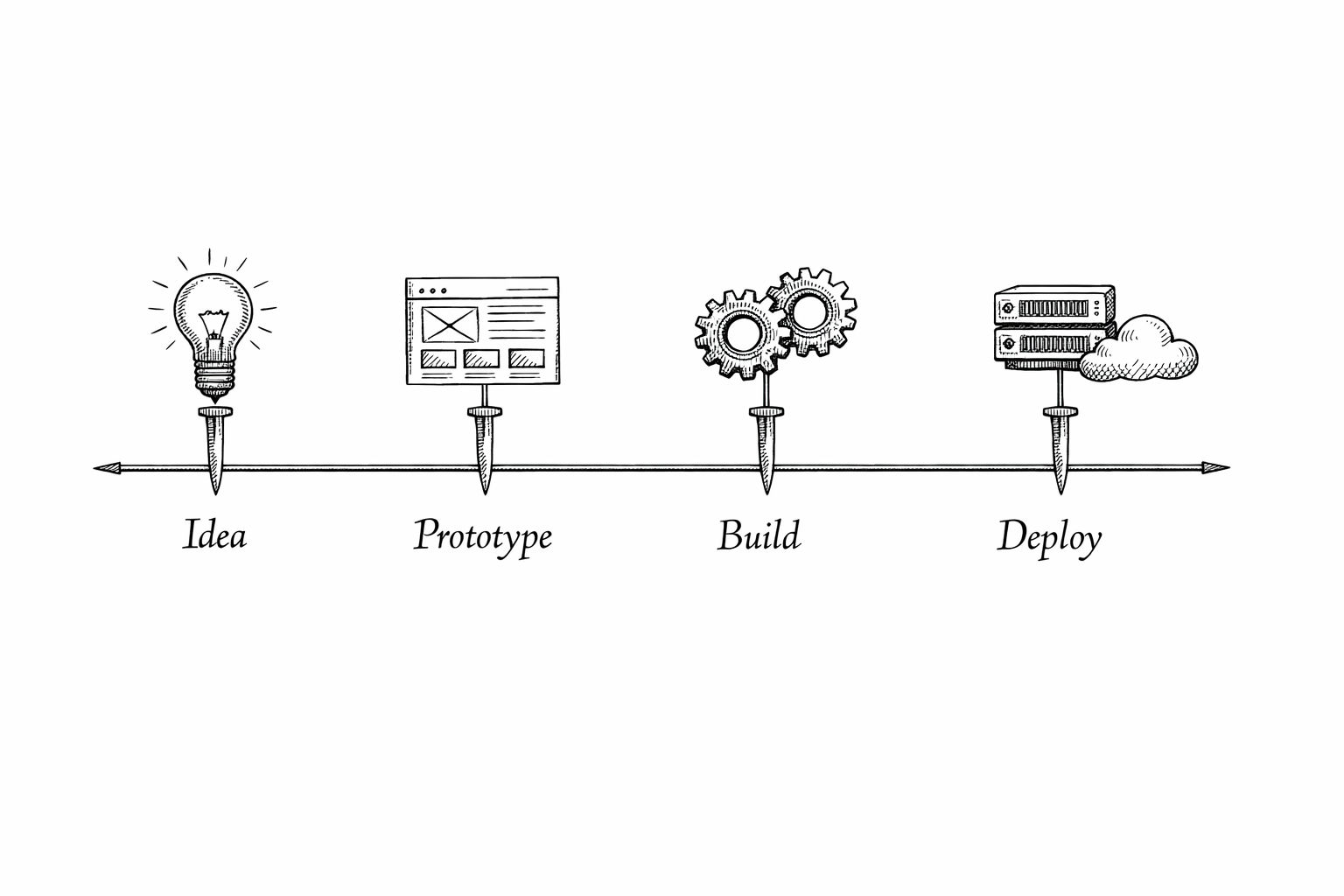
The 72-hour arc: from idea to live product in four phases
The 72-Hour Playbook: Hour by Hour
Here’s the sequence that works, distilled from the case studies above and benchmarks from dozens of vibe coding tools.
72 Hours: Idea to Deployed App
Phase 1
Hours 0–4: Architect, Don't Code
Use Claude or ChatGPT to validate the idea, define the problem tightly, and generate a full product spec: data model, API routes, user flows, and feature priority list. This is the step most people skip — and the one every successful 72-hour builder credits.
Phase 2
Hours 4–8: Scaffold and Ship the Shell
Pick your stack. For speed: Bolt.new or Lovable (~28–35 min to prototype). For control: Cursor or Claude Code (~75–90 min). Get auth, database, and a basic UI running. Deploy immediately to Vercel, Railway, or Netlify — even if it's ugly. Having a live URL from hour 8 changes your psychology.
Phase 3
Hours 8–24: Build Core Features in Dependency Order
Follow the AI-prompt sequencing method: feed your AI tool self-contained feature prompts ordered by dependency. Auth first, then data models, then features that depend on those models. Test each module before moving on. This is where 80% of the product gets built.
Phase 4
Hours 24–48: Payments, Polish, and Edge Cases
Integrate Stripe (or RevenueCat for mobile). Add error handling, loading states, and mobile responsiveness. Fix the 20% of bugs that AI introduced. This phase always takes longer than you expect — budget for it.
Phase 5
Hours 48–72: Launch Infrastructure
Custom domain, DNS, SSL. SEO basics: sitemap.xml, meta tags, Google Search Console. A landing page or blog post explaining what you built. Submit to directories and post on communities (Reddit, X, Hacker News). This non-code work is 40–60% of the effort.
Choosing Your Vibe Coding Tools
The right tool depends on whether you want speed or control. Here’s how the current landscape breaks down.
AI App Builder Comparison
Tool
Best For
Time to Prototype
Price
Code Quality
Bolt.new
Fastest full-stack prototype
~28 min
$20/mo
⭐⭐⭐
Lovable
Non-technical founders
~35 min
$25/mo
⭐⭐⭐⭐
Cursor
Developers wanting control
~75 min
$20/mo
⭐⭐⭐⭐
Claude Code
Complex architecture
~90 min
Usage-based
⭐⭐⭐⭐⭐
Replit Agent
Sequenced builds
Varies
$25/mo
⭐⭐⭐⭐
Windsurf
Full-stack with frameworks
~60 min
$15/mo
⭐⭐⭐⭐
A common pattern from successful builders: use a conversational AI (Claude, ChatGPT) for planning and architecture, then a coding-specific tool (Cursor, Bolt, Replit Agent) for implementation. The cigar app founder used Claude for strategy and Replit Agent for building. The CoachWriter founder used Claude.ai for planning and Claude Code for execution.
You don’t have to pick one tool. The best results come from using the right tool for each phase.
The Honest Part: Where This Breaks Down
I’d be lying if I said this was all upside. The data on AI-generated code quality is sobering.
A study found that developers using AI tools were actually 19% slower on complex tasks — despite predicting they’d be 24% faster. That’s a 39-percentage-point gap between perception and reality.
Only 3% of developers report high trust in AI-generated code. 71% refuse to merge AI code without human review. And 63% say they spend more time debugging AI-generated code than writing it from scratch.
On security: nearly half of AI-generated code contained vulnerabilities in testing, with failure rates above 70% for Java and 38–45% for Python and C#.
The economic math gets tricky too. AI-assisted development’s first-year cost can actually be 12% higher than traditional development when you account for code review overhead, 1.7x testing burden, and double the code rewrite rate. By year two, without active tech debt management, maintenance costs can hit 4x those of traditional development.
Building an App with AI: Real Tradeoffs
72-Hour AI Build
80–90% cheaper than traditional MVP ($12–$2,800 vs. $20K–$150K)
Ship and validate in days instead of months
Solo founders can build what used to require a team
41% of all code is now AI-generated — the tooling is mature
Free tiers make it possible to launch at €0 infrastructure cost
72-Hour AI Build
63% of devs spend more time debugging AI code than writing it
Only 3% of developers highly trust AI-generated code
Nearly 50% of AI code contains security vulnerabilities
Year 2 maintenance costs can hit 4x traditional if tech debt isn't managed
Complex business logic, concurrency, and compliance still need human expertise
The 72-hour build is an MVP, not a finished product
What you ship in 72 hours is a functional prototype that validates demand. Treat it that way. If users show up and pay, then invest in code review, security audits, and architecture refactoring. Don't polish before you have proof. And don't pretend AI-generated code is production-hardened without human review.
How to Build a SaaS with AI (Without Drowning in Tech Debt)
The founders who pull this off don’t just “vibe code” their way through. They follow three principles:
1. Architect before you prompt. Every successful rapid builder spent 20–30% of their total time on planning before writing a single line of code. The cigar app founder spent “several hours” with Claude on architecture before touching Replit. This isn’t wasted time — it’s the reason the remaining hours are productive.
2. Build in dependency order. The AI-prompt sequencing method works because each module assumes the previous ones are done. Auth → data models → features → payments → polish. Skip this order and you’ll spend more time debugging integration issues than building features.
3. Ship, then fix. Get a live URL as early as possible. The CoachWriter founder had his site indexed on Google within 24 hours. Tom Blomfield deployed to Heroku continuously during development. A live URL forces you to confront real problems instead of imaginary ones.
Here’s what the “I built an app in 48 hours” posts don’t emphasize enough: building the product is maybe 40% of the work.
The CoachWriter founder listed everything else he did in those 72 hours: domain purchase, DNS configuration, CORS debugging, duplicate meta tag fixing, sitemap submission, Google Search Console setup, directory listings, blog posts, Reddit and Twitter promotion.
That distribution work — SEO, content, community posts — is what separates a deployed app from a deployed app with users. 90% of developers who save hours with AI spend an average of 2.5 hours per day on tasks AI could also handle, like writing blog posts and creating marketing content.
This is exactly the wall we hit at Vibeblogger — and why we built a tool that handles the entire blog operation, from keyword research to published post, without you babysitting it.
You Shipped the App. Now Make It Rank.
You can build an app with AI in 72 hours. But organic traffic takes consistent, high-quality blog content — the kind that ranks on Google and gets cited by AI search engines. Vibeblogger handles all of it: keyword research, writing, images, and publishing. So you can focus on your product, not your blog.