Here’s a hard truth about your SaaS content strategy: the AI isn’t the problem. Your inputs are.
Over 50% of newly published articles online are now AI-generated, according to a 2025 Graphite analysis of 65,000 URLs. That number was around 5% just five years ago. And most of it reads exactly the same — polished, competent, and completely forgettable.
You’ve seen the symptoms. Every paragraph opens with “In today’s competitive landscape.” Every section closes with “By leveraging these strategies.” Every piece sounds like it was written by the same mid-level marketing manager at a company that sells nothing in particular.
But here’s what most founders get wrong: they blame the tool. They switch from one AI writer to another, hunting for the magic model that “gets” their voice. It doesn’t exist. The reason your AI content sounds generic is because you’re giving it generic instructions.
The fix is a system, not a better subscription. And it takes about an hour to set up.
Why AI Defaults to “Corporate Voice” (and How to Break the Pattern)
AI writing models are trained on the entire internet. That means they’ve absorbed millions of blog posts, press releases, marketing pages, and corporate reports. When you prompt one with “write a blog post about project management,” it does exactly what it was trained to do: produce the statistically most likely combination of words.
The result is consensus writing. The average of everything. The linguistic equivalent of beige.
The problem gets worse when founders use adjective-based prompts. “Write in a friendly, professional tone.” “Be conversational but authoritative.” These words mean nothing to an AI model. When you say “friendly,” it reaches for the most common version of friendly in its training data — exclamation marks, “Great question!” openers, and the word “absolutely.”
That’s not your version of friendly. That’s everyone’s version of friendly.
Research backs this up. According to content strategists who’ve tested this systematically, prompts with specific rules — banned words, sentence length targets, formatting requirements — produce 40-60% less editing than adjective-based prompts. Add concrete writing examples on top of those rules and the editing drops even further.
The Prompt That Produces Slop (vs. the One That Doesn't)
Generic prompt: "Write a blog post about onboarding for SaaS products. Be friendly and professional."
Voice-aware prompt: "Write a blog post about SaaS onboarding. Use short paragraphs (2-3 sentences max). Address the reader as 'you.' No phrases like 'it's worth noting' or 'in today's landscape.' Write like a founder explaining something to another founder over coffee. Start with a specific claim, not a generic intro. Here's an example of the voice I want: [paste 150 words of your best writing]."
The second prompt gives the AI constraints it can follow mechanically. Adjectives are interpretive. Rules are actionable.
Build a Brand Voice Brief That Any AI Can Follow
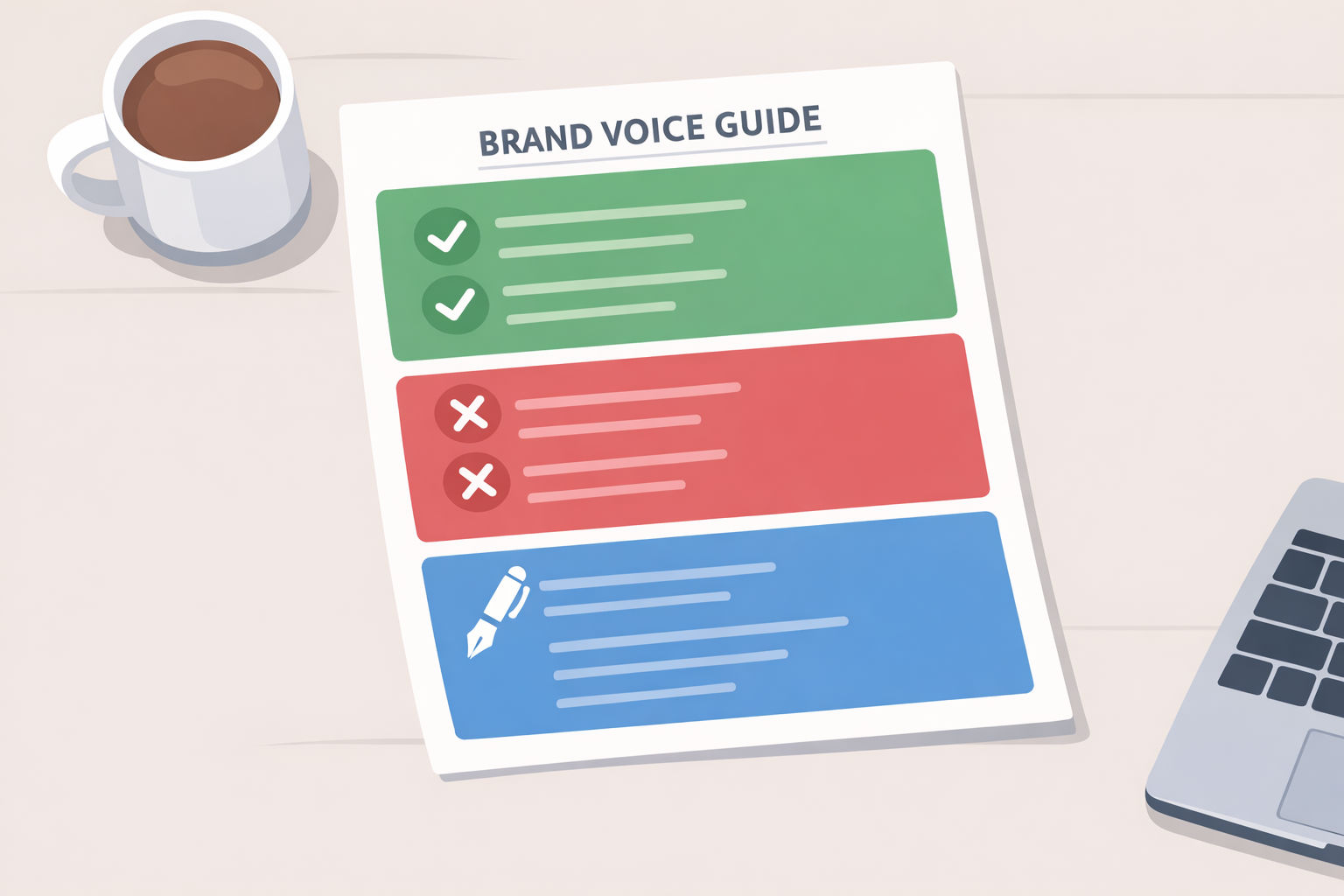
The single most effective thing you can do for your SaaS content strategy is spend 45 minutes writing a brand voice brief. Not a fluffy brand book with mission statements and values pyramids. A working document with concrete rules the AI can execute.
Think of it as an API spec for your voice. You wouldn’t give a developer a vague description and expect working code. Don’t do it to your AI writer either.
Here’s the template we use. Steal it.
Your brand voice brief is an API spec for your writing. Make it concrete enough for a machine to follow.
The Brand Voice Brief Template — fill this out once, use it in every AI prompt
| Section | What to Include | Example |
|---|
| **Words We Use** | Your signature vocabulary — 10-20 words/phrases that feel like you | "ship," "build," "honest take," "the real number is," "here's the thing" |
| **Words We Never Say** | AI defaults and corporate jargon you want banned | "delve," "leverage," "utilize," "robust," "seamless," "navigate," "in today's landscape" |
| **Sentence Structure** | Average word count, paragraph length, use of fragments | "12-15 words average. 2-3 sentences per paragraph. Fragments OK. Contractions always." |
| **Tone Dimensions** | Rate on a 1-5 scale: Funny↔Serious, Formal↔Casual, Respectful↔Irreverent, Enthusiastic↔Matter-of-fact | "Funny: 3, Formal: 1, Respectful: 3, Enthusiastic: 2" — this gives AI a specific target, not a vibe |
| **On-Brand Example** | 150-200 words of your best writing, pasted verbatim | Pull from a blog post, newsletter, or even a tweet thread where you sounded most like yourself |
| **Off-Brand Example** | 100 words of the generic content you hate | Paste a bland AI-generated paragraph about your topic — this teaches the AI what to avoid |
The key insight: AI follows explicit vocabulary rules with roughly 90-95% compliance when you give it concrete word lists. Give it vague instructions like “avoid corporate jargon” and compliance drops to 50-60%. The specificity of your brief is directly proportional to how much the output sounds like you.
Once you’ve written this brief, paste it at the top of every AI prompt. If you’re using agentic AI for content marketing, bake it into your system prompt so it’s always there.
Train AI on Your Existing Writing (3-5 Examples Is Enough)
You don’t need 50 blog posts to teach AI your voice. You need 3-5 good ones.
A University of Michigan study tested this with 50 award-winning authors — including Nobel laureates and Pulitzer Prize winners. When they fine-tuned AI models on an author’s complete works, expert writers preferred the AI output over standard prompting by a massive margin (odds ratio of 8.16 for stylistic fidelity). Even more striking: fine-tuned outputs had a 3% AI detection rate, compared to 97% for standard prompting.
You’re probably not fine-tuning a model. But the principle scales down. Pasting 3-5 strong writing samples into your prompt gives AI concrete patterns to work from — not abstract adjectives.
Here’s how to pick the right examples:
- Choose pieces where you sounded most like yourself. Not your most polished work — your most you work. That newsletter where you ranted about a problem. That blog post you wrote in one sitting because you were fired up.
- Include variety. One intro paragraph, one explanatory section, one opinionated take. This teaches the AI your range, not just one mode.
- Keep each example to 150-200 words. Long enough to capture voice patterns, short enough that it doesn’t flood the context window.
Before and After: What Voice-Aware AI Content Actually Looks Like
Let’s make this concrete. Here’s the same SaaS onboarding topic, written two ways.
Generic AI Output vs. Founder Voice Rewrite
| Generic AI Output (Default Prompt) | Founder Voice (With Brand Brief) |
|---|
| Effective onboarding is crucial for SaaS businesses looking to reduce churn and improve customer retention. By implementing a comprehensive onboarding strategy, companies can ensure that new users quickly realize the value of their product. It's worth noting that organizations with strong onboarding processes see up to 50% greater new-hire productivity. | Most SaaS churn happens in the first 14 days. Not because the product is bad — because the onboarding is. You get one shot to show a new user why they should care. Miss it, and they're gone before your drip sequence even kicks in. We learned this the hard way. Our activation rate was 23% until we killed our 5-step tour and replaced it with a single "do the thing" moment. |
Same topic. Completely different feel. The second version has specifics (14 days, 23%, 5-step tour), a point of view (“kill the tour”), and it sounds like a person who’s actually lived through this. That’s what a brand voice brief and real examples produce.
The generic version could be about any company, written by anyone. The founder version could only come from someone who built the thing.
The “Edit Like a Founder” Checklist
Even with a good brand voice brief, AI drafts need a human pass. Not a full rewrite — a focused 10-minute scan. Here are the five things to look for every time.
5 Things to Fix in Every AI Draft
Step 1
Kill the throat-clearing intro
AI almost always opens with a generic setup paragraph. "In today's competitive market..." or "When it comes to X, many businesses..." Delete it. Start with a specific claim, a number, or a story. Your real intro is usually hiding in paragraph two or three.
Step 2
Search-and-destroy banned phrases
Do a Ctrl+F for your banned word list. Common AI crutches: "it's worth noting," "furthermore," "robust," "seamless," "navigate," "landscape," and anything with "leverage." Replace each with something a real person would say. Or just delete the sentence — it's usually filler.
Step 3
Add one real story or specific number per section
AI writes in generalities. Founders have receipts. For every major section, add at least one concrete detail from your own experience: a metric, a failure, a tool you actually used, a timeline. This is what readers remember and what AI literally cannot invent.
Step 4
Check for hedge-stacking
AI hedges everything. "It can potentially help you possibly improve..." Pick a position. If you believe something, say it directly. "This works" beats "this can potentially be beneficial" every time. Your audience is founders — they respect conviction.
Step 5
Read the first sentence of every paragraph out loud
If they all sound the same length and rhythm, the piece has a cadence problem. Real human writing varies — short punchy sentences followed by longer explanatory ones. If every paragraph opener is 15-20 words, break the pattern. Throw in a three-word sentence. Or a fragment.
The 86% Rule
86% of consumers say authenticity is a key factor when deciding which brands to support. Your founder voice isn't a nice-to-have — it's a trust signal that directly affects whether someone buys your product. When every SaaS blog sounds identical, the one with a real human behind it wins.
Voice Consistency at Scale Is the Competitive Moat
Here’s where this all connects to your broader SaaS content strategy.
77% of consumers are more likely to buy from founders who have a strong personal presence, according to research cited by Noren. And consistent branding across channels increases revenue by up to 23%, per Forbes data.
The math is straightforward. If you’re publishing 2-3 blog posts per week (and you should be if SEO is part of your growth strategy), voice consistency is the difference between building an audience that trusts you and adding to the noise.
Most founders treat AI content as a volume play. Crank out posts, target keywords, hope Google notices. But Google’s search results are already 86% human-written content in the top positions. The generic AI stuff isn’t ranking.
What does rank — and what does build an audience — is content that sounds like it came from someone who knows what they’re talking about. Someone with opinions. Someone who’s built things. Understanding what Google’s Helpful Content Update actually targets makes this crystal clear — it’s not AI content that’s penalized, it’s lazy content.
That’s you. The AI is just the amplifier.
The Bottom Line
You don’t need to choose between speed and voice. You need a system:
- Write your brand voice brief once (45 minutes). Include word lists, tone dimensions, and real examples.
- Feed it into every prompt. Or better yet, build it into your automation pipeline so it’s always there.
- Run every AI draft through the 5-point editing checklist (10 minutes per post).
- Update your brief quarterly as your voice evolves.
The founders who nail this will own their niche in search. Everyone else will keep publishing content that sounds like it was written by the same robot — because it was.
The AI writing that sounds human isn’t coming from a better model. It’s coming from founders who took an hour to tell the AI who they are. That’s the SaaS content strategy nobody’s talking about, and it’s the one that actually works.
If you want the data on which specific keywords are worth targeting with that content, our guide to keyword research for startups covers the exact frameworks for finding terms you can actually rank for.
If you’re building in public, your voice is already your biggest asset. Don’t let AI flatten it.
Stop Publishing Content That Sounds Like Everyone Else's
Vibeblogger bakes your brand voice brief directly into every post it writes — from research to publish, on autopilot. It's the AI content team that actually sounds like you.
See How It Works