SaaS organic discovery traffic dropped 53% in the second half of 2025. Not a slow decline. A cliff.
That stat comes from ALM Corp’s analysis of 774,331 LLM sessions — ChatGPT referrals alone fell 56%, and Perplexity dropped 50%. If you’ve been watching your Google Analytics and thinking “something feels off,” now you know why.
The culprit isn’t that your SEO got worse. It’s that the search game changed underneath you. AI answers are eating your clicks. Google AI Overviews now appear in over 13% of queries and cut organic CTR by 47%. Zero-click searches hit 60% overall — 77% on mobile. Your content might still rank on page one. But nobody’s clicking through because ChatGPT, Perplexity, and Google’s own AI already gave them the answer.
This is where generative engine optimization comes in — and why every founder shipping a SaaS product needs to understand the difference between ranking on Google and getting cited by AI.
This isn't "SEO is dead" doomerism
75% of search volume still flows through traditional results. You need both. GEO is a new layer on top of your existing SEO — not a replacement. Think of it as expanding your surface area from one channel to five.
Here’s the math that should worry you.\n\nGartner predicts a 50% decline in traditional organic traffic by 2028. ChatGPT has 800 million weekly active users. 62% of users now start their search journey with AI tools instead of Google. And AI-referred sessions jumped 527% in 2025 alone.\n\nThe old playbook was simple: rank in the top 10, get clicks, convert visitors. But AI search engines don’t show ten blue links. They show one synthesized answer and cite 3-5 sources. If you’re not one of those cited sources, you get zero traffic from that query — regardless of your Google ranking.\n\nThis is the "zero-click" reality. A user asks ChatGPT "best project management tools for small teams" and gets a complete answer with recommendations, pros, cons, and pricing. They never visit your beautifully optimized comparison page.\n\nMost founders are still optimizing for 2022 search. Keyword density, backlink profiles, meta descriptions. That stuff still matters for Google — but it does almost nothing for AI citation. The Princeton/Georgia Tech GEO study actually found that keyword stuffing decreases AI visibility by 8.7%. If you want to know <a href="/blog/how-to-rank-on-google-what-actually-matters-2026">what actually drives Google rankings in 2026 before layering GEO on top, we’ve broken down the five factors that account for 75% of the algorithm. If you’re still figuring out the fundamentals, our guide to <a href="/blog/keyword-research-for-startups-how-to-find-terms-you-can-actually-rank-for">keyword research for startups covers the exact frameworks for finding terms worth targeting in the first place.
What Is Generative Engine Optimization (GEO)?
Generative engine optimization is the practice of structuring your content so AI language models choose to cite it when answering user queries.
The key word is cite. In traditional SEO, you compete for a spot on a list of links. In GEO, your content gets pulled into the answer itself — either quoted directly, used as a source, or referenced as the basis for the AI’s response.
As Andreessen Horowitz put it in their 2025 analysis: “It’s no longer just about click-through rates — it’s about reference rates: how often your brand or content is cited in model-generated answers.”
SEO and GEO aren’t enemies. They’re complementary. If you’re already doing solid topical authority work, you have a head start — 71.7% of ChatGPT citations come from pages that already have organic presence. But the optimization tactics diverge significantly.
Traditional SEO vs Generative Engine Optimization
| Dimension | Traditional SEO | GEO (Generative Engine Optimization) |
|---|
| Goal | Rank high in SERPs, drive clicks | Get cited inside AI-generated answers |
| Target platforms | Google, Bing | ChatGPT, Perplexity, Google AI Overviews, Claude, Gemini |
| Success metric | Rankings, CTR, organic traffic | Citation rate, share of voice in AI answers |
| Content format | Keyword-optimized long-form pages | Structured, quotable, data-dense content with clear answers |
| Key signals | Backlinks, keyword relevance, page speed | Expert quotes, statistics with sources, schema markup, freshness |
| What hurts you | Thin content, slow pages, bad UX | Keyword stuffing (-8.7%), outdated content, blocking AI crawlers |
| Result format | 10 blue links per page | One synthesized answer citing 3-5 sources |
| Traffic model | User clicks through to your site | User may never visit — but your brand gets recommended |
How AI Models Decide What to Cite
AI models don’t work like Google’s algorithm. They don’t care about your backlink profile or your domain authority score (at least not directly). Instead, they evaluate content based on whether it’s trustworthy, extractable, and verifiable.
The Princeton/Georgia Tech GEO study (arXiv:2311.09735) tested nine content optimization methods on AI visibility. The results were clear:
Princeton/Georgia Tech GEO Study — Impact of Content Optimization Methods on AI Visibility
| Optimization Method | Visibility Impact | Takeaway |
|---|
| Quotation addition | +42.8% | Expert quotes give AI models attributable, verifiable claims |
| Statistics addition | +33.2% | Named source + year + data point = citation magnet |
| Source citations | +27.8% | Inline references signal you're a node in a knowledge graph |
| Fluency optimization | +29.0% | Clear, readable prose beats jargon-heavy writing |
| Technical terms | +18.5% | Domain-specific vocabulary signals real expertise |
| Keyword stuffing | -8.7% | The only method that HURTS AI visibility |
Three factors dominate: quotes, stats, and source citations. Combined, they represent over 100 percentage points of potential visibility improvement.
Each AI platform also weights different signals. Perplexity heavily favors recency — 76.4% of its most-cited pages were updated within 30 days. ChatGPT leans on domain authority and Wikipedia-style references. Google AI Overviews prioritize E-E-A-T signals. You’re not optimizing for one algorithm. You’re optimizing for several.
And here’s a kicker from Otterly.AI’s analysis of 1 million+ citations: 73% of websites have technical barriers that block AI crawlers entirely. Before you optimize your content, make sure bots can actually read it.
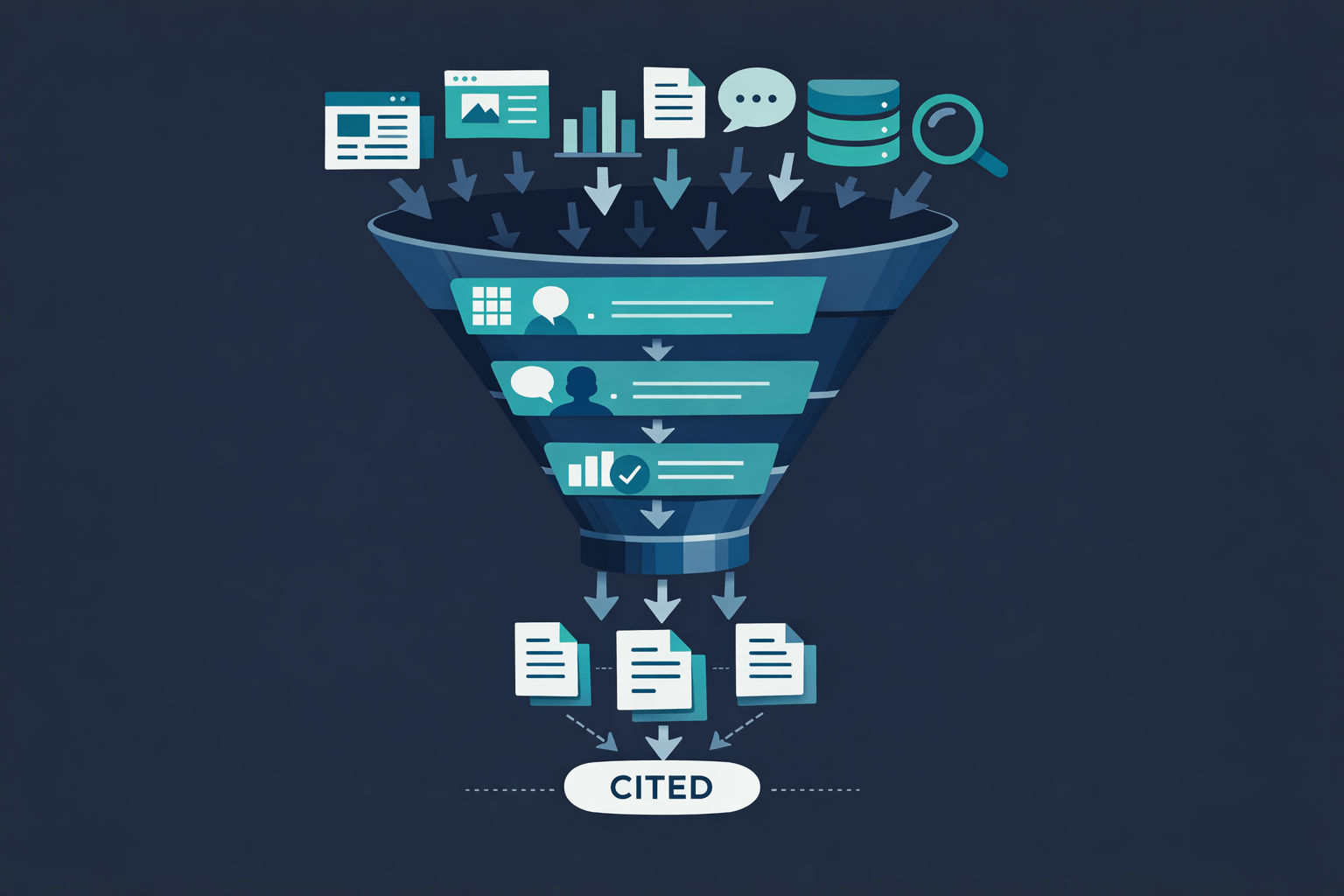
AI models don't rank content — they filter it. Only sources that pass multiple trust signals get cited.
5 GEO Tactics That Get Your Content Cited by AI
Forget vague advice. Here are five specific things you can do to your existing content — this week — to increase your AI citation rate.
1. Write “Answer Capsules” After Every H2
AI models extract concise, self-contained answers. Give them exactly what they want: a 40-60 word direct answer paragraph immediately after each section heading.
Example: Instead of burying your key point in paragraph four of a section, lead with it:
H2: How much does customer acquisition cost for SaaS startups?
The median customer acquisition cost (CAC) for B2B SaaS startups is $205, according to a 2025 FirstPageSage study of 300+ companies. CAC varies by channel — paid search averages $341, while organic content marketing averages $87. Companies spending under $10K/month on marketing see 40% higher CAC than those spending $10-50K.
That paragraph is perfectly extractable. An AI can cite it directly without needing to parse three paragraphs of context.
2. Add Expert Quotes and Statistics With Full Attribution
The Princeton study found that adding quotations improved AI visibility by 42.8% — the single highest-impact tactic tested. Statistics with sources added 33.2%.
But attribution matters. Don’t write “studies show that…” Write: “According to SparkToro’s 2024 analysis, 58.5% of Google searches now end without a click.” Name the source. Include the year. Include sample size if you have it.
AI models can cross-reference attributed claims against their training data. Unattributed claims get treated as opinions.
3. Implement FAQ Schema (FAQPage JSON-LD)
Pages with FAQPage schema markup are 3.2x more likely to appear in Google AI Overviews than pages without it. Schema markup overall increases AI citation probability by 30-36%.
FAQ schema works because it mirrors the exact format AI systems use internally: question-answer pairs. You’re literally pre-formatting your content in the structure AI models prefer to extract.
Add 3-5 FAQ questions at the bottom of every blog post with concise, factual answers. It takes 20 minutes and the compound effect on citation rates is real. If you’re using a content automation workflow, you can generate and inject FAQ schema automatically.
4. Keep Content Fresh (Update Every 30-90 Days)
Perplexity weights recency heavily. 76.4% of its most-cited pages were updated within the last 30 days. Content updated within 3-6 months gets cited 3-4x more than older content.
You don’t need to rewrite every post monthly. Add a new stat. Update a date reference. Refresh an example. Add a new FAQ question. Then update your dateModified in your Article schema.
This is a massive edge for solo founders who are actually in the trenches. You have real-time product knowledge. Use it.
5. Unblock AI Crawlers in Your robots.txt
73% of sites block AI crawlers without realizing it. Check your robots.txt for these user agents and make sure they’re allowed:
OAI-SearchBot (ChatGPT Search)ChatGPT-User (ChatGPT browsing)PerplexityBotGoogle-Extended (Gemini/AI Overviews)ClaudeBot
This is the lowest-effort, highest-impact fix. It takes 5 minutes. If AI crawlers can’t access your content, nothing else in this article matters.
The anti-pattern: keyword stuffing
Keyword stuffing is the only method in the Princeton GEO study that made content less visible to AI (-8.7%). If your content strategy revolves around hitting a target keyword density, you're actively hurting your AI visibility. Write for clarity and depth, not repetition.
How to Track Your AI Citations
You can’t improve what you can’t measure. Traditional rank tracking tools don’t cover AI citations. Here’s what does.
Otterly.AI ($29/mo) — The best entry point for indie founders. Tracks your brand citations across ChatGPT, Perplexity, Google AI Overviews, and Claude. Clean dashboard, Brand Visibility Index, and GEO audits. Their analysis of 1M+ citations is the most comprehensive AI citation dataset published so far.
Profound ($99-499/mo) — Enterprise-grade but powerful. Monitors 10+ AI engines, processes 5 million citations daily, and has a “Conversation Explorer” for understanding citation patterns. Overkill for most solo founders, but worth knowing about as you scale.
CiteMetrix ($79/mo) — Offers a free “ModelScore” check to see how AI platforms describe your brand right now. Good for a quick baseline before investing in a paid tool.
Free methods: Check Google Search Console for AI Overview impressions. Use Bing Webmaster Tools’ AI Performance dashboard to see Copilot citations. And honestly — just ask ChatGPT and Perplexity questions about your product category and see if you show up. Low-tech but surprisingly informative.
The key metric to track is share of voice — what percentage of AI answers in your product category cite you vs. competitors. A single citation means little. Your relative citation frequency tells the real story.
Your GEO Action Plan for This Week
Step 1
Audit your robots.txt (5 minutes)
Check that OAI-SearchBot, ChatGPT-User, PerplexityBot, Google-Extended, and ClaudeBot are not blocked. This is the single highest-ROI fix — 73% of sites fail here.
Step 2
Ask AI about your product category (15 minutes)
Open ChatGPT, Perplexity, and Google. Ask questions your customers would ask. See who gets cited. Screenshot the results as your baseline.
Step 3
Pick your 3 highest-traffic blog posts (10 minutes)
Look at Google Search Console. Find the posts that already rank well. These are your best candidates for GEO optimization because they already have organic presence.
Step 4
Add answer capsules and expert quotes (60 minutes)
For each of those 3 posts, add a 40-60 word direct answer after every H2. Add at least 2 attributed statistics and 1 expert quote per post.
Step 5
Add FAQ schema to those 3 posts (30 minutes)
Write 3-5 FAQ questions with concise, factual answers per post. Add FAQPage JSON-LD markup. Use Google's Rich Results Test to validate.
Step 6
Set up basic tracking (15 minutes)
Sign up for Otterly.AI's free trial or CiteMetrix's free score check. Set a monthly reminder to re-check your AI visibility and update your top posts.
The Bigger Picture: GEO Is a Compounding Advantage
Here’s why this matters beyond just recovering lost traffic.
Every time an AI cites your content, it reinforces your authority in that model’s training and retrieval data. Citations compound. The more you’re cited, the more likely you are to be cited again. Early movers in GEO are building moats that will be hard to catch up to.
This is the same dynamic that played out with SEO in the early 2010s. The founders who understood Google’s algorithm early built organic traffic machines. The ones who waited paid 10x more to catch up.
You don’t need to choose between SEO and GEO. You need both. SEO gets you indexed and ranked. GEO gets you cited and recommended. Together, they cover the full surface area of how people discover software in 2026.
The good news? If you’re already publishing quality content that doesn’t read like AI slop, you’re 80% of the way there. GEO isn’t a rewrite — it’s a restructure. Same content, better packaging.
Start with your robots.txt. Update your top three posts. Add schema. Track your citations. That’s not a six-month roadmap — that’s a Tuesday afternoon.
Let Vibeblogger Handle Your GEO-Optimized Content
We build every blog post with AI citation in mind — answer capsules, structured data, attributed stats, and FAQ schema baked in. Because the best content strategy is the one that runs while you're building your product.
See How It Works