How to Get Press as an Indie Hacker (Without Paying for PR)
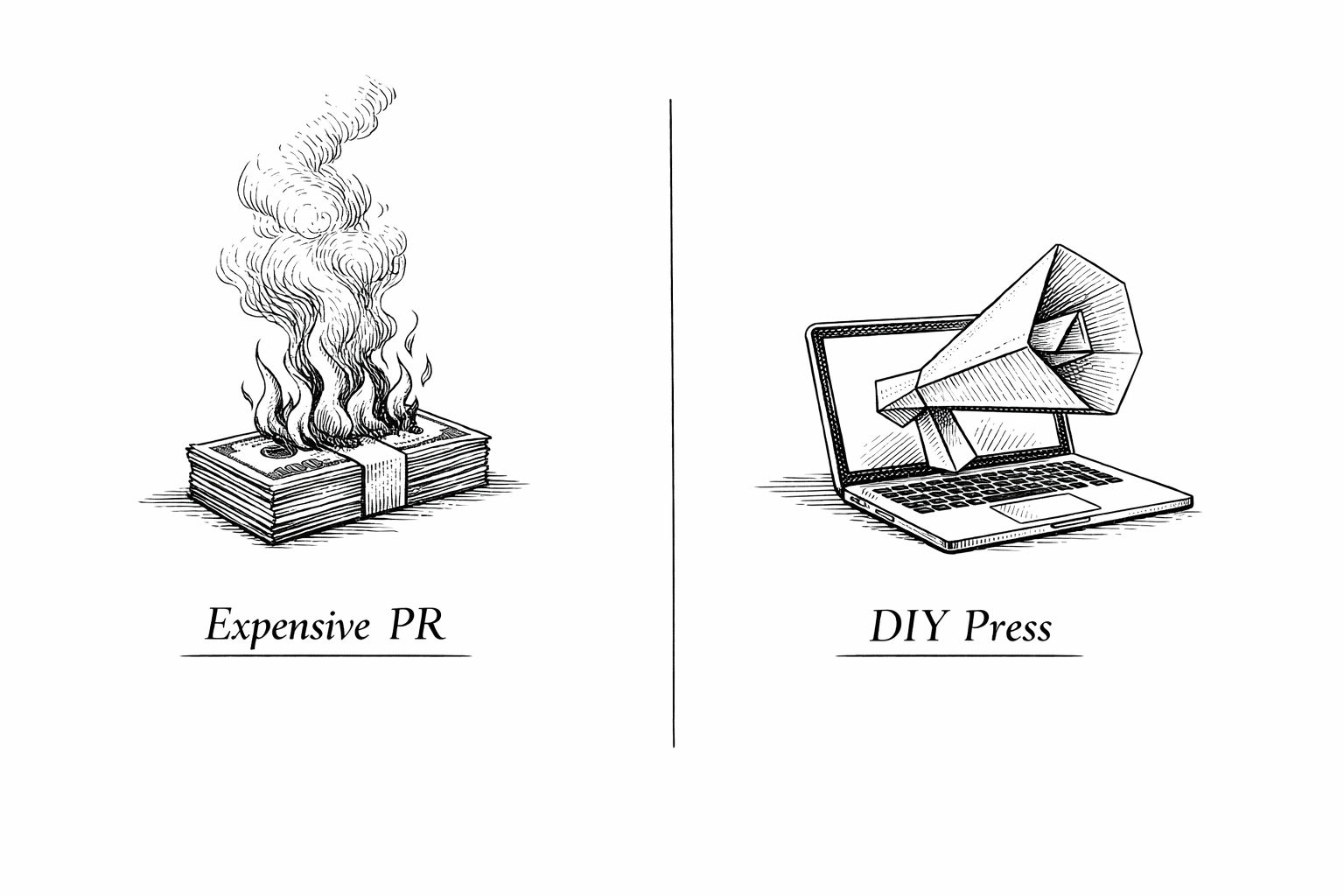
PR agencies charge $2K-$6K/month. Cold pitching journalists has a 3% response rate. Here's the data-backed playbook indie hackers actually use to land press coverage for free — with real case studies and specific tactics.
Rori Hinds··9 min read
A PR agency retainer for a startup runs $2,000 to $6,000 per month. That’s $24K to $72K a year — for a bootstrapped founder who’s probably paying themselves less than that.
Here’s the thing about indie hacker marketing that most PR guides won’t tell you: cold pitching journalists has an average response rate of 3.43%, according to an analysis of 400,000 pitches on the Propel platform. That means for every 100 emails you send, 96 go straight to the void.
But some indie hackers are landing Forbes, Washington Post, and CNBC coverage with literally zero PR budget. The difference isn’t luck. It’s strategy.
This post breaks down the exact tactics — with data — that work for founders who’d rather spend money on servers than publicists.
The cold pitch trap
73% of reporters reject pitches as irrelevant to their beat. Only 26% of journalists respond "always or usually" to cold pitches. Before you blast 200 emails, read the rest of this post. There are dramatically better approaches.
Why Most Indie Hackers Fail at Press (It’s Not What You Think)
The default playbook sounds reasonable: find journalists, send them a pitch about your product, hope for the best. But the numbers are brutal.
Journalists receive 100+ pitches daily. Cold emails convert to actual coverage at under 1%. And 65% of journalists want pitches under 200 words — yet most founders write 500-word product descriptions disguised as pitches (Muck Rack, 2024 State of Journalism).
The founders who actually get press aren’t doing mass outreach. They’re using a completely different system.
You don't need a budget. You need a system.
The 4-Tactic Framework for $0 Press
After researching dozens of indie hacker case studies and analyzing the data, four tactics consistently outperform everything else. In order of reliability:
Response rates based on Propel platform analysis (400K pitches), Indie Hackers community surveys, and Product Hunt 2025 data.
Tactic
Avg. Success Rate
Time Investment
Best For
Quote-response platforms (Qwoted, Terkel)
22-50% publication rate
30 min/day
Consistent backlinks + mentions
Build in public (X, LinkedIn)
19% achieve coverage
3-5 posts/week
Long-term founder personal brand
Strategic journalist pitches
7.5% (short, relevant pitches)
2-3 hrs/week
Tier 1 outlet features
Free tools + data as content
12% reach PH top 10 → secondary press
One-time build
Viral moments + link building
Tactic 1: Stop Pitching Journalists. Answer Their Questions Instead.
This is the single highest-ROI tactic in this entire post, and almost nobody talks about it.
Platforms like Qwoted and Terkel flip the script on traditional PR. Instead of you guessing what a journalist wants to write about, they tell you. Journalists post specific queries — “Looking for a SaaS founder to comment on bootstrapping challenges” — and you respond with a quote.
RatePunk, a bootstrapped travel-tech startup, used this exact approach to go from zero press to 19 articles in April 2023, 46 articles in May, and 36 in June — all in publications with a combined monthly traffic of billions of visits. Their total PR spend? €0.
Here’s what their founder Justin Albertynas reported:
Qwoted: Most consistent source of mentions. Respond to quote requests in your niche, and your quotes get placed in articles.
Terkel: 50% of submitted answers got published.
Cold emailing journalists: Only 5% of their PR effort, and it barely moved the needle.
The lesson? Don’t look for journalists. Look for quote opportunities.
HARO is dead. Here's what replaced it.
HARO (Help A Reporter Out) shut down in December 2024. The quote-response ecosystem has shifted to Qwoted, Terkel, Source of Sources, and Featured.com. If you were using HARO, now's the time to migrate — there's less competition on the newer platforms while everyone figures out the landscape.
Tactic 2: Build in Public as Indie Hacker Marketing
Here’s a stat that should change how you think about your founder personal brand: 19% of indie hackers using #BuildInPublic gained coverage in outlets like Morning Brew and BetaList without any PR spend, based on a study of 500 founders tracked via the Twitter API.
Building in public isn’t just a community tactic. It’s a PR strategy. And it feeds directly into your founder personal brand — which is your most durable distribution channel.
Plausible Analytics went from $400/month to $188,000/month in 3 years with zero paid advertising. Their entire growth engine was building in public — sharing what they were building, why they made specific decisions, and posting opinionated content about web analytics and privacy. Journalists found them.
As co-founder Marko Saric put it: the unusual thing about their growth is what they haven’t done — no paid ads, no affiliate program, no sales calls. Just transparent storytelling.
Chatbase scaled from 0 to $1M ARR in 117 days. The founder Yasser started with just 16 followers on X. By sharing his building journey publicly, he built an audience that turned into customers — and attracted press along the way.
The pattern is clear: journalists follow founders who share real numbers. Build in public and you become a source, not a cold pitcher.
The Build-in-Public Press Playbook
Step 1
Share real metrics weekly
Post your MRR, user count, or traffic numbers every week. Journalists love founders who share actual data. Plausible's public dashboard was directly cited in multiple articles.
Step 2
Document your decisions, not just your wins
Write about why you chose one tech stack over another, or why you pivoted. BuzzStream found that relationship-based pitching has a 20.1% reply rate vs. 1.06% for cold — being known as a transparent founder IS relationship building.
Step 3
Be opinionated about your industry
Jon Yongfook (Bannerbear, $600K ARR) credits 'spicy takes' on Twitter as a core growth driver. Opinionated content gets shared, and shared content gets noticed by journalists.
Step 4
Maintain a simple press page on your site
Include your story, a high-res headshot, key metrics, and a one-line pitch. When a journalist finds you through social media, make it dead simple for them to cover you.
Tactic 3: Strategic Pitches That Actually Get Responses
Sometimes you do need to pitch a journalist directly. When you do, the data shows exactly what works.
An analysis of 400,000 media pitches by Propel found that pitch length is the biggest predictor of response rate:
51-150 words: 7.51% response rate
150-300 words: ~4% response rate
300+ words: response rate craters
That’s not a small difference. Cutting your pitch in half can nearly double your response rate.
Other data-backed rules from the same study:
83% of journalists prefer personalized, 1-to-1 emails (not mass blasts)
87% prefer email over any other channel
Subject lines under 60 characters maximize open rates
Tuesday through Thursday, 8-9 AM in the journalist’s time zone gets the highest opens
One follow-up sent 3-7 days later is the sweet spot — 51% of journalists say one is ideal
WriteMapper’s founder Guan Xun Chew applied this approach systematically: he identified 24 journalists who had previously covered similar Mac apps, sent each a concise pitch, and landed Forbes and Cult of Mac coverage. That’s a focused, data-informed approach — not spray and pray.
Stop treating journalists like automated lead forms: personal relevance and timing are the only metrics that matter.
Tactic 4: Build Free Tools and Let the Press Come to You
This tactic takes more upfront effort but has the highest ceiling.
Adsby built a free AI keyword generator before launching their main product. That single tool ranked 22nd for “keyword generator” — one of the most competitive keywords in marketing — and generated 20,000 visitors in 4 months with zero marketing spend. The backlinks and newsletter mentions from that free tool created a flywheel of press coverage.
Bannerbear did something similar. Jon Yongfook built free tools and “vs. and alternatives” comparison pages that ranked in search, attracted links, and drew press coverage organically on his way to $600K ARR.
The playbook is simple:
Build a free, useful tool related to your product’s space
Launch it on Product Hunt (26.5% of launches get 500-1,000 users; 22.4% get 1,000-2,000)
Let the tool generate backlinks — press often follows backlink momentum
If you’re looking for more tactics on earning links without paying, we covered this in depth in our backlinks for startups playbook. The same principles apply: give away something genuinely useful and links follow.
The Compound Effect: Press → Backlinks → SEO → More Press
Here’s what makes this worth your time as a long-term indie hacker marketing strategy.
Companies that regularly get press are 3x more likely to be cited as industry experts in future articles, according to eReleases data. Press coverage creates backlinks, backlinks boost your domain authority, higher domain authority means your content ranks better, and better rankings bring more journalist attention.
It’s a flywheel. And once it starts spinning, it compounds.
Earned media delivers up to 5x more ROI than paid media, according to industry benchmarks. And unlike a Google Ads campaign that stops the moment you stop paying, a Forbes mention lives forever.
The real question isn’t whether you can afford to do PR as an indie hacker. It’s whether you can afford not to — when the best tactics cost nothing but time.
The 2-hour weekly press routine
Here's a realistic weekly time commitment that covers all four tactics:
Monday (30 min): Check Qwoted and Terkel for new journalist queries. Respond to 2-3 relevant ones.
Tuesday-Thursday (15 min/day): Post one build-in-public update on X or LinkedIn. Share a metric, a decision, or a lesson.
Friday (30 min): Research one journalist in your niche. Send one personalized pitch under 150 words.
Total: ~2 hours/week. That's less time than most founders spend debating their landing page button color.
What Not to Do
A quick list of things that sound smart but waste your time:
Mass cold emailing journalists: 3% response rate, and you burn relationships with reporters who might have covered you later
Paying for press release distribution: Unless you have actual news (funding, major launch), press releases from unknown startups get ignored
Hiring a PR firm before product-market fit: $2K-$6K/month is hard to justify when you don’t know if people want what you’re building. Validate your idea first.
Writing AI-generated pitches: 59% of PR pros rank AI as a top priority, but journalists can smell templated pitches. Keep it human, keep it short.
The 43% of Americans who now avoid news entirely means the media landscape is fragmenting. Niche outlets, newsletters, and podcasts are where your audience actually is. Don’t chase TechCrunch when a well-placed mention in a 10,000-subscriber industry newsletter might drive more signups.
The Bottom Line
Getting press as an indie hacker isn’t about competing with startups that have $10K/month PR retainers. It’s about playing a different game entirely.
Respond to journalist queries instead of cold pitching. Build your founder personal brand in public instead of hiding behind a logo. Send 5 perfect pitches instead of 500 generic ones. And let free tools and genuine content do the heavy lifting.
The data consistently shows that authenticity, relevance, and relationships beat budget every single time. A warm pitch gets 19x the response rate of a cold one. Build warmth through transparency, and the press follows.
Of course, press is just one piece of the puzzle. While you’re building relationships with journalists, you also need a steady stream of content keeping your site visible in search. That’s the compounding engine that turns a one-time press mention into long-term organic growth. If you want to understand how to measure that ROI, we’ve got you covered.
Want your SaaS to rank on Google while you focus on building?
Press gets you spikes. SEO gets you compounding traffic. Vibeblogger handles the entire blog operation — research, writing, images, publishing — so you can focus on your product while your content works 24/7.