Vibe Coding Mistakes That Kill Your Launch Before It Starts
Vibe coding gets you 70% of the way to a real product. These 5 mistakes in the last 30% are what kill launches — backed by hard data on what each one actually costs.
As of late 2025, 8,000+ vibe-coded startups need rebuild or rescue work, with cleanup costs running $50K–$500K per project (Vexlint, 2025). The total industry damage estimate sits between $400 million and $4 billion. These aren’t bad ideas. They’re bad executions of good ideas — apps that looked finished in the demo, then imploded on contact with real users.
The pattern is always the same. A founder uses Cursor, Lovable, or Bolt to build an app with AI. It works on their laptop. The demo goes great. Then they launch, and something breaks that they can’t explain — because nobody actually read the code that handles it.
The 70/30 Problem
Researchers at Columbia University’s DAPLab found that vibe coding gets you roughly 70% of the way to a production application. That first 70% is genuinely impressive — full-stack apps, authentication, databases, payments, all generated from a conversation.
The last 30% is where launches die.
That last 30% is security hardening, error handling, database optimization, testing, deployment infrastructure — all the unglamorous stuff that separates a demo from a product. AI skips it because you didn’t ask for it. And you didn’t ask for it because you didn’t know you needed to.
Here are the five mistakes that live in that gap. Every one of them is fixable — but only if you catch them before launch day.
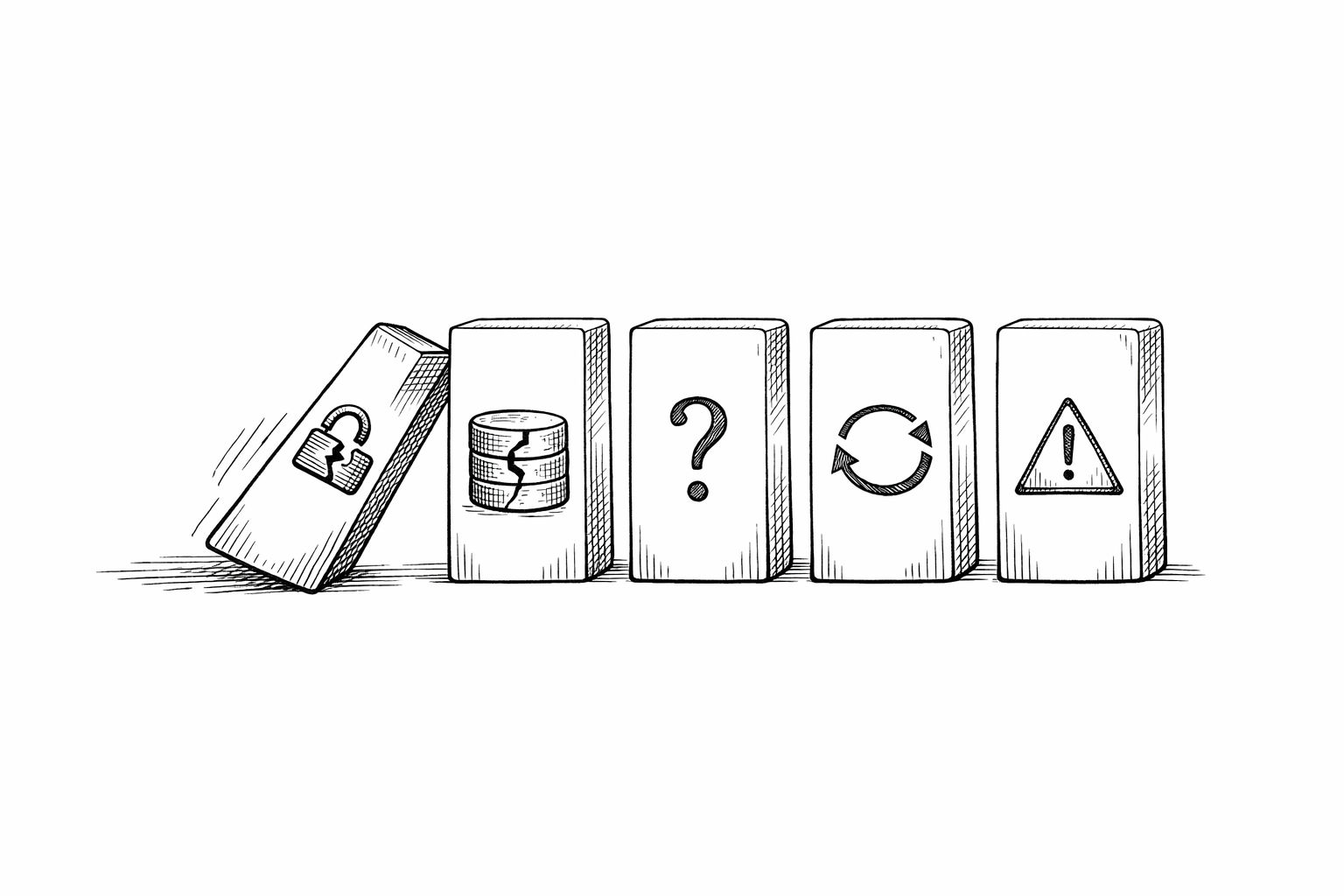
Five mistakes, one chain reaction. Each compounds the next.
Mistake 1: No Architecture Before You Prompt
This is the mistake upstream of every other mistake. You open Cursor, describe what you want, and start building feature by feature. Each prompt produces code that works in isolation. But nobody — not you, not the AI — is holding the floor plan.
LLMs are stateless. Every prompt is a fresh context window. The AI doesn’t remember that Tuesday’s database schema contradicts Thursday’s API endpoint. It builds one room at a time and assumes someone else is keeping track of the hallways.
The result is what one audit of five vibe-coded startups called “modular on the surface, deeply coupled underneath.” Clean file structures hiding spaghetti dependencies. One startup had the same login logic duplicated across seven files.
GitClear’s analysis of 211 million lines of code found that refactoring collapsed from 25% to under 10% when AI tools were used, while code duplication increased 4x. That’s not a code quality problem. It’s an architecture problem — there’s no blueprint telling the AI (or you) what already exists.
The Fix
Spend 30 minutes writing a one-page architecture doc before your first prompt. List your data models, API endpoints, and how components talk to each other. Feed this to the AI as context with every session. It's not glamorous, but it's the single highest-leverage thing you can do.
Mistake 2: Treating Security as a Post-Launch Problem
This one can end your startup overnight.
Veracode analyzed AI-generated code across 100+ LLMs and found that 45% of samples fail security benchmarks across OWASP Top-10 categories. Cross-site scripting had an 86% failure rate. Log injection: 88% failure rate. Java code specifically exceeded a 70% failure rate.
CodeRabbit’s research puts it even starker: AI-generated code contains 2.74x more security vulnerabilities than human-written code. The most common patterns? Hardcoded credentials, input validation failures, authentication bypasses, and SQL injection risks.
A Wiz study found 20% of vibe-coded apps have serious vulnerabilities or configuration errors. Security researchers scanning 5,600 vibe-coded applications discovered over 2,000 vulnerabilities and 400+ exposed secrets.
The specific failure mode is predictable: the AI builds the login form but not the security infrastructure around it. You get a working auth screen with no session expiration, no row-level security, and API keys sitting in client-side code.
The Fix
Before launch, run through this checklist: Are API keys in environment variables (not code)? Does your auth have real session management and token rotation? Is row-level security configured so User A can't access User B's data? Is input validation happening server-side? If you're handling payments or PII, this is the emergency — everything else waits.
Mistake 3: Zero Test Coverage
AI-generated code looks polished. Clean syntax, reasonable variable names, functions that run. This is exactly what makes it dangerous — it looks like it works, so you assume it does.
The data says otherwise. A study of ~800 developers found that after adopting GitHub Copilot, teams shipped 41% more bugs with no significant improvement in pull request cycle time. AI-generated code produces approximately 1.7x more issues than human-written code overall.
And here’s the kicker from a Cortex report: while pull requests per author increased 20% year-over-year with AI tools, incidents per pull request increased 23.5%. More code, more bugs, heavier review workloads.
Without tests, you have no automated way to verify that things that used to work still do. Every new prompt risks breaking something that was working yesterday. You enter what one practitioner calls the “fix this, break that” loop — the AI fixes one bug and introduces two more, because it has no memory of your system’s constraints.
In vibe coding you don't care about the code, just the behaviour of the system. In augmented coding you care about the code, its complexity, the tests, and their coverage.
The Fix
Ask the AI to write tests before writing features. Kent Beck's TDD approach works even better with AI — the models generate tests easily, and those tests become guardrails for every future prompt. Minimum viable testing: cover your auth flow, payment processing, and any data mutation endpoints.
Mistake 4: Building Before Validating
This isn’t unique to vibe coding, but vibe coding makes it 10x worse. When building takes weeks, you naturally validate first — you can’t afford not to. When building takes hours, you skip validation because “I’ll just build it and see.”
One indie hacker documented this perfectly: he spent 30 days vibe coding a financial planning tool for founders, burned through $127 in Replit credits, got calculations wrong by 20%, and watched 23 interested founders become 2 signups. His takeaway: AI struggles with precision logic, and founders don’t want another spreadsheet — they want advice.
Another founder spent three months building a Reddit compliance tool, launched to $0 MRR, and realized too late they were optimizing for feeling productive, not for learning if people actually wanted the product.
The speed of vibe coding tools creates a dangerous illusion: shipping feels like progress. But shipping something nobody wants is just organized waste.
The Fix
Build a landing page first. Describe the problem, show a mockup, add a waitlist signup. Set a kill criterion before you start building — e.g., "fewer than 50 signups in 14 days means pivot." Vibe coding makes this even easier: you can have a landing page live in an hour. No excuses.
Mistake 5: Ignoring the Compound Interest of Technical Debt
Every shortcut compounds. AI-generated technical debt grows at an estimated 23% monthly — a $1,000 problem in January becomes a $30,000 crisis by July (byteiota, 2025).
Across the broader software industry, developers spend 41% of their time managing technical debt, costing a 50-person engineering team roughly $1.65 million per year. For a solo founder, you don’t have $1.65 million to burn. You have your weekends.
The specific way this kills launches: your AI-generated codebase feels fast at first. Then you try to add a real feature — Stripe integration, multi-tenancy, a proper admin panel — and it takes 5x longer than it should. You’re fighting the codebase instead of building on it. Time-to-market for new features slows by 50% in high-debt codebases.
57% of teams fail outright once they hit real complexity on AI coding platforms. Not struggle. Fail.
The Fix
Schedule one "debt day" per week — even just 2 hours — where you refactor instead of build. Add database indexes. Separate your environments. Set up basic error logging. This isn't exciting work. It's the work that determines whether your app survives month two.
The real cost of each vibe coding mistake — in dollars, time, and launches
Mistake
What It Costs
When It Hits
No architecture
4x code duplication, $50K–$500K rebuild
Month 2–3, when you add real features
Security gaps
45% of AI code fails security checks, avg breach cost $4.88M
The Pre-Launch Sanity Check\n\nYou don’t need to become a senior engineer overnight. You need to spend one focused day — seriously, one day — running through the basics before you flip the switch. Our deep dive on vibe coding to production covers exactly what breaks — and the checklist to fix it — if you want the full technical walkthrough.
Your Vibe Coding Pre-Launch Checklist
Step 1
Audit your secrets
Search your codebase for hardcoded API keys, database URLs, and credentials. Move everything to environment variables. This takes 30 minutes and prevents the most common catastrophic failure.
Step 2
Test your auth flow end-to-end
Can User A see User B's data? Do sessions expire? Is there token rotation? Log in, change the user ID in the URL, and see what happens. If you can see someone else's data, stop everything.
Step 3
Write 5 critical tests
Cover your auth, payment processing, and core data mutations. You don't need 100% coverage — you need coverage where bugs cost money. Ask the AI to generate these tests for you.
Step 4
Add basic error handling and logging
Right now when something breaks, you probably don't know what broke or why. Add error logging so your debugging sessions don't take 3x longer than they should.
Step 5
Validate with 10 real humans
Not your friends. Not your co-founder's mom. 10 people who have the actual problem your product solves. Watch them use it. If they won't pay for it today, launching won't change that.
The Bottom Line
Vibe coding is real and it’s powerful. 25% of YC’s Winter 2025 batch had codebases that were 95%+ AI-generated. 46% of all new code on GitHub is written by AI. This isn’t going away — it’s becoming the default way to build.
But the founders who actually ship — who make it past launch day with a product that works under real traffic — aren’t the ones who prompt the fastest. They’re the ones who catch these five mistakes before their users do.
The speed is the gift. Using it wisely is the skill.
You Fixed Your Code. Now Fix Your Content.
Your vibe-coded app deserves a blog that actually ranks on Google. Vibeblogger handles the entire content operation — keyword research, writing, images, publishing — so you can focus on building your product instead of writing blog posts.