The Best Vibe Coding Tools for Building SaaS in Public in 2026
A data-packed field guide to the vibe coding tools founders actually use to build SaaS in public — organized by workflow stage, with real pricing, real case studies, and the growth layer most builders forget.
Rori Hinds··9 min read
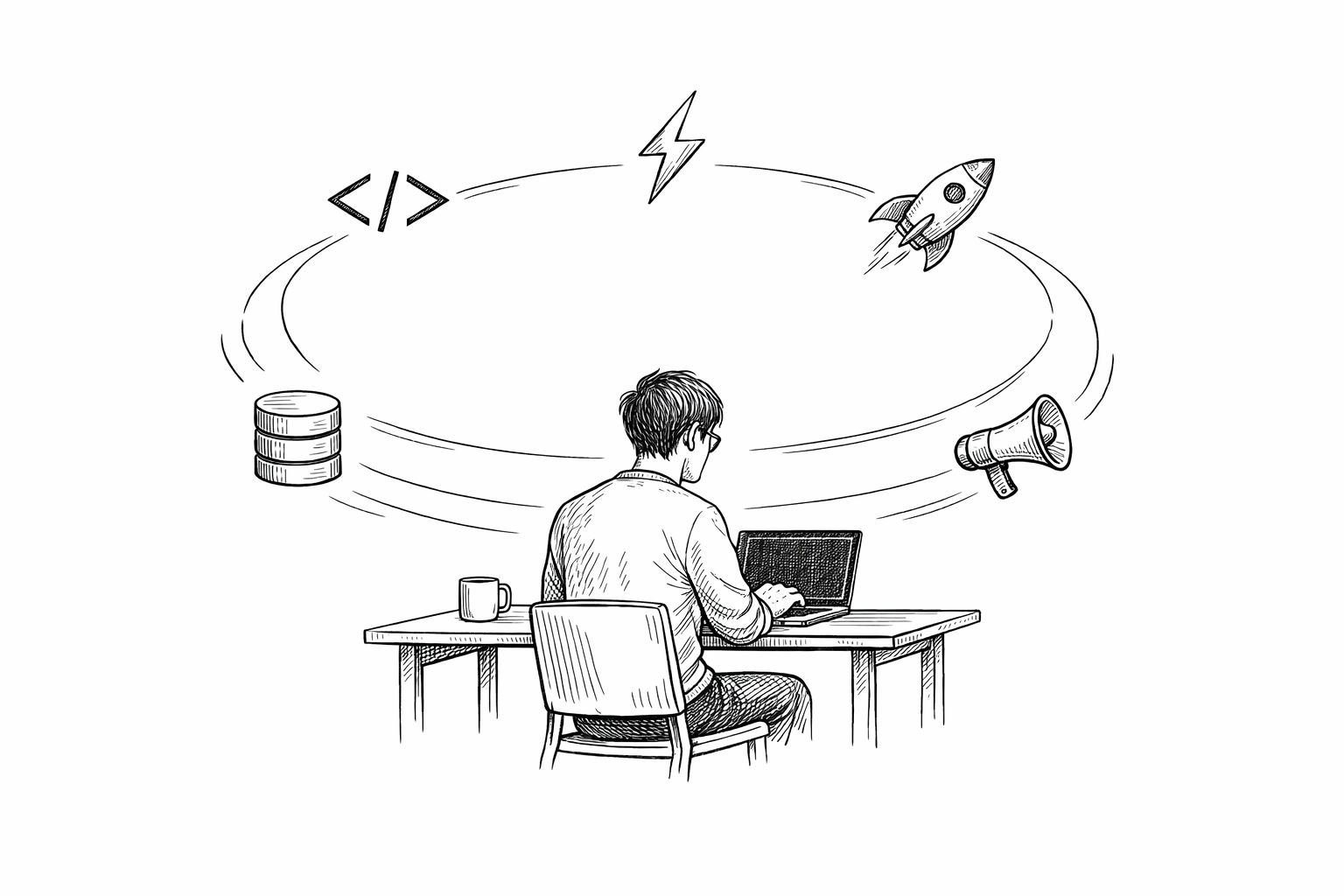
Shipping code isn’t the hard part anymore.
The vibe coding market hit $2.96 billion in 2025 and is growing at 36.79% CAGR. Cursor crossed $1 billion in ARR faster than any B2B company in history. A quarter of Y Combinator’s W25 batch has codebases that are 95%+ AI-generated. One founder built a full production platform with Claude Code in five weeks without writing a single line of code.
So here’s the real question for founders who build in public: if everyone has access to the same vibe coding tools, what actually separates the winners?
It’s not which AI coding tool you pick. It’s understanding the full stack — from validation to growth — and knowing which layer to use when. This is the field guide.
The 2026 vibe coding landscape in 3 numbers
92% of US developers use AI coding tools daily. 46% of GitHub Copilot users' code is AI-generated. Solo founders using AI tools grew 340% YoY — and the average MVP now takes 3.2 weeks instead of 4.5 months.
The Build-in-Public Stack: 4 Layers, Not 1 Tool
Most “best AI tools” lists dump 20 products on you and call it a day. That’s useless if you’re trying to actually ship a SaaS and grow it in public.
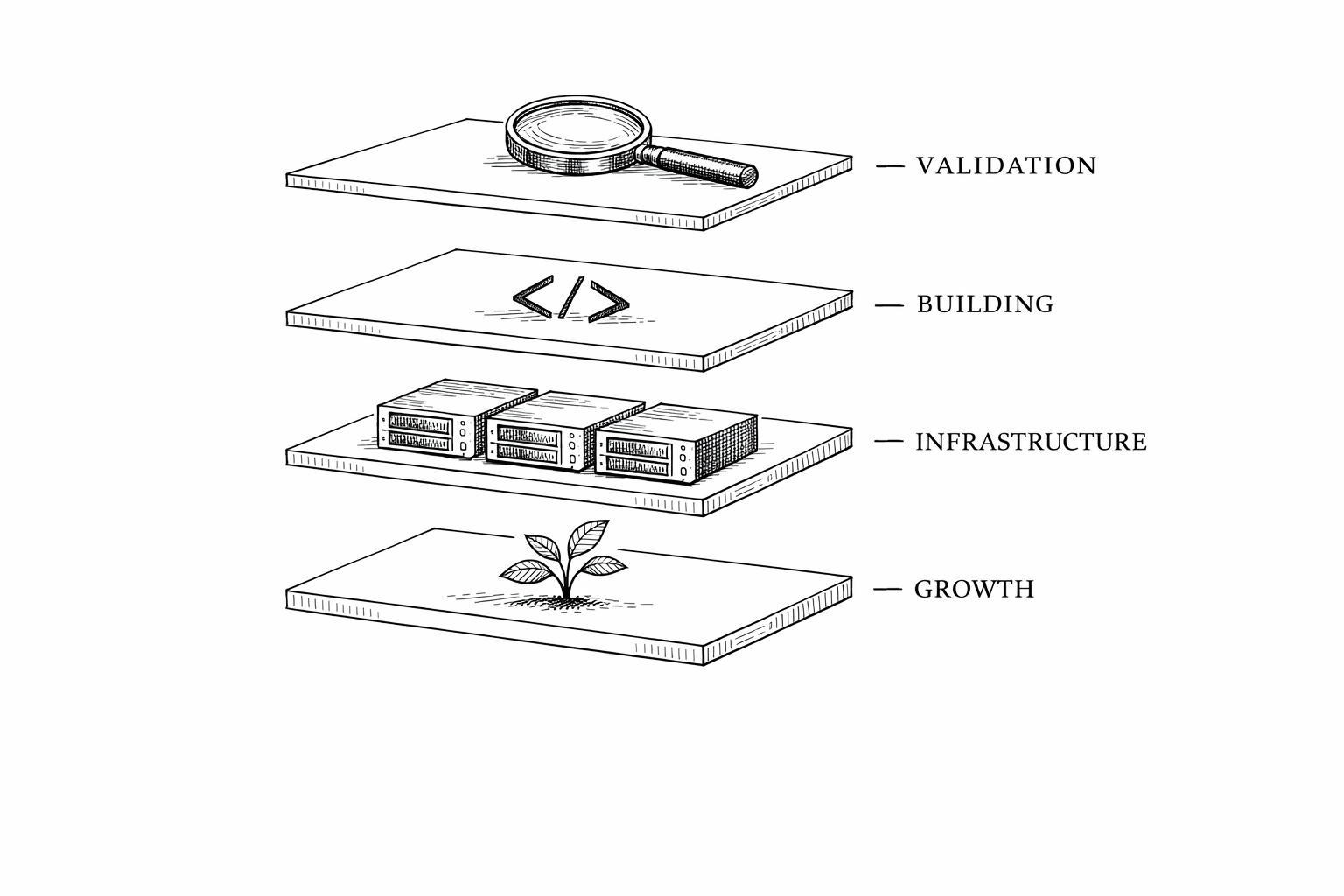
The founders doing this well in 2026 aren’t using a single tool. They’re running a layered stack, and each layer has a job:
Validation — Kill bad ideas fast before you write real code
Building — Write production-grade features with AI pair programming
Growth — Content, SEO, and distribution (the layer everyone skips)
The four layers of a modern build-in-public stack. Most founders nail layers 1-3 and completely ignore layer 4.
Layer 1: Validation Tools — Kill Bad Ideas in Hours\n\nBefore you spend a weekend building, spend two hours validating. The best AI app builder tools in 2026 make this trivially fast.\n\nLovable is the speed king here. It turned prompts into full-stack apps with auth, database, and UI — and hit $206M ARR by November 2025 with 8 million users. At its peak, 100,000 new products were being built on the platform per day.\n\nBolt.new hit $20M ARR in its first two months. It’s browser-based, zero-config, and perfect for spinning up a clickable prototype to share on Twitter before you commit to a real codebase.\n\nThe validation play: generate a landing page with Lovable or Bolt, attach a Stripe link, share it in 3 relevant communities. One founder in the scheduling space got 14 attempted payments in 48 hours — before any product code existed. That signal is worth more than a month of building. If you want a structured process for this, our guide on how to test your SaaS idea before writing a single line of code walks through the full validation playbook.\n\nBut here’s the honest take: traffic to Lovable dropped 40% and v0 dropped 64% after the summer 2025 hype cycle. These tools are great for prototypes. They hit a ceiling fast for production apps. Code is coupled to their infrastructure, customization is limited, and vendor lock-in is real.
The prototype trap
AI-native platforms like Lovable, Bolt, and Replit are great for validation but limited for production. Code is tied to their infra, debugging is harder, and you'll likely rebuild from scratch if the idea works. Use them to validate. Then move to Layer 2 to build for real.
Layer 2: Building Tools — Where the Real Work Happens
Once you’ve validated, you need production-grade vibe coding tools that give you full code ownership. Two tools dominate this layer in 2026.
Cursor
Cursor is the default choice for most vibe coders this year. It’s a VS Code fork with AI baked into autocomplete, chat, and multi-file editing. The killer feature is Composer — it creates and modifies multiple files in a single operation.
The numbers speak for themselves: 1M+ daily active users, $29.3 billion valuation, and the fastest path to $1B ARR for any B2B company on record. GitHub Copilot has more total users (20M+, 4.7M paid), but Cursor is where the indie hacker community has landed.
Pricing: $20/month Pro plan gets you $20 in API credits and unlimited Tab completions. The $60/month Pro+ plan is where heavy builders end up.
Claude Code
Claude Code takes a different approach. It runs in your terminal as an autonomous agent — no GUI, no clicking around. You describe what you want, and it reads your codebase, runs commands, and makes changes across your entire project.
Practitioners like Chris Raroque (indie app builder shipping thousands in MRR) use both tools together: Cursor for ~80% of daily coding, Claude Code for complex multi-file features that touch multiple layers. His tip: enable plan mode for almost every action so the AI thinks through steps before touching the codebase.
Best AI Coding Tools for Building SaaS in Public (2026)
Tool
Best For
Price/mo
Code Control
Production Ready
Lovable
MVP validation, quick demos
$20+
None (platform-locked)
No
Bolt.new
Fast prototypes, idea validation
$20+
Minimal
No
v0
UI components, React generation
Free/$20+
Export only
Partial
Cursor
Daily dev work, full-stack building
$20 Pro / $60 Pro+
Full ownership
Yes
Claude Code
Complex features, multi-file changes
Usage-based
Full ownership
Yes
GitHub Copilot
Teams in GitHub ecosystem
$19 / $39
Full ownership
Yes
Windsurf
Agentic, end-to-end features
Freemium
Full ownership
Yes
Replit Agent
Browser-based, rapid prototyping
$25+
Some
No
Layer 3: Infrastructure — The Boring Stuff That Makes It Work
The best AI coding tools can generate features all day, but you still need a foundation. The 2026 consensus stack for bootstrapped SaaS:
Supabase for database, auth, and storage (open-source Firebase alternative)
Stripe for payments — still the default, and every boilerplate integrates with it
Vercel for deployment — push to GitHub, it goes live
PostHog for analytics — know what your users actually do
Resend for transactional email
Total cost for this infra layer: roughly $50-100/month on free and starter tiers. Pair it with a SaaS boilerplate like ShipFast ($199 one-time) or Open SaaS (free), and you’ve got a launchable foundation in an afternoon.
The complete starter stack — boilerplate + AI coding tool + infra — runs about $150/month. Compare that to the $50K-500K and 6-18 months it took to build SaaS products in 2020-2023.
Layer 4: Growth — The Layer Nobody Wants to Talk About
Here’s where building in public gets interesting — and where most founders drop the ball.
Vibe coding makes code “wealthy” (easy to produce) but makes attention “poor” (hard to capture). Because everyone is shipping 10x faster, you’re not just competing with other founders. You’re competing with an infinite stream of AI-generated products.
The founders winning the build-in-public game in 2026 combine fast shipping with consistent content. They share weekly revenue updates, bug fixes, and milestones. They publish content that drives organic traffic. They treat SEO as a growth channel, not an afterthought.
But here’s the problem: you just spent your entire creative energy building the product. Who has time to also research keywords, write 2,000-word blog posts, generate images, and publish consistently?
That’s the gap. You can ship a SaaS in a weekend now. But you can’t rank on Google in a weekend. Content compounds over months, and most build-in-public founders quit posting after 3-4 weeks because it feels like a second job. The data backs this up — founders who combine fast shipping with consistent content are the ones reaching $1K MRR the fastest.
The question is no longer 'Can I build this?' but 'Will anyone find this?'
Real Numbers: What This Stack Costs in 2026
Let’s get specific. Here’s what a solo founder building SaaS in public actually spends per month:
Monthly cost breakdown for a solo founder's build-in-public stack in 2026
Layer
Tool
Monthly Cost
Validation
Lovable or Bolt.new (starter)
$0-20
Building
Cursor Pro
$20
Building
Claude Code (usage-based)
$20-50
Infra
Supabase (free tier)
$0
Infra
Vercel (free tier)
$0
Infra
Stripe (transaction fees only)
$0
Infra
PostHog (free tier)
$0
Growth
Content / blog automation
$49-99
**Total**
**$89-189/month**
That’s the entire operation. Building, deploying, and marketing a SaaS product for under $200/month. The success rate for solo founders reaching $1K MRR has jumped from 8% to 23% with AI tools, according to a 2025 founder survey.
The ROI math is simple. If your SaaS hits even $500 MRR, your tooling costs represent less than 40% of revenue. At $2K MRR, it’s under 10%.
The Build-in-Public Advantage (With Data)
Building in public isn’t just a vibe. It’s measurable.
Founders who share their process consistently report lower customer acquisition costs and pre-launch audiences that convert on day one. Dustin, founder of Magi AI, built to $100K+ MRR by sharing his journey of learning to code with AI — no ad spend, pure organic.
AdLoft AI, a solo founder building an AI image SaaS in public, hit 500 paying users with a $250 lifetime value per customer. The strategy: weekly updates on Twitter and Indie Hackers, sharing raw MRR numbers, bug fixes, and user feedback.
The pattern is clear. The build-in-public founders who win aren’t just shipping — they’re creating content alongside the product. Every milestone post, every revenue screenshot, every “here’s what broke this week” thread is a piece of marketing that compounds.
The Build-in-Public Stack Setup (Weekend Edition)
Step 1
Friday evening: Validate with Lovable or Bolt
Describe your SaaS in one paragraph. Generate a landing page with auth and a Stripe payment link. Share in 3 relevant communities. If nobody bites by Sunday morning, kill the idea.
Step 2
Saturday: Build the real thing with Cursor + Claude Code
Clone a SaaS boilerplate (ShipFast or Open SaaS). Use Cursor for daily feature work and Claude Code for complex multi-file logic. Ship auth, one core feature, and a pricing page.
Step 3
Sunday morning: Deploy on Vercel + Supabase
Push to GitHub, deploy to Vercel. Connect Supabase for your database. Wire up Stripe. You should have a live URL that accepts payments by lunch.
Step 4
Sunday afternoon: Set up your growth layer
Start your blog, automate your content pipeline, and write your first build-in-public post with real numbers. This is the layer that compounds — don't skip it.
What to Watch Out For
A few honest caveats before you go all-in:
Trust in AI code accuracy is falling. Only 29-33% of developers trust AI-generated code as accurate in 2025, down from higher numbers the year before. Review what the AI writes. Use tools like BugBot for automated code review before you merge.
72% of developers say fully prompt-based coding isn’t in their professional workflow. Vibe coding works best when you know enough to steer it. You don’t need to write code from scratch, but you need to understand what the AI is producing.
The hype cycle is real. Traffic to v0 dropped 64% and Lovable dropped 40% after the summer 2025 peak. The tools that survive will be the ones delivering real production value, not just impressive demos. Cursor and Claude Code are winning that race.
For more on how to cluster your keywords properly so your build-in-public blog posts actually rank, we’ve written a whole guide on that.
The Bottom Line
The best vibe coding tools in 2026 give you superpowers for building. Cursor and Claude Code for production work. Lovable and Bolt for fast validation. Supabase and Vercel for infrastructure. Total cost: under $200/month.
But building is only half the game when you’re doing it in public. The founders who build audiences, rank on Google, and turn their journey into a distribution channel — they’re the ones who turn a weekend project into a real business.
The code layer is solved. The growth layer is where the leverage is.
You've got the build tools. Now automate the growth.
Want your SaaS to rank on Google without content marketing becoming a second job? Vibeblogger handles the entire blog operation — keyword research, writing, images, publishing — on autopilot. It's how this very post was made.