You’ve got a SaaS idea. Three possible customer segments. And the instinct to spend the next three weeks agonizing over a landing page.
Stop.
Here’s what most founders get wrong about content marketing for startups: they treat blog posts as an SEO play you do after you’ve nailed your positioning. But content is actually the cheapest, fastest way to test your positioning before you commit to anything.
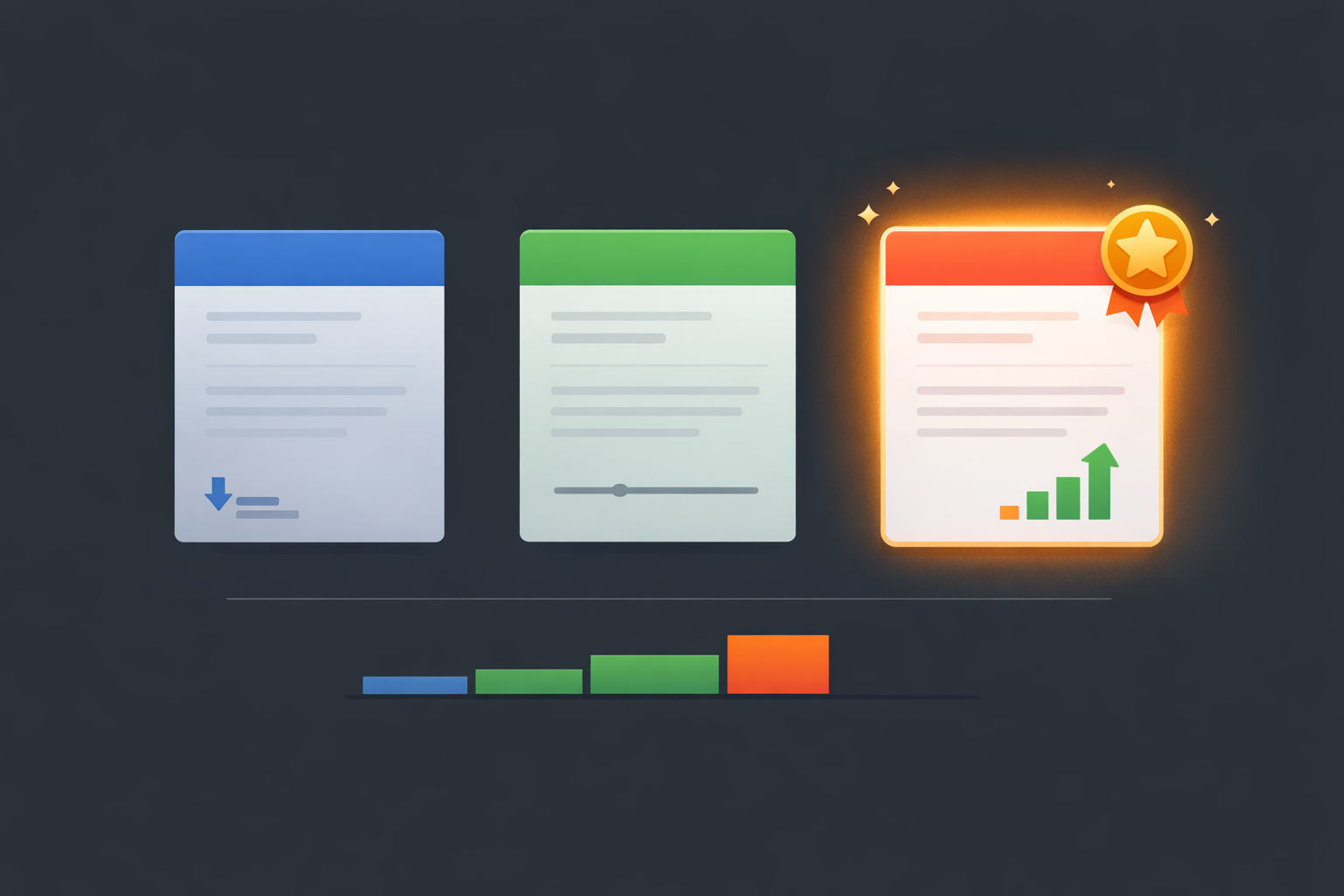
Publish three blog posts. Each one targeting a different ICP angle. See which one drives real engagement. Then build your landing page around the winner.
That’s not a content strategy. That’s a positioning experiment — and it costs you an afternoon instead of a month.
Why Content Validates Positioning Faster Than Landing Pages
April Dunford, the person who literally wrote the book on SaaS positioning, has a problem with A/B testing landing pages. She said it directly: “We’d A/B test different versions of the homepage and we’d always get these kind of inconclusive results… I don’t know whether it’s my layout, page layout or whatever I did that’s working or not working.”
She’s right. Landing page tests confound positioning with design, copy, and traffic quality. You’re testing five variables at once and learning nothing about any of them.
Blog posts strip out the noise. A positioning-test blog post has one variable: the angle. Same product, same author, same blog — different framing of who it’s for and what problem it solves. The engagement signals tell you which framing resonates with real people.
And the friction is near zero. No design mockups. No Figma reviews. No “let’s get the copy just right” loops. You write it, publish it, and measure what happens.
The numbers back this up
67% of small business owners using AI for content marketing or SEO report higher ROI, and AI cuts content production time by 70-88% — from 3.5 hours to under 1 hour per post (Semrush, 2024). That means you can generate and publish three positioning variants in a single afternoon.
There’s another advantage nobody talks about. Blog posts attract organic visitors — people who searched for a problem and found your content. That’s a fundamentally different signal than paid traffic hitting a landing page.
When someone Googles “how to stop wasting time on manual QA” and reads your entire post about automated testing for two-person dev teams, that’s real intent data. It’s worth more than 500 ad clicks from people who were half-watching a YouTube video.
How to Structure a Positioning Test Post
Here’s the framework. You’re going to write three posts about the same product, each one framed for a different ICP.
Say you’re building a code review automation tool. Your three hypotheses might be:
- Solo founders who can’t afford to hire a second engineer for code review
- Engineering leads at 5-15 person teams drowning in PR backlogs
- Agency CTOs managing code quality across multiple client projects
Each post should target a pain point specific to that ICP. Not a generic “code review is important” post — a post that makes one specific person think “this was written for me.”
Publish three positioning variants. Let the data pick the winner.
Each post needs three things:
- A pain-point headline that names the ICP’s specific frustration (not your product)
- A story or example the target reader recognizes from their own life
- A soft CTA — email capture, waitlist, or “get early access” — so you can measure conversion, not just pageviews
Publish all three within the same week. Share them in the communities where each ICP hangs out. Then wait 7-14 days and look at the numbers.
If you’ve already got some topical authority built up, these posts will index faster and give you cleaner data.
The AI Prompt Template for Generating Positioning Variants
This is where AI turns a week-long project into an afternoon. You don’t need to write all three posts from scratch.
Here’s the exact prompt template you can paste into Claude, ChatGPT, or any AI tool. It generates a positioning-test blog post for a specific ICP angle:
You are a SaaS content strategist writing for early-stage startups.

I'm building [PRODUCT — one sentence description].

My positioning hypothesis: [ICP DESCRIPTION] struggle with
[SPECIFIC PAIN POINT] and would pay to solve it.

Write a blog post (800-1000 words) that:
1. Opens with a scenario [ICP] would immediately recognize
2. Describes the pain point in their language, not mine
3. Presents my product category as the solution (don't hard-sell)
4. Ends with a CTA to join a waitlist or grab early access

Tone: Direct, founder-to-founder. No fluff. Short paragraphs.
Do NOT mention competitors by name.
Include one specific data point or stat that supports the pain point.

Target keyword: [PRIMARY KEYWORD]
Secondary keywords: [2-3 SECONDARY KEYWORDS]
Pro tip: Run this prompt three times
Change only the ICP and pain point each time. Keep everything else identical. This isolates the positioning variable so your engagement data actually means something. If you're using an automated content workflow, you can template this and run all three in parallel.
Run the prompt three times — once per ICP hypothesis. You’ll have three draft posts in under an hour. Edit them for voice (AI-assisted content that’s human-edited drives 5.44x more traffic than pure AI output), add your real examples, and publish.
Total time investment: 2-4 hours. Total cost: roughly $0 if you’re on free AI tiers.
Compare that to three weeks of landing page design and $500+ in paid traffic to test the same thing.
What Metrics Tell You a Positioning Angle Is Working
You published three posts. Now what? Don’t just check pageviews — that tells you about distribution, not positioning.
Here are the four metrics that actually matter, with benchmarks so you know what “good” looks like:
Positioning validation metrics and benchmarks for B2B SaaS blog posts (Sources: Umbrex, Semrush, HubSpot 2024 benchmarks)
| Metric | What It Tells You | Benchmark (Good) | Benchmark (Winner) |
|---|
| Time on page | Did they actually read it? | > 2 minutes | > 4 minutes |
| Scroll depth | How far did they get? | > 50% | > 75% |
| Email opt-in rate | Did they care enough to act? | > 2% | > 5% |
| Return visits | Did they come back? | Any return | 2+ returns in 14 days |
The B2B average for time on page is 1.37 minutes. If your positioning-test post is pulling 4+ minutes, people aren’t just reading — they’re recognizing themselves in what you wrote. That’s the signal.
Email opt-in rate is the most important number here. The average B2B site converts 2.3% of visitors to leads. If one of your three posts is converting at 5%+ while the others sit at 1%, you’ve found your positioning.
Set up these metrics before you publish. Google Analytics 4 handles time on page and scroll depth natively. For email capture, any simple form tool works — ConvertKit, Buttondown, even a Google Form.
Real Example: From 3 ICPs to 1 in Five Weeks
Here’s how this plays out in practice.
An early-stage SaaS startup building a scheduling tool had three ICP hypotheses: operations managers at agencies, freelance consultants, and HR teams at startups. Instead of building three landing pages, they published ICP-specific blog content over five weeks — 4-6 awareness-stage posts testing each pain-point angle.
The results were unambiguous. Posts targeting ops managers at 10-50 person agencies pulled 3x the time on page and significantly higher email captures. The founder confirmed through follow-up interviews that these readers resonated because they were burning 5+ hours per week on manual scheduling — a pain point acute enough to pay for.
They narrowed to that single ICP, built their landing page around the ops-manager angle, and within 18 months hit $40K MRR with 60+ customers. The content didn’t just validate the positioning — the best-performing posts became the foundation of their SaaS SEO strategy.
Don't skip the follow-up interviews
Content data tells you which angle wins. It doesn't tell you why. Once you see a clear winner, talk to 5-8 people who engaged with that post. Ask them what resonated. Their language becomes your landing page copy — straight from the customer's mouth, not your assumptions.
The Pre-Launch Content Strategy Playbook
Here’s the whole thing condensed into a repeatable SaaS positioning strategy you can run in two weeks:
Two-Week Positioning Test via Content
Step 1
Day 1: Define 3 ICP Hypotheses
Write one sentence per ICP: [Role] at [company type] who [specific problem]. Be specific — "small businesses" is not an ICP.
Step 2
Day 2: Generate 3 Positioning Variants With AI
Use the prompt template above. Run it three times, changing only the ICP and pain point. Edit each draft for voice and add real examples.
Step 3
Day 3: Add CTAs and Tracking
Add an email capture form to each post. Set up GA4 scroll depth and time-on-page tracking. Use UTM parameters if sharing on social.
Step 4
Days 4-5: Publish and Distribute
Publish all three posts. Share each in the communities where that specific ICP hangs out (subreddits, Slack groups, Twitter/X threads).
Step 5
Days 6-14: Measure and Compare
Let posts run for 7-10 days. Compare time on page, scroll depth, email opt-in rate, and return visits across all three.
Step 6
Day 14: Pick Your Winner and Interview
Identify the top-performing post. Reach out to 5-8 people who engaged. Their words become your landing page copy.
The whole process costs you roughly 10-15 hours and $0 in tooling. A landing page A/B test costs you 3+ weeks and hundreds in ad spend to drive meaningful traffic — and still conflates positioning with design.
Content testing won’t give you perfect data. But it gives you directional data fast enough to actually matter when you’re pre-launch and every week counts.
If you want to automate the content production side of this so you can focus on reading the data instead of writing the posts, that’s exactly what tools like Vibeblogger are built for.
Let Vibeblogger Run Your Positioning Experiments
Generate positioning-test blog posts in minutes, not hours. Vibeblogger handles the research, writing, and publishing — you focus on reading the signals and building the right product.
Start Testing Your Positioning