Organic click-through rates drop 61% when Google AI Overviews appear on a search result. That’s not a prediction — it’s measured data from Seer Interactive’s study of 3,119 queries and 25.1 million impressions.
But here’s the part most founders miss: brands that get cited inside those AI Overviews see 35% more organic clicks and 91% more paid clicks than uncited brands. The traffic isn’t disappearing. It’s concentrating around the sources AI decides to quote.
This is what generative engine optimization (GEO) is about. Not ranking in a list of ten blue links. Getting quoted inside the answer itself — whether that’s ChatGPT, Perplexity, Google AI Overviews, or Claude.
If you’ve been writing blog posts optimized for traditional SEO and wondering why traffic is stalling, this is probably why. The rules changed, and nobody sent you the memo.
The scale of the shift
ChatGPT now accounts for 87.4% of all AI referral traffic across industries. AI-referred sessions jumped 527% between January and May 2025. Gartner predicts traditional search volume will decline 25% by 2026. This isn't a future trend — it's already happening to your traffic numbers.
GEO vs Traditional SEO: What Actually Changed
Traditional SEO optimizes for ranking position. You target a keyword, build backlinks, optimize your on-page elements, and try to crack the top 10.
Generative engine optimization targets citation selection. AI engines don’t rank pages — they select passages. They pull a sentence or paragraph from your content, quote it inside a synthesized answer, and (sometimes) link back to you.
The Princeton and Georgia Tech researchers who coined the term GEO in their 2023 paper (published at KDD 2024) found that specific optimization techniques boost AI citation visibility by up to 40%. The techniques that worked? Adding statistics, citing sources, and including quotable statements. Keyword stuffing actually performed worse than doing nothing.
Here’s the practical difference:
Traditional SEO vs Generative Engine Optimization
| Dimension | Traditional SEO | GEO |
|---|
| Goal | Rank in top 10 results | Get cited inside the AI answer |
| Unit of optimization | The page | The passage / paragraph |
| Key signals | Backlinks, keywords, site speed | Entity authority, structured data, quotability |
| What wins | Comprehensive, keyword-optimized content | Specific, extractable, data-backed statements |
| Measurement | Rankings, CTR, organic traffic | Citation rate, AI referral traffic, brand mentions |
| Timeline to results | 3-6 months | 2-6 weeks for initial citations |
The bottom line: SEO asks “can Google find and rank this page?” GEO asks “will an AI model quote this page when answering a question?”
You need both. But if you’re only doing SEO, you’re optimizing for a shrinking slice of the pie. If you already have a blog with decent topical authority, you’re actually in a strong position to start capturing AI citations.
The 3 Things That Actually Get You Cited
Forget the 47-point checklists. The research and practitioner data point to three core levers that drive AI citations. Everything else is a variation of these.
1. Structured, Extractable Content
AI engines don’t read your blog post like a human does. They scan for extractable units — self-contained passages that can stand alone as a cited fact inside a generated answer.
The data backs this up hard:
- Pages with FAQPage JSON-LD schema get 3.2× more AI citations (GEORaiser audit of 200+ sites)
- Listicle-format pages capture 74.2% of all AI citations (BuzzStream 4-million-citation analysis)
- Content sections of 120–180 words between headings receive 70% more citations than sections under 50 words
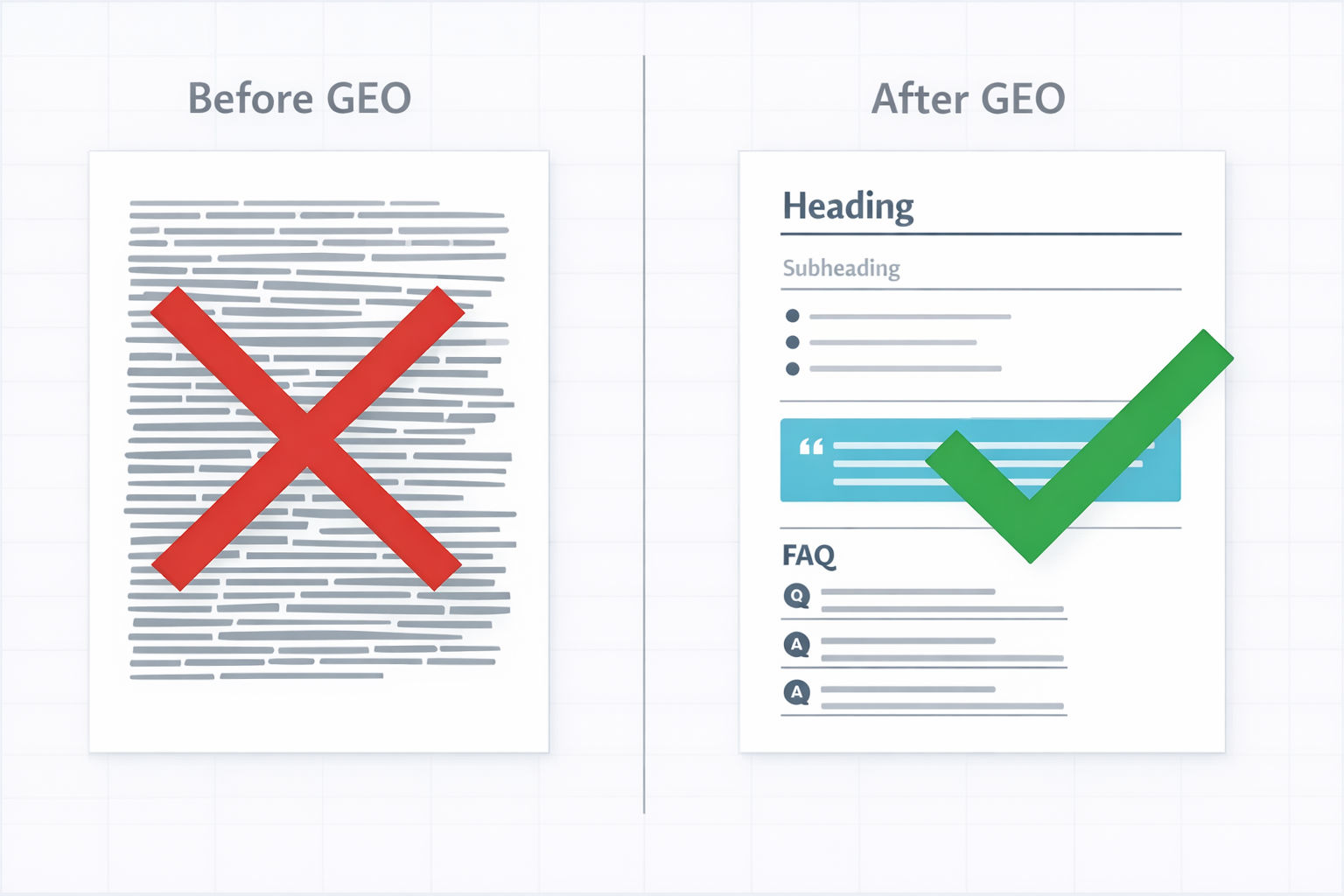
What does this look like in practice? Structure your content so every section has at least one sentence that could be quoted verbatim in an AI answer. Use clear H2/H3 headings that match the questions people ask. Add FAQ sections with schema markup. Use comparison tables, numbered lists, and definition-style openings.
The AI is looking for passages it can extract without rewriting. Make extraction easy.
2. Entity Authority — Being Mentioned Where It Matters
Here’s a stat that should reframe how you think about brand building: brand search volume has the highest correlation (0.334) with AI citations — higher than backlinks, domain authority, or content quality scores alone.
AI models build internal knowledge graphs. When your brand name appears frequently across trusted editorial sources — podcasts, industry roundups, guest posts, forum discussions — the model develops higher “entity confidence” and cites you more.
Yotpo’s research found that sites with 32,000+ referring domains are 3.5× more likely to be cited by ChatGPT. That sounds out of reach for an indie hacker. But the mechanism isn’t just raw link count — it’s entity recognition. Your brand needs to exist as a known entity in the AI’s training data and retrieval index.
For a solo founder, that means:
- Get mentioned by name in podcast interviews and guest posts
- Participate in community discussions (Reddit, Hacker News, niche forums) where your brand gets referenced
- Publish original data and research that others cite
- Build a clear, consistent entity presence across your site, social profiles, and third-party mentions
This isn’t new advice — but the reason it matters has changed. You’re not just building backlinks for Google. You’re building entity recognition for every AI model that might recommend you.
3. Answer-First Writing That AI Can Quote Directly
Most blog content buries the answer. You open with context, build up to the insight, and drop the key point in paragraph four. Humans might tolerate that. AI models won’t.
AI engines use Retrieval-Augmented Generation (RAG). They scan your page, extract candidate passages, and select the ones that most directly answer the query. If your key insight is buried inside a story, it gets skipped.
The Aggarwal et al. research proved this: adding clear, quotable statements with statistics boosted citation rates by 30-40%. Fluent, well-structured prose gets cited more than keyword-stuffed or meandering text.
The fix is straightforward. Lead every section with the answer. Then support it.
GEO-optimized content is structured for extraction — every section contains a quotable, standalone statement.
Before vs After: What GEO-Optimized Content Looks Like
Let’s make this concrete. Say you’re writing about deployment strategies for your SaaS blog.
The same topic, two different approaches. Only one gets cited by AI.
| Generic Content (Gets Skipped) | GEO-Optimized Content (Gets Cited) |
|---|
| "There are many ways to deploy applications in the cloud. Over the past few years, containerization has become increasingly popular among developers. The benefits include better scalability and more consistent environments." | "Container-based deployments reduce production incidents by 37% compared to VM-based approaches (2025 DORA Report). The three most common strategies are blue-green, canary, and rolling deployments — each suited to different risk tolerances." |
| Buries the insight, no data, nothing quotable | Leads with a specific stat, names the strategies, citable as a standalone sentence |
Notice the pattern. The GEO version has a specific number, a named source, and a complete answer in the first sentence. An AI engine can extract that sentence verbatim and drop it into a generated response with a citation link.
The generic version? There’s nothing to quote. It’s context without a conclusion.
Apply this lens to every section you publish. Ask yourself: “Could an AI pull one sentence from this paragraph and use it as a cited fact?” If the answer is no, rewrite it.
The Biggest Mistake Founders Make
You’re writing for Google. You’re probably not writing for AI crawlers.
Most founders haven’t checked whether their robots.txt even allows AI bots to access their site. GEORaiser’s audit data shows 68% of SMB sites block at least one major AI crawler without realizing it.
The major AI crawlers you need to allow:
- GPTBot and OAI-SearchBot (OpenAI / ChatGPT)
- PerplexityBot (Perplexity)
- ClaudeBot (Anthropic)
- Googlebot already covers AI Overviews
If your robots.txt has a User-agent: * / Disallow: / rule — which many legacy configs do — you’re invisible to every AI engine regardless of how good your content is.
Fix this first. It takes five minutes and costs nothing.
Beyond robots.txt, consider adding an llms.txt file to your domain root. Think of it as a sitemap.xml for language models — a plain-text guide that tells AI crawlers which pages matter most and what your company does. Early adopters are reporting faster AI indexing of highlighted pages.
Quick robots.txt check
Go to yourdomain.com/robots.txt right now. Search for "GPTBot" and "PerplexityBot." If they're not explicitly allowed — or if a wildcard Disallow rule blocks all bots — you're leaving AI citations on the table. This is the single highest-leverage, lowest-effort GEO fix.
The 5-Point GEO Checklist for Founders
You don’t need a GEO agency. If you’re already publishing content consistently and have a basic SEO foundation, you can start getting AI citations with these five moves.
Your GEO Action Plan
Step 1
Unblock AI crawlers
Check your robots.txt. Explicitly allow GPTBot, OAI-SearchBot, PerplexityBot, and ClaudeBot. Add an llms.txt file listing your 10-20 most important pages. Time: 15 minutes.
Step 2
Add FAQ schema to your top 10 posts
Identify your highest-traffic blog posts. Add FAQPage JSON-LD schema with 3-5 real questions per post. Pages with FAQ schema get 3.2× more AI citations. Time: 1-2 hours total.
Step 3
Restructure content for extraction
Audit your top posts. Does every section lead with the answer? Does every H2/H3 section contain at least one specific, quotable sentence with a data point or clear conclusion? Rewrite intros to put the answer first. Time: 30 min per post.
Step 4
Add original data to key pages
81% of AI citations go to original editorial content. Add your own benchmarks, survey results, A/B test data, or customer case study numbers. Even one original stat per post makes it dramatically more citable. Time: varies.
Step 5
Build entity mentions outside your site
Brand mentions have the highest correlation with AI citations — higher than backlinks or DA. Get on 2-3 podcasts, write guest posts, answer questions in niche communities, and participate in roundup posts. Target: 5+ new brand mentions per month.
This Compounds Fast
GEO has a shorter feedback loop than traditional SEO. Practitioners report initial citation improvements in 2-6 weeks compared to 3-6 months for ranking changes.
The reason is mechanical. When you restructure a post for extractability and add schema, AI crawlers pick that up on their next pass. You’re not waiting for Google to recalculate your authority — you’re making your content easier for AI to quote right now.
And the compounding effect is real. A challenger brand in the DojoAI study achieved a 45% AI citation rate for relevant queries — beating established competitors who had higher domain authority but worse content structure. They did it in four months.
The AI search era doesn’t reward the biggest brand. It rewards the most quotable one. That’s good news if you’re a bootstrapped founder building in public with real expertise.
Your blog already has the raw material. Now make it citable.
Your blog content should work for AI search — not just Google
Vibeblogger researches, writes, and publishes GEO-optimized blog posts on autopilot. Structured content, FAQ schema, answer-first formatting — all handled without you lifting a finger.
See how it works