Agentic AI for Content Marketing: What It Actually Means for Founders Running Lean
Everyone's talking about agentic AI, but most founders are still copying ChatGPT output into Google Docs. Here's what actually works for content marketing today, what's still vaporware, and the realistic AI content workflow for SaaS founders running lean.
Rori Hinds··9 min read
Agentic AI pulled in $3.8 billion in startup funding last year. It’s Gartner’s #1 strategic technology trend. Every SaaS company with a marketing page is slapping “AI agents” on it.
And you’re still copying ChatGPT output into Google Docs, manually fixing the weird phrasing, and then spending another hour on internal links.
Here’s the disconnect: 85% of companies say they’ll adopt AI agents in at least one workflow by end of 2025. But only 7% of marketing leaders strongly agree AI actually boosts their effectiveness. That gap — between the hype and what a bootstrapped founder can deploy for their AI content workflow for SaaS — is exactly where this post lives.
No “agentic AI will revolutionize everything” fluff. Just what works, what doesn’t, and what to actually spend your $50-100/month content budget on.
Agentic vs. Assisted AI: The 30-Second Version
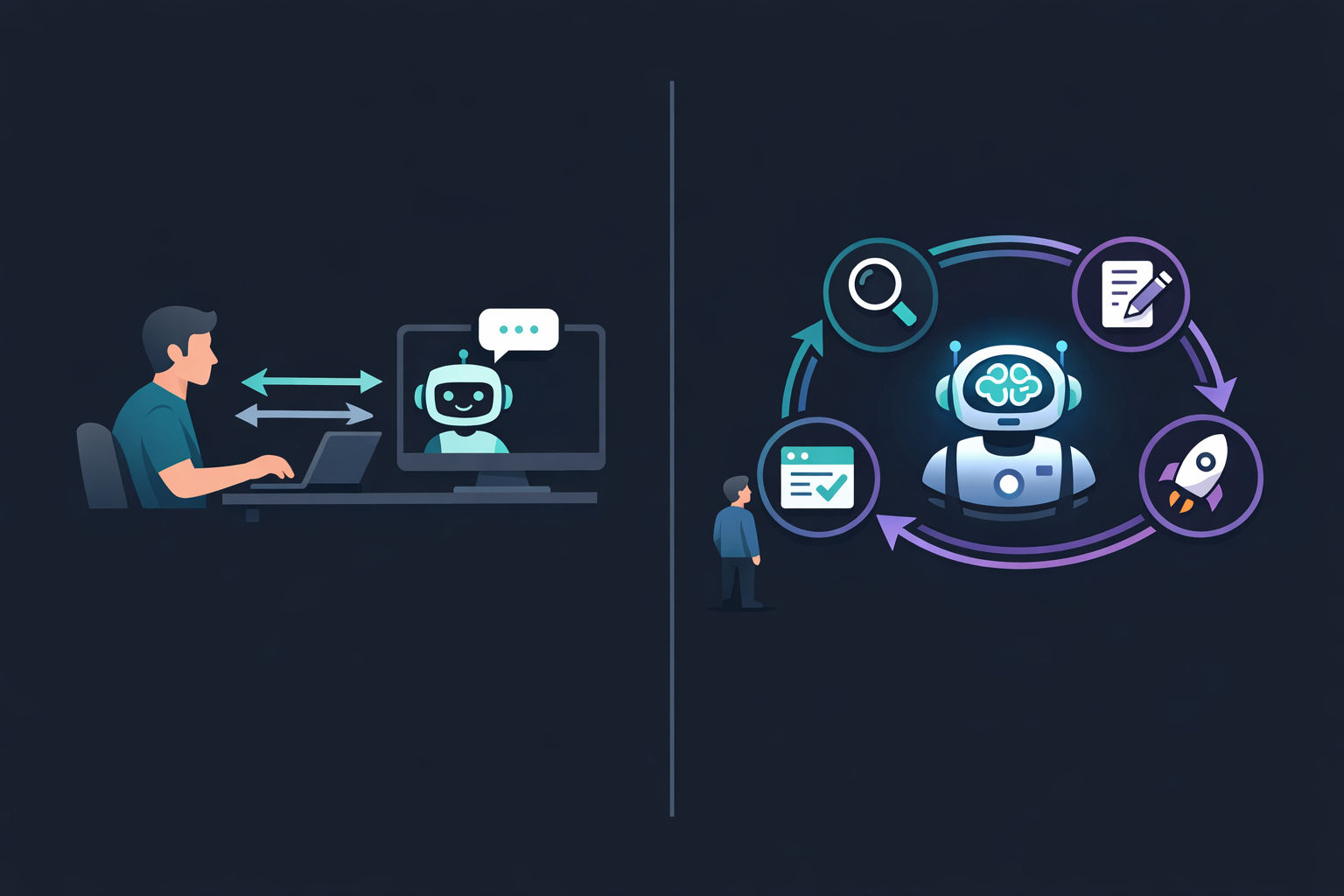
You already use assisted AI. You open ChatGPT, type a prompt, get a response, tweak it, prompt again. Each interaction is a single step. You’re the orchestrator. The AI is a tool.
Agentic AI flips that. You give it a goal — “write a blog post targeting this keyword cluster” — and it handles the multi-step workflow on its own. Research, outline, draft, optimize, link. Multiple steps, minimal hand-holding.
Assisted AI waits for your next prompt. Agentic AI runs the whole workflow.
The practical difference for founders: assisted AI saves you time on individual tasks. Agentic AI eliminates entire workflow stages.
But — and this is the part the marketing pages skip — agentic systems need guardrails, persistent context, and a clear pipeline to actually work. You can’t just tell Claude “handle my content marketing” and go build features. Not yet.
The real question isn’t “is agentic AI real?” It is. The question is: which content tasks are ready for it today?
3 Content Tasks Where Agentic AI Actually Delivers
After cutting through the noise, there are three areas where agentic AI content marketing workflows genuinely save bootstrapped founders time and money right now. Not in a demo. Not in an enterprise pilot. In a real $50-100/month stack.
1. Keyword Research Loops
This is where agentic AI shines brightest. Traditional keyword research means: open Ahrefs, search a seed term, export results, filter in a spreadsheet, group by intent, check SERP difficulty, then build a content plan. That’s 2-3 hours per topic cluster.
An agentic workflow handles this as a loop. Give it a seed keyword, and it explores related terms, analyzes SERP competition, clusters by search intent, validates volume across sources, and outputs a prioritized content brief — in minutes, not hours.
Tools like Frase can analyze the top 20 SERPs in under 5 minutes versus the 2-3 hours it takes manually. That’s not a marginal improvement. That’s the difference between doing keyword research and skipping it because you “don’t have time.”
If you’re building topical authority for your SaaS blog, agentic keyword research is the unlock that makes cluster planning actually viable for a team of one.
2. Brief-to-Draft Pipelines
The average blog post takes 3 hours and 51 minutes to create. For founders, it’s usually more — because you’re context-switching between product work and content work all day.
Agentic brief-to-draft pipelines compress this. You feed in a keyword, target audience, and angle. The system researches the topic, builds a structured brief, writes the draft, and optimizes for SEO — all as one connected workflow. HubSpot’s 2026 data shows blog production costs dropped from $820 to $476 per article with AI-assisted workflows. The time drop is even more dramatic: from 8.2 hours to 2.7 hours.
The key distinction: this isn’t just “AI writes a draft.” That’s assisted AI, and you’ve already tried it. A proper agentic pipeline means the research informs the outline, the outline shapes the draft, and the optimization happens inline — not as separate prompts you have to chain together yourself.
This is the unsexy one that most founders ignore. And it’s exactly the kind of repetitive, structural task where agents outperform humans.
An agentic internal linking system reads your existing content, understands the semantic relationships between posts, and automatically suggests (or inserts) contextual internal links. It enforces rules like “every new post links to at least one pillar page” and distributes page authority to high-priority URLs.
Manually, this means opening every related post, scanning for anchor text opportunities, and adding links one by one. Most solo founders just… don’t. Which is why orphan pages and broken topic clusters are so common on SaaS blogs.
Automated internal linking is one of those tasks that’s boring, important, and perfectly suited for agents. No creativity required. Just pattern matching and consistent execution.
Realistic time savings from agentic AI content workflows for solo founders
Task
Manual Time
With Agentic AI
Time Saved
Keyword research + clustering
2-3 hours
5-15 minutes
~90%
Brief + draft + SEO optimization
4-8 hours
30-90 minutes
~80%
Internal linking audit + updates
1-2 hours per post
Automated
~95%
Full article (research to publish)
8+ hours
2-3 hours
~70%
What’s Still Broken (The Honest Part)
Here’s where I lose the marketers and keep the founders. Because if you’ve actually used these tools, you know the limitations are real.
Hallucinated Stats Are a Real Problem
AI models hallucinate. On simple summarization tasks, the best models are down to ~0.7-1.5% hallucination rates. Sounds great.
But on complex reasoning and open-ended factual claims — the kind of stuff that shows up in SaaS blog posts about industry trends — hallucination rates jump to 33-51% on some benchmarks. A meta-analysis across studies found an overall rate of 23%.
That means if your agentic pipeline is spitting out stats like “87% of SaaS companies saw 3x growth from content marketing,” there’s a real chance that number is completely made up. And publishing fabricated data nukes your credibility with exactly the technical audience you’re trying to reach.
The fix: Any good AI content workflow for SaaS needs a verification layer. Either the system grounds claims in real sources (RAG reduces hallucinations by 40-71%), or you fact-check the data points yourself. There’s no getting around this.
Brand Voice Consistency Is Hard
Peep Laja, founder of CXL, nailed it: “The problem isn’t that AI creates bad content. It’s that it creates average content. And average is the enemy of memorable.”
Generic AI tools have zero persistent context. Every session starts from scratch. Your brand voice guidelines exist in your head (or a doc somewhere), but the AI doesn’t remember them between runs. The result is content that sounds like… everyone else.
Teams using dedicated brand voice systems — with persistent context, style guides baked in, and iterative feedback loops — report 95% usable content on first drafts. Teams using raw ChatGPT? Good luck getting past 50% without heavy editing.
This is the gap between “AI that writes” and “AI that writes like you.” Most agentic tools are still closer to the first one.
The Brand Voice Reality Check
If your AI content sounds like it could've been written for any SaaS company, it's not working. The best agentic systems bake in your tone, examples, and anti-patterns from day one. If your tool doesn't support persistent brand context, you're just using a fancy prompt wrapper.
“Full Autopilot” Is Still Marketing Spin
Some tools claim full autonomous content marketing. Set a goal, walk away, come back to a published blog.
In practice, the tools that try to do everything — strategy, content, images, distribution — across every channel tend to do everything at a B-minus level. The 70% of marketing leaders who see agentic AI as transformative aren’t wrong about the potential. But the 93% who don’t strongly agree it’s boosting effectiveness are telling you about the present.
Full autopilot works for low-stakes content like social repurposing. For SEO content that needs to rank, convert, and not embarrass you? You still need a human in the loop. The goal isn’t zero-touch. It’s minimal-touch with maximum control over what matters.
The Realistic 2026 Content Stack for a Solo Founder
Forget the enterprise dashboards. Here’s what a practical SaaS content strategy looks like when you’re running lean and want to publish consistently without it becoming a second job.
What to Automate vs. What to Keep Human
Keep Human Control
Content strategy and editorial direction
Fact-checking statistics and claims
Brand voice and tone final review
Unique insights from your product/customer experience
Linking strategy decisions (what to promote, when)
Final publish approval
Disadvantages
None listed
The Math That Matters
Let’s make this concrete. As a solo founder publishing 8 blog posts per month:
The freelancer route: 8 posts × $400 average = $3,200/month. Plus your time managing writers, providing feedback, and waiting 5-7 days per article.
The raw ChatGPT route: $20/month for ChatGPT Plus. But you’re spending 3-4 hours per post on prompting, editing, formatting, SEO optimization, and image sourcing. That’s 24-32 hours/month — almost a full work week.
The agentic AI route: $50-100/month for tools with proper pipelines. ~1-2 hours per post for review and your unique insights. That’s 8-16 hours/month and content that’s structured for SEO from the start.
The agentic approach doesn’t just save money compared to freelancers (we’ve broken down that math before). It saves you the one resource that actually matters when you’re bootstrapped: your hours.
Your Content Budget Sweet Spot
For most solo founders, the ~$100/month range covers a solid AI content stack: keyword research tool + agentic content pipeline + SEO optimization. You're not paying for enterprise features you'll never use. You're paying for a workflow that runs while you build product.
What This Means for You Right Now
Agentic AI for content marketing is real. It’s not vaporware. But it’s also not the “set and forget” magic the funding announcements suggest.
Here’s the honest take:
Keyword research loops are ready for full automation. The time savings are dramatic and the quality is genuinely good.
Brief-to-draft pipelines work well when they have persistent brand context and research grounding. Without those? You’re getting generic output with extra steps.
Internal linking is a perfect agent task — boring, rule-based, and impactful for SEO.
Full autopilot content marketing is still a couple of years away from being trustworthy for anything you care about ranking.
The founders who’ll win the content game in 2026 aren’t the ones waiting for perfect AI. They’re the ones building a content automation workflow that handles the 70% of grunt work, so they can focus their limited time on the 30% that actually requires a human brain: strategy, unique insights, and not publishing hallucinated statistics.
The problem isn't that AI creates bad content. It's that it creates average content. And average is the enemy of memorable.
The bar isn’t “can AI write a blog post.” It clearly can. The bar is “can AI run a content operation that sounds like you, targets the right keywords, links to the right pages, and doesn’t make stuff up.”
We’re getting there. But the founders who pick the right pieces to automate today — rather than waiting for the all-in-one magic tool — are the ones who’ll have 50 ranking posts by the time everyone else is still evaluating their options.
This Post Was Researched, Written, and Published by Vibeblogger
An agentic AI content pipeline that handles keyword research, writing, SEO optimization, image generation, and publishing — so you can ship product instead of blog posts.