Vibe Coding vs Hiring a Developer: The Real Costs in 2026 (Data From 200+ Projects)
Vibe coding an MVP costs under $2K. Hiring a developer costs $50K+. But the real math is more complicated. Here's the dollar-for-dollar breakdown with data from 200+ projects, hidden costs nobody tweets about, and the hybrid playbook smart founders actually use.
Rori Hinds··9 min read
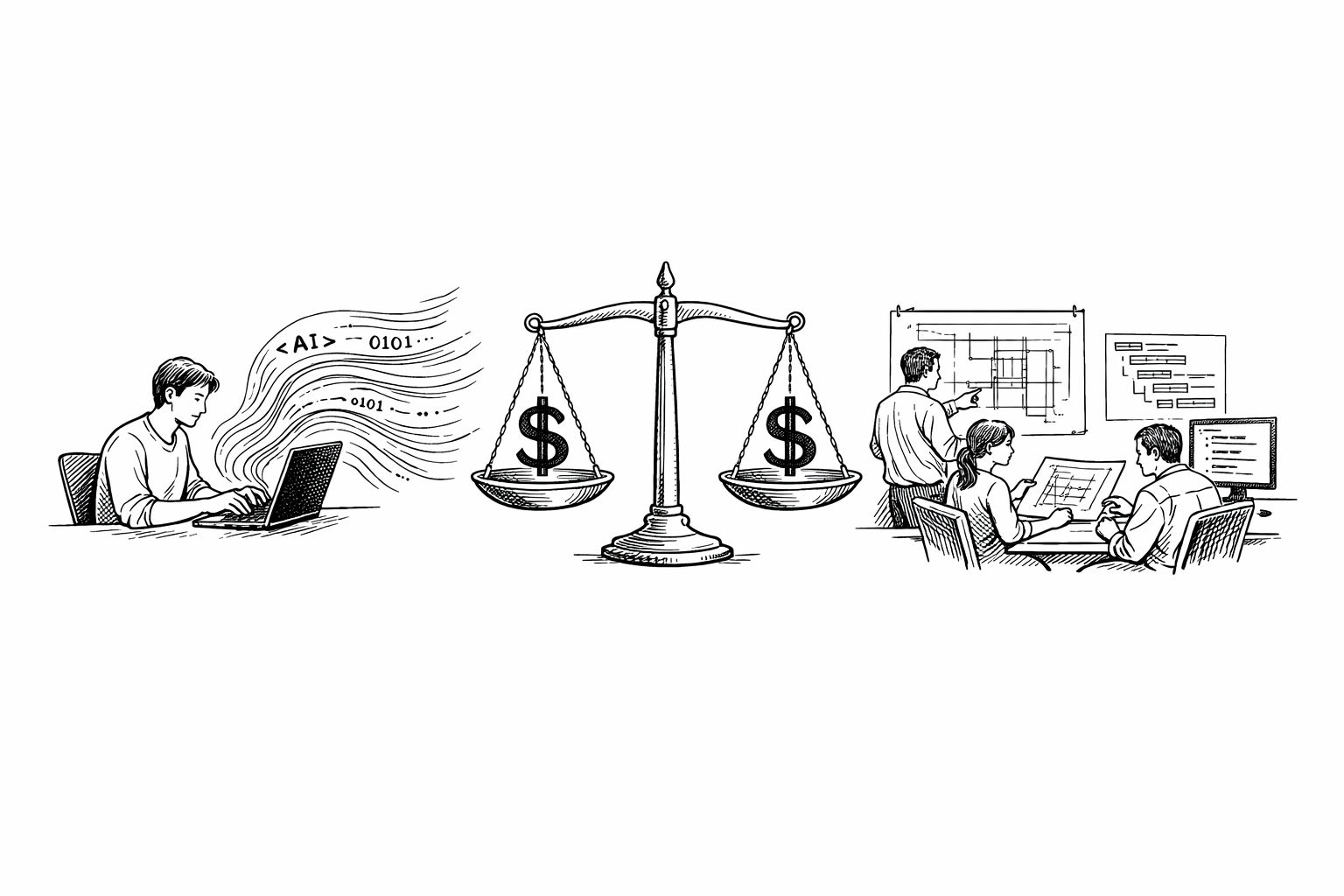
Here’s the headline number everyone shares: you can vibe code a SaaS MVP for under $2,000. Hiring a dev agency for the same thing costs $50,000 to $80,000.
That’s a real stat — pulled from data across 200+ tracked projects. And it’s also wildly misleading.
Because the cost of building your app is not the same as the cost of running your app. The gap between a $40/month prototype and a production-ready product is where most vibe-coded projects quietly die. And almost nobody publishes the honest math that fills that gap.
Let’s fix that.
The $40 Prototype vs. the $57K Agency Bill
Vibe coding — describing what you want in plain English and letting AI write the code — has gone from Andrej Karpathy’s Twitter coinage in early 2025 to a $4.7 billion market in 2026. Collins Dictionary named it their 2025 Word of the Year. MIT Technology Review listed it as a 2026 Breakthrough Technology. Stack Overflow’s 2025 survey of 49,000+ developers found 84% now use or plan to use AI coding tools.
The tools are cheap. Cursor runs $20/month. GitHub Copilot Pro is $10/month. Lovable is $25/month. Bolt gives you 1M free tokens monthly. You can stack a full AI coding toolkit for $40–$60/month and start shipping features in hours.
Meanwhile, across 200+ surveyed projects, the average agency-built MVP lands at $57,200 with a 12–16 week timeline. And 60% of those projects blow past their initial deadline.
MVP Build Costs: Vibe Coding vs. Hiring (Same Feature Scope)
Those numbers are real, sourced from Idlen’s ROI analysis and DEV Community’s 2026 industry report. Vibe coding reduces direct MVP costs by 65–92% compared to traditional development.
If you’re just validating an idea — testing whether anyone will pay for your thing — the math is obvious. Spend $2K and two weekends, not $57K and four months.
But here’s where it gets interesting.
The Hidden Costs Nobody Tweets About
Every “I built a SaaS in a weekend” post conveniently skips what happens at month 3. That’s when the bills show up — and they’re not tool subscriptions.
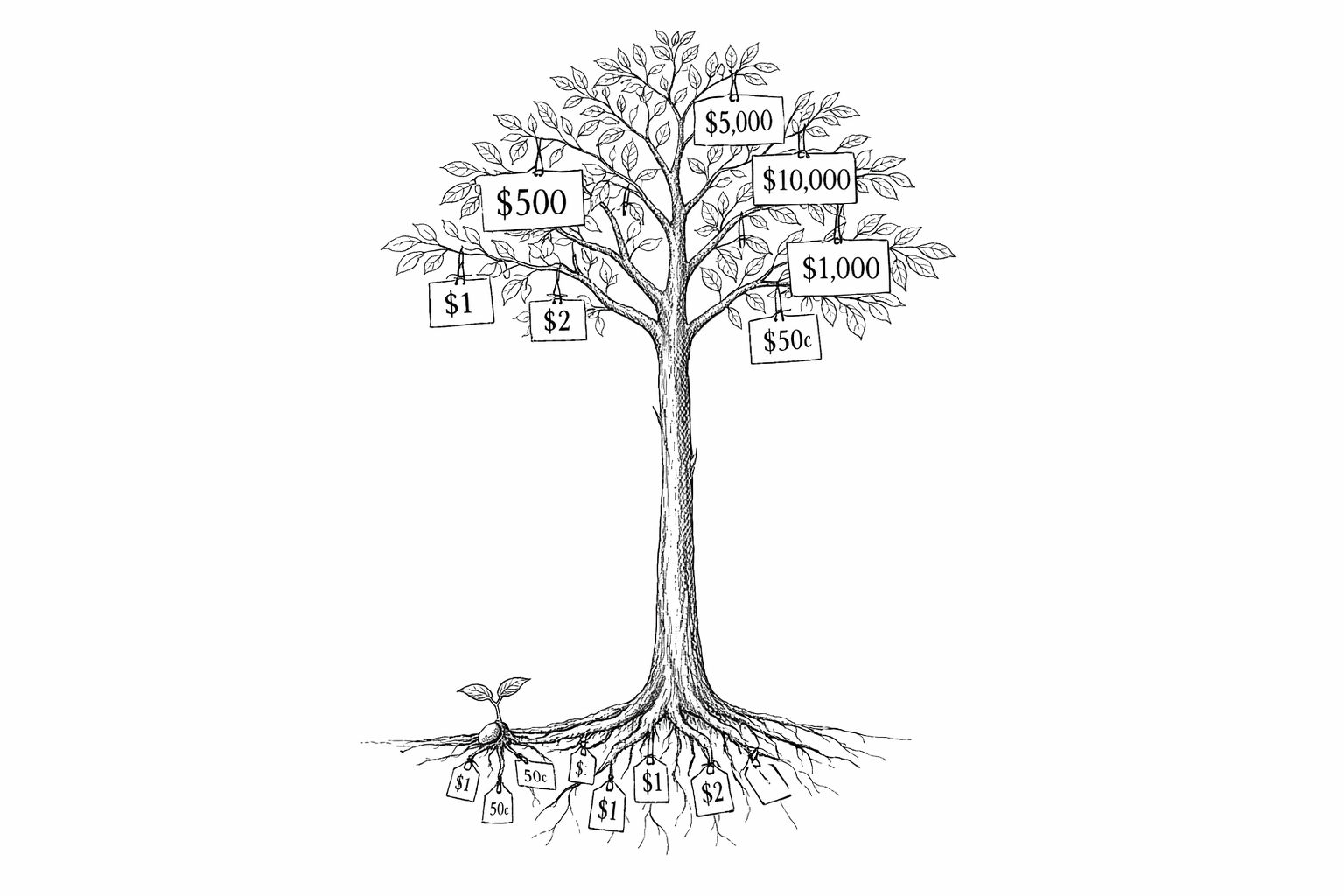
The cheapest part of vibe coding is the beginning. The real costs grow with the product.
Bug density is 1.7x higher in AI-generated code according to multiple analyses. Faros AI research shows 9% more bugs than human-written code, and those bugs cost 3–4x more to fix because the person debugging didn’t write the code — and often doesn’t fully understand it.
Security is a real problem. 45% of vibe-coded projects contain security flaws. GitClear’s study of 211 million lines of code found code duplication rose from 8.3% to 12.3% between 2021 and 2024, while refactoring activity dropped 60%. More duplicated code means more attack surface.
Maintenance costs spike. Traditional software maintenance runs 20–25% of initial development cost annually. For vibe-coded apps, that jumps to 30–50%. CI/CD failures triple. Test coverage drops below 50%.
And then there’s the cleanup economy — a growing market of developers who charge $200–$400/hour specifically to fix vibe-coded apps. One developer recently posted an unexpected $607 Replit bill. Others report $2,000–$5,000/month in AI agent costs with no clear ROI.
I tried to use Claude/Codex agents a few times but they just didn't work well enough at all and net unhelpful, possibly the repo is too far off the data distribution. It's basically entirely hand-written.
Year 1 Reality Check
A vibe-coded prototype costs $40/month. A vibe-coded production app costs $6,000–$32,000 in Year 1 once you add infrastructure, security, bug fixes, and maintenance. A traditionally-built MVP costs $30,000–$150,000 for the same period. The gap is real — but it's not as wide as the Twitter screenshots suggest. (Source: Barrack AI's analysis)
Where Vibe Coding Actually Wins
None of this means vibe coding is a bad choice. It means it’s a specific choice — and when you use it right, it’s an unfair advantage.
Speed is the killer feature. AI-assisted development delivers 26% faster overall task completion, 51% faster on routine tasks, and up to 81% time savings on repetitive work like auth flows and database schemas. Small teams of 2–5 people move roughly 2x faster with vibe coding compared to pure traditional development.
The success stories are real. Drew Griffin vibe-coded SendPush.io and hit $135,000 in revenue in less than a week. A 21-year-old student built a SaaS generating $14,000/month using ChatGPT and Cursor. Krzysztof Cichy, with zero coding experience, sold three micro-SaaS apps.
These aren’t flukes. They’re what happens when you use vibe coding for what it’s good at: getting to market fast and validating demand before investing heavily. If you’ve adopted the vibe coding mindset, you already know that shipping beats planning.
Where It Falls Apart
Vibe coding hits a wall in three predictable places:
Scaling past ~1,000 concurrent users. Performance issues are common because AI-generated code optimizes for “works” not “works at scale.”
Anything security-sensitive. User data, payments, healthcare, fintech — vibe coding these is asking for trouble. Privilege escalation vulnerabilities are up 322% in AI-generated code.
Complex business logic. As Karpathy found out, once your codebase grows beyond what the AI was trained on, the tools become “net unhelpful.” The code grows past your comprehension, and you’re left prompting randomly until bugs disappear.
25% of Y Combinator’s Winter 2025 batch had codebases 95% AI-generated. That’s great for getting into YC. The question is how many of those codebases survive contact with 10,000 paying users.
The Hybrid Playbook (What Smart Founders Actually Do)
The best approach isn’t vibe coding OR hiring. It’s both — in the right sequence.
This is the framework that minimizes total cost while maximizing speed:
The Hybrid Build Framework
Step 1
Vibe code your prototype ($40–$200)
Use Cursor, Lovable, or Bolt to build a working MVP in 1–2 weeks. Focus on core features only — auth, one key workflow, basic UI. Don't optimize. Don't polish. Just make it work. Total cost: tool subscriptions only.
Step 2
Validate with real users ($0–$500)
Put it in front of 10–50 potential customers. Charge money. If nobody pays, you just saved $50K+ by not hiring a dev agency to build the wrong thing. If people pay, you have proof the idea works.
Step 3
Hire a developer to harden the code ($5K–$15K)
Once validated, bring in a senior freelancer ($100–$175/hr) for 40–80 hours. They'll fix security holes, add proper error handling, optimize database queries, and set up CI/CD. This is where you prevent the 3–4x bug-fix cost multiplier.
Step 4
Continue iterating with AI + human review
Use vibe coding for new feature prototypes and routine tasks. Have your developer review critical code. This hybrid approach gives you the speed of AI with the reliability of human expertise. Budget $2,500–$3,500/month for ongoing development.
The Math That Matters
Hybrid approach Year 1 cost: $12,000–$25,000 — that's vibe coding tools ($600–$1,200) + validation ($500) + developer hardening ($5K–$15K) + ongoing infrastructure ($2,400–$4,200) + maintenance ($3,500–$4,000). Compare that to $30K–$150K for pure traditional development or $6K–$32K for pure vibe coding with unpredictable quality.
Decision Framework: Which Approach When
Stop asking “vibe code or hire?” Start asking “what am I building and what stage am I at?”
When to vibe code, when to hire, and when to do both
Scenario
Best Approach
Why
Testing a new idea
Vibe code only
Speed > quality. Validate before you invest.
Internal tool / side project
Vibe code only
Low stakes, low users. Ship it.
Post-validation MVP
Hybrid
Vibe coded base + dev hardening. Best ROI.
User data / payments
Hire developer
Security flaws cost more than dev fees.
Scaling past 1K users
Hire developer
AI code doesn't optimize for performance.
Enterprise / regulated
Hire developer
Compliance isn't something you can prompt.
The Bottom Line
Vibe coding has genuinely changed the economics of building software. A SaaS MVP that cost $57K and four months in 2024 can now be prototyped for $2K in two weekends. That’s a real shift — 92% of US developers now use AI tools daily, and 41% of all code is AI-generated.
But “cheap to build” and “cheap to run” are different things. The prototype-to-production gap — where bug density is 1.7x higher, maintenance costs double, and a growing cleanup economy charges $200–$400/hour to fix what AI broke — is where the real cost lives.
The smart play: use vibe coding to validate fast, then invest in professional development for the code that actually needs to work at scale. You’ll spend less than either pure approach and ship faster than both.
Vibe coding gets your app live. But who's writing the blog posts that make Google send you customers? Vibeblogger handles your entire blog — research, writing, images, publishing — on autopilot. So you can stay in the code while your content compounds.