You’ve been staring at that Notion doc for three weeks. Wireframes, architecture diagrams, feature lists that keep growing. Meanwhile, 25% of Y Combinator’s W25 batch shipped products with codebases that are 95% AI-generated — and they’re already talking to users.
That’s the vibe coding mindset in action. Not a dev tool. Not a framework. A philosophy: ship something real, then fix it based on what actually happens.
The data says this approach wins. Overwhelmingly.
What Vibe Coding Actually Means for Founders
Andrej Karpathy coined the term in February 2025. He described it as giving in to the vibes — describing what you want in plain English, letting AI write the code, and iterating based on what you see instead of what you planned.
But here’s what most people miss: vibe coding isn’t really about AI. It’s about bias toward action. It’s Bezos’s 70% rule applied to building software — make decisions with 70% of the information you wish you had, because waiting for 90% means you’re too slow.
The AI just makes this mindset absurdly more powerful. 92% of US developers now use AI coding tools daily, and 41% of all code globally is AI-generated. The barrier between “idea” and “working prototype” has never been thinner. If you’re new to this space or want a grounding definition, our guide to what vibe coding actually is covers it from first principles — including where it breaks down for production use.
The Karpathy Definition
"Fully give in to the vibes, embrace exponentials, and forget that the code even exists." — Andrej Karpathy, February 2025. He wasn't joking. He was describing how the best prototypes get built.
The Numbers That Prove Shipping Wins
This isn’t vibes-only advice. The data is stark.
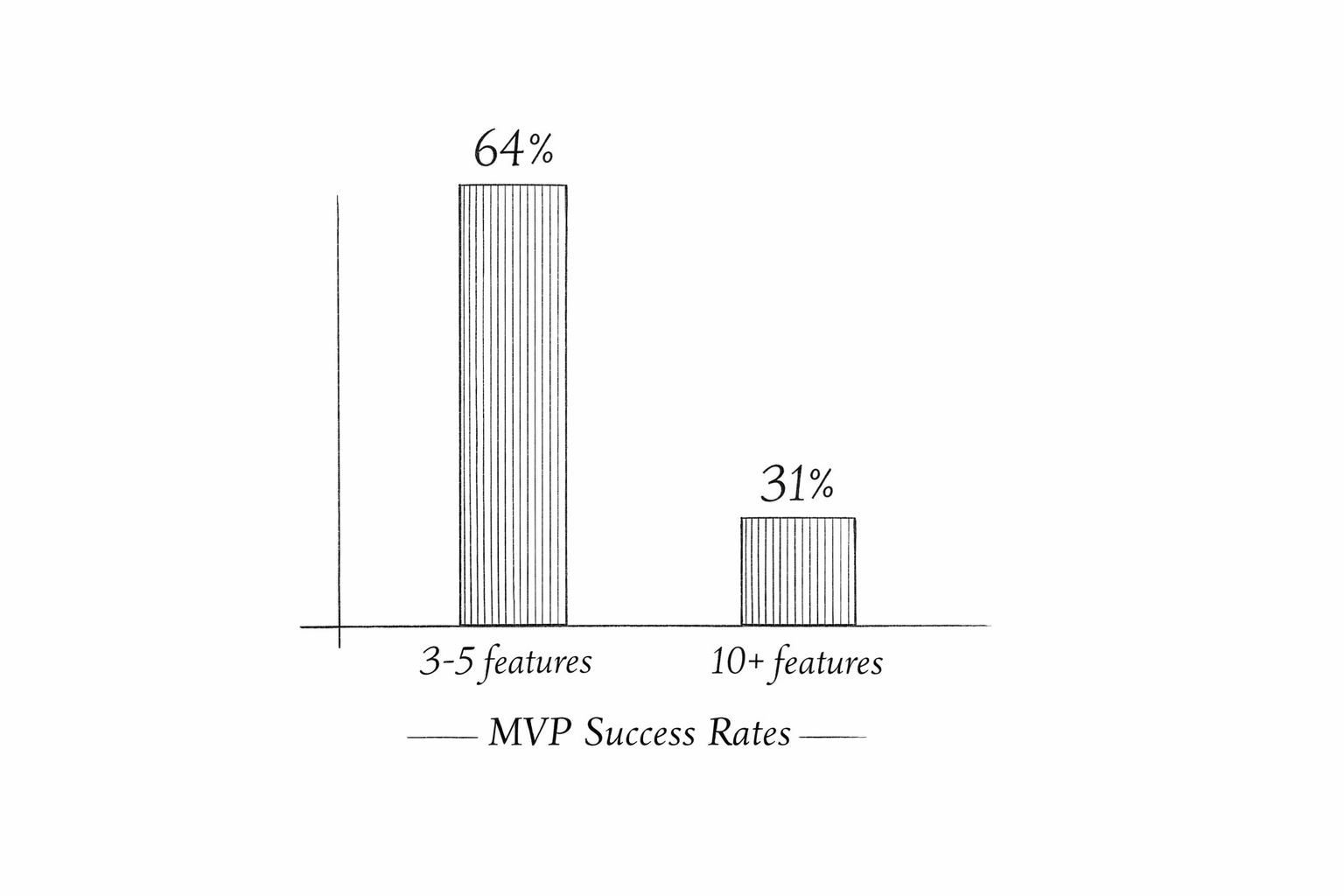
An analysis of 70 MVP launches by Innoworks found that MVPs with 3-5 features succeeded at 64%. Add more features? The rate drops to 48% for 6-9 features and 31% for 10+.
That’s a 2x success rate for doing less.
Of course, speed only helps if you ship something that’s actually production-ready. The most common ways vibe code breaks before launch are worth knowing before your first deploy — so your fast ship doesn’t come back as a slow emergency fix.
Data from Innoworks' analysis of 70 MVP launches. Fewer features, higher success rates.
But the most brutal stat is about iteration speed. Successful MVPs in that same study averaged 11 days to their first post-launch update. Failures? 47 days — or they never updated at all.
Think about that. The difference between winning and losing wasn’t the idea, the tech stack, or the funding. It was how fast the team could ship a change after real users touched the product.
If your feedback loop is 6 weeks, you get roughly 8 learning cycles per year. Compress it to 1 week, and you get 50. That’s not a small improvement — it’s a 6x advantage in learning speed. And for founders who want to go from raw idea to deployed product inside a weekend, this playbook on building and deploying an app with AI in 72 hours is the closest thing to a step-by-step operating manual you’ll find.
Shipping-first founders learn faster, fail cheaper, and win more often.
| Metric | Shippers | Planners |
|---|
| Time to first update | 11 days | 47 days (or never) |
| Feature count at launch | 3-5 features | 10+ features |
| MVP success rate | 64% | 31% |
| Learning cycles per year | ~50 (weekly loops) | ~8 (6-week loops) |
How to Apply the Vibe Coding Mindset
You don’t need to go full Karpathy and accept every AI suggestion blindly. That’s the prototype version. What works for founders building real products is a calibrated version of the same philosophy:
1. Cap your feature list at 5. The data is clear. If you’re planning more than 5 features for your first release, you’re planning too much. Dropbox launched with a $50K demo video and went from 5,000 to 75,000 signups overnight — no product required.
2. Set a 1-week iteration clock. CRV’s seed investors specifically look for founders who ship MVPs in weeks, not months. If your first version takes 6 months, your second will too.
3. Use AI to collapse the build cycle. With tools like Cursor and Replit, you can go from prompt to working prototype in hours. That’s not hype — 74% of developers report increased productivity with AI-assisted coding.
4. Decide at 70%. Bezos built Amazon on this rule. You’ll never have all the information. Ship at 70% confidence, then let user behavior fill in the remaining 30%.
The Real Risk Isn't Bugs — It's Building Something Nobody Wants
Cash depletion kills 38% of startups (CB Insights). Every week you spend planning instead of shipping is burn with zero learning. A messy app with real users beats a perfect app with zero users — every time.
The vibe coding mindset isn’t about sloppy engineering. It’s about recognizing that the market is a better architect than your Notion doc.\n\nThe founders winning right now aren’t the ones with the cleanest codebases or the most detailed PRDs. They’re the ones who shipped something this week, learned something from real users, and will ship something better next week.\n\nThat’s the loop. That’s the whole thing.\n\nThe moment your product is live, distribution becomes the next bottleneck. Building in public — sharing what you ship, what breaks, and what you learn — is one of the highest-leverage ways to turn momentum into an audience. And once you’ve got something worth promoting, the vibe coding SEO playbook walks through exactly how to turn your shipped app into organic traffic — without a marketing team.\n\nYou already know how to rank on Google. You know how to build an audience. The only question is whether you’ll ship something worth talking about — or keep planning it.
You shipped the product. Now ship the content.
Your SaaS needs a blog that ranks on Google — but you don't have time to write 2,000 words every week. Vibeblogger handles keyword research, writing, images, and publishing on autopilot. It's the vibe coding mindset applied to content.
Start ranking on autopilot