Your SaaS blog is getting traffic. Google Analytics looks healthy. You’re ranking for keywords, visitors are reading your posts, and the line goes up.
But signups? Flat.
This is the most common saas content marketing failure mode, and it happens to smart founders all the time. You do what the playbooks say — publish consistently, target keywords with volume, write comprehensive guides — and end up with a blog that educates thousands of people who never become customers.
The problem isn’t your writing. It’s your content mix. You’re over-indexing on content that attracts browsers and under-investing in content that converts buyers.
The Top-of-Funnel Trap (And Why Most SaaS Blogs Fall Into It)
Here’s a stat that should make you uncomfortable: 50% of marketers focus on top-of-funnel content, while only 14% actively create bottom-of-funnel content. That’s a 3.5:1 ratio — and it’s completely backwards if your goal is signups.
The trap works like this. You open your keyword research tool, sort by search volume, and pick the biggest numbers. “What is project management” gets 30K searches a month. “Asana vs Monday vs your-product” gets 400. So you write the first one.
Six months later, you have 10,000 monthly visitors reading your educational content. They learn something, maybe bookmark the page, and leave. They were never going to sign up. They were in learning mode, not buying mode.
Meanwhile, those 400 people searching for comparison terms? They’re holding a credit card. And they’re signing up for whoever shows up with the best answer.
The math is brutal. According to Grow and Convert’s research, comparison and alternatives pages convert at 7.5%+, while generic blog posts convert at roughly 0.5%. That’s a 15x difference in conversion rate.
The Real Math on Content Conversion
10,000 visits to a TOFU blog post at 0.3% conversion = 30 signups
500 visits to a BOFU comparison page at 10% conversion = 50 signups
That comparison page with 20x less traffic just generated 67% more signups. Volume is a vanity metric. Intent is what pays the bills.
This is the trap that catches most founders running a SaaS content strategy. They celebrate the traffic dashboard while ignoring the signup dashboard. And the longer you wait to fix it, the more you’re essentially running a free education site for people who’ll sign up with your competitor.
If you’re building your content strategy for SaaS from scratch, don’t start with awareness content. Start with the content that converts.
Map Your Content to Your Buyer’s Job-to-Be-Done
The fix isn’t complicated. It just requires thinking about content differently.
Stop asking “what keywords have volume?” and start asking “what job is the reader trying to do when they find this post?” This is the jobs-to-be-done framework applied to content marketing for startups, and it changes everything about what you publish.
A person Googling “what is email marketing” has a very different job than someone Googling “Mailchimp vs ConvertKit for SaaS.” The first is trying to learn. The second is trying to decide. Only one of them is going to sign up for something today.
B2B buyers complete 70% of their research independently before ever contacting sales. Your content is doing the selling whether you designed it to or not. The question is whether it’s selling effectively — or just teaching and hoping.
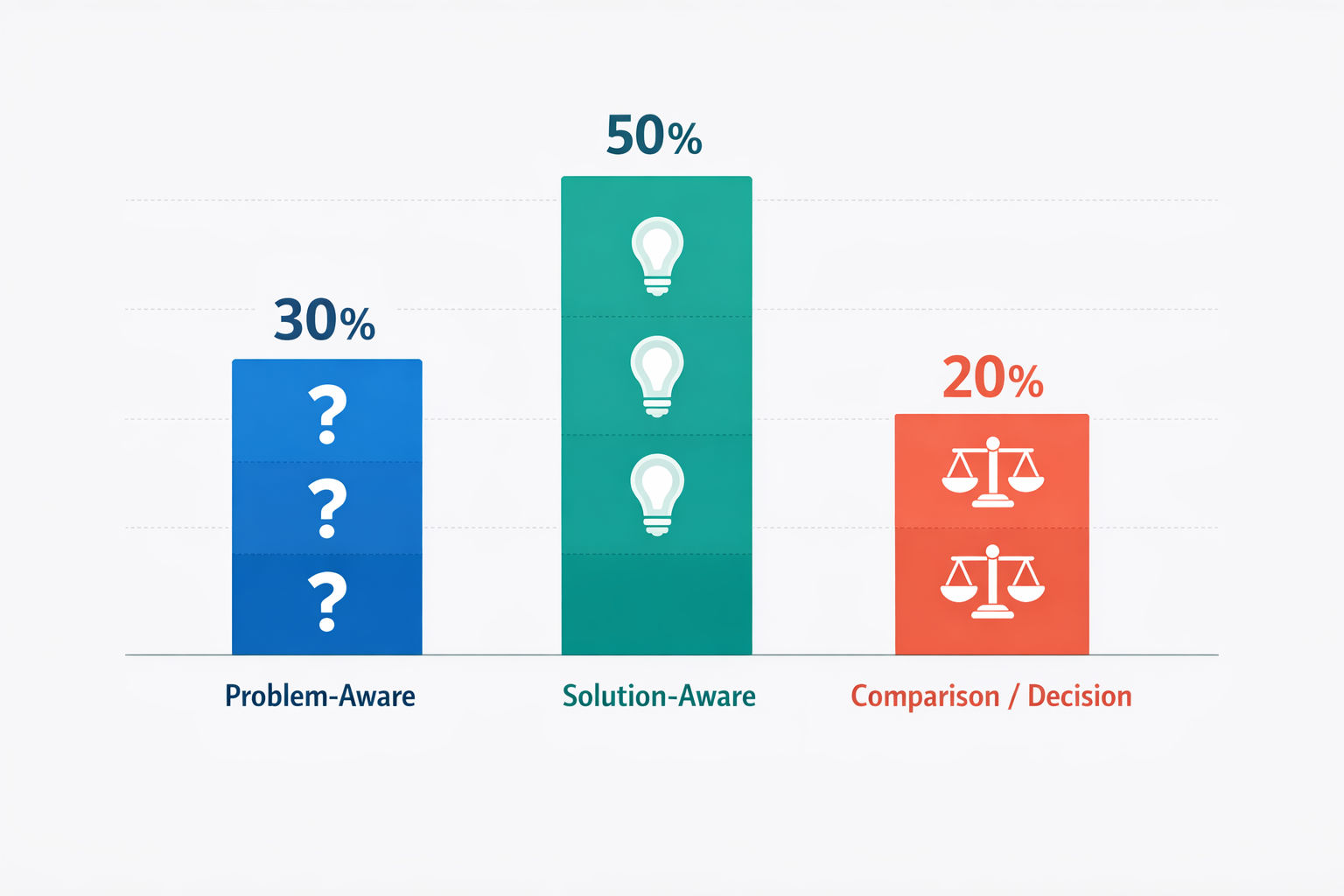
Every piece of content you publish should map to one of three buyer states: problem-aware, solution-aware, or decision-ready. Each state requires different content, different keywords, and different calls to action.
The 3-Category Content Mix for SaaS Founders
Forget the traditional TOFU/MOFU/BOFU jargon for a second. Here’s a simpler framework that maps directly to how your potential users actually search and think. This is the SaaS blog strategy that drives signups, not just pageviews.
The content mix that actually drives signups — weight your strategy toward solution and decision content.
Category 1: Problem-Aware Posts (30% of your content)
What they are: Content targeting people who know they have a problem but haven’t started looking for tools yet.
Example keywords: “how to reduce customer churn,” “why my SaaS onboarding sucks,” “email open rates dropping”
Real example: Intercom’s early blog was legendary for this. They published posts like “Why Cards Are the Future of the Web” and deep dives on customer engagement psychology. This content built their 200K monthly pageview blog and contributed to their path to $50M in ARR. The key? Every problem-aware post naturally connected to Intercom’s solution.
Your signup CTA here: Soft. Think “subscribe for more” or “get the free guide.” These readers aren’t ready to buy — don’t push them. Your goal is to earn the return visit.
Expected conversion to signup: 0.2–1%
Category 2: Solution-Aware Posts (50% of your content)
What they are: Content for people who know solutions exist and are exploring their options. This is where you should spend half your content effort.
Example keywords: “best project management tools for small teams,” “how to automate blog publishing,” “tools for SaaS keyword research”
Real example: Buffer built massive early traction with posts like “The Ideal Length of Everything Online” and “The Science of Social Media Timing.” These weren’t about Buffer directly, but they targeted people who were already looking for social media solutions. The content naturally funneled readers toward Buffer’s product because it demonstrated expertise in the exact problem Buffer solved.
Your signup CTA here: Medium intent. “Try it free” buttons embedded naturally after you’ve demonstrated value. Use-case content and product-led tutorials work brilliantly here. Users following setup guides are 3x more likely to convert to paid.
Expected conversion to signup: 2–5%
Category 3: Comparison & Decision Posts (20% of your content)
What they are: Content for people who are ready to buy and are choosing between options. This is your highest-converting content category by a wide margin.
Example keywords: “[your product] vs [competitor],” “[competitor] alternatives,” “[product category] pricing comparison”
Real example: One SaaS marketing agency reported that their client’s BOFU posts converted at 6x the rate of everything else on the blog. Traffic actually dropped 10-20%, but monthly trial signups leaped because the remaining traffic had real buying intent.
This is the content most founders feel uncomfortable writing. Comparison posts feel aggressive. Alternative pages feel competitive. But visitors from BOFU content are 4x more likely to convert than average visitors. You’re leaving signups on the table by skipping this category.
Your signup CTA here: Direct and prominent. “Start your free trial” after showing why you win the comparison. These people are deciding right now.
Expected conversion to signup: 7.5–15%
The 3-category content mix formula with real conversion benchmarks from B2B SaaS data
| Content Category | % of Mix | Conversion Rate | Keyword Example | CTA Intensity |
|---|
| Problem-Aware | 30% | 0.2–1% | "how to reduce churn" | Soft (subscribe, guide) |
| Solution-Aware | 50% | 2–5% | "best tools for X" | Medium (try free, demo) |
| Comparison/Decision | 20% | 7.5–15% | "Product A vs Product B" | Direct (start trial) |
What Conversion Rates Should You Actually Expect?
Let’s get specific, because vague advice is useless.
The average SaaS blog converts organic visitors to signups at 2–5%. But that average hides massive variance depending on content type.
If you’re sitting below 1% conversion on blog traffic, you almost certainly have a content mix problem — too much awareness content, not enough decision content. Top SaaS companies get 40–60% of new signups from content-driven organic channels. That’s not a typo. Content can be your primary acquisition channel if you build the right mix.
Here’s the benchmarks by content type to check yourself against:
Don't Kill Your TOFU Content — Rebalance It
This isn't about deleting your educational posts. Problem-aware content builds topical authority, earns backlinks, and grows domain strength. You need it. But if 80% of your blog is TOFU and 0% is comparison content, you're running a library, not a growth channel. Rebalance, don't abandon.
The Content Audit: Fix Your Mix in One Afternoon
You don’t need a 90-day content strategy overhaul. You need to look at what you’ve already published and figure out where the gaps are.
Here’s exactly how to do it.
Audit and Rebalance Your SaaS Content Mix
Step 1
Export your blog posts into a spreadsheet
Pull every published post. Add columns for: Title, URL, Monthly Traffic, Signups (or conversions), and Category (problem-aware / solution-aware / comparison).
Step 2
Categorize every post
Tag each post as problem-aware, solution-aware, or comparison/decision. Be honest — if a post is a generic "what is X" explainer, it's problem-aware at best.
Step 3
Calculate your current mix ratio
Count the percentages. If you're like most SaaS blogs, you'll see 70%+ problem-aware content and less than 5% comparison content. That's your conversion leak.
Step 4
Identify your top 5 competitors by name
Write one "[Your Product] vs [Competitor]" post and one "[Competitor] alternatives" post for each. That's 10 high-converting posts you can start writing today.
Step 5
Add solution-aware CTAs to your existing top-traffic posts
Your most-visited problem-aware posts are leaking signups. Add contextual CTAs that link to your product or free trial — not just "subscribe to our newsletter."
The Uncomfortable Truth About SaaS Content Strategy
Most content marketing advice tells you to publish more. More blog posts, more keywords, more content.
That’s wrong.
The SaaS content strategy for companies that actually convert focuses on publishing smarter. One agency pivoted their client from broad TOFU content to targeted BOFU keywords. Total traffic dropped 10-20%. But trial signups didn’t just hold — they jumped, because the remaining traffic was full of people ready to buy.
Content marketing generates 3x more leads than outbound at 62% lower cost. But only when the content targets the right stage of the buyer journey. Publishing 50 awareness articles while ignoring comparison content is like running ads to people who don’t know your product category exists.
If you’re building a content engine for your SaaS — especially as a solo founder or small team — don’t waste your limited bandwidth on content that just fills a blog. Every post should map to a buyer job. Every post should have a conversion path. And the majority of your effort should go toward content where the reader is already looking for a solution like yours.
That’s the whole strategy. It’s not complicated. It’s just different from what most people do.
For a deeper framework on how to structure your content publishing cadence and build compounding traffic alongside conversions, check out our full content strategy for SaaS guide. And if you want to see what it looks like when you actually automate this entire process — content research, writing, and publishing — that’s the problem we built Vibeblogger to solve.
Stop Writing Blog Posts That Don't Convert
Vibeblogger builds your entire content engine — from keyword research to published, conversion-optimized posts. It's the SaaS content strategy on autopilot.
See How It Works