You’ve been posting your build-in-public journey for six months. Shipping screenshots. Revenue milestones. The late-night debugging thread that got 200 likes.
Pipeline from all of this? Maybe one demo. From someone who wasn’t a fit anyway.
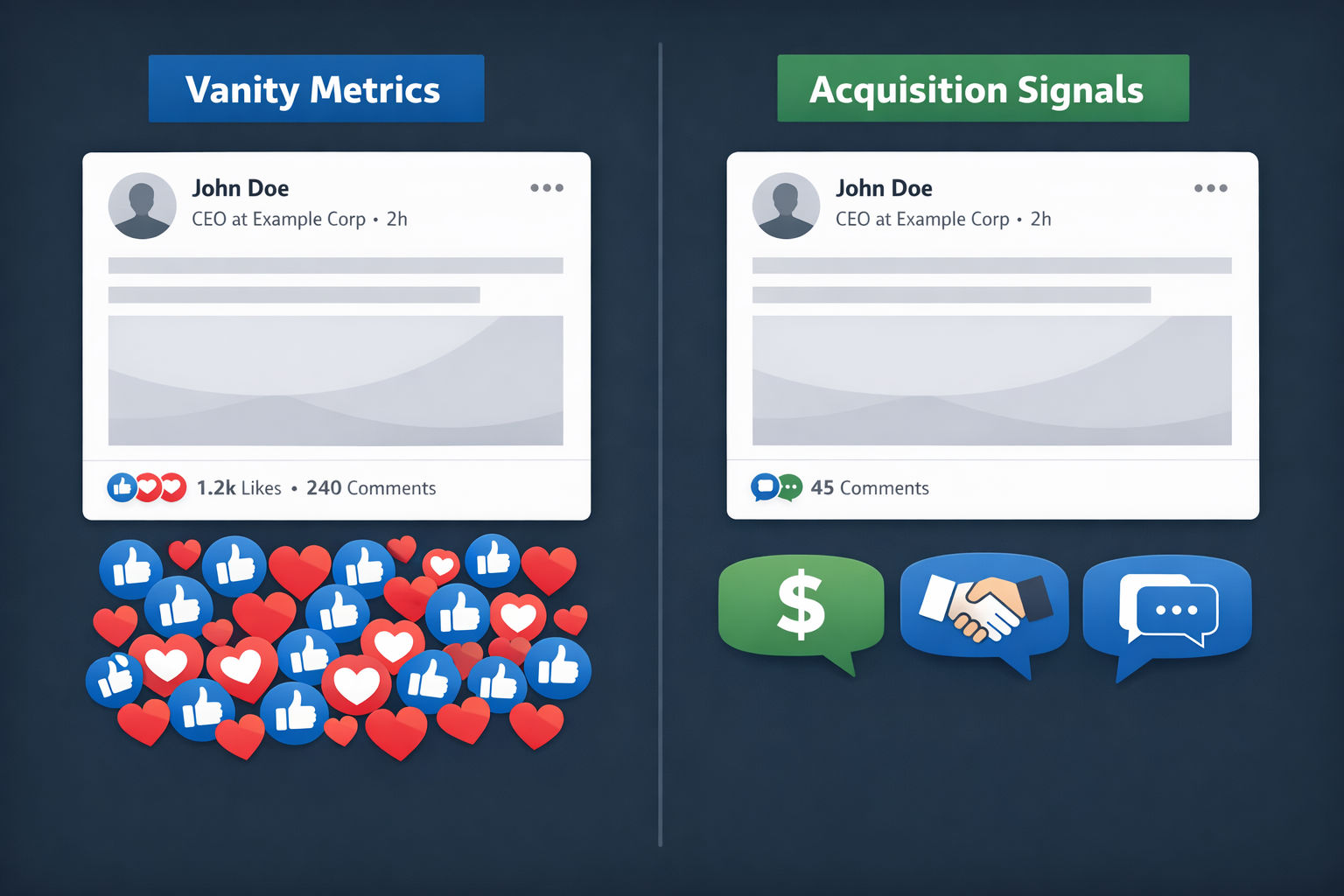
Here’s the problem: only 2.9% of LinkedIn engagements come from ICP-fit prospects. The other 97.1% are peers who will never buy your product. You built an audience — just the wrong one. And you never added a conversion layer.
This post is about fixing that.
Left: what most build-in-public posts optimize for. Right: what actually drives revenue.
The Missing Conversion Layer
Building in public works for awareness. It doesn’t work for acquisition — unless you add a mechanism that moves the right people from reading to buying.
Think about what your typical build-in-public post signals. “We hit $5K MRR” tells people you’re making progress. It doesn’t tell a VP of Engineering that you can fix their deployment pipeline.
This is the core issue with most founder content strategy advice: post consistently, but never post for conversion.
The data is unambiguous:
- Founder-led inbound converts at ~14.6%, compared to 1.7% for cold outbound — an 8.6x difference (Linkboost 2026)
- 73% of B2B decision-makers say thought leadership from a named individual is more trustworthy than marketing materials (Edelman-LinkedIn, 2024)
- 75% say thought leadership led them to research a product they weren’t previously considering
- Only 15% rate thought leadership quality as “very good” or “excellent”
Buyers are hungry for credible founder content. Most of it just isn’t written for them.
The Peer Trap
If your comments section is filled with other founders saying "congrats!" and "love this!" but zero people asking about pricing or use cases, you've built a peer audience, not a buyer audience. The fix isn't posting less — it's writing for a different reader.
The Post Format That Actually Drives Signups
Creators who name specific results with before/after metrics report 5–10x more sales-qualified connection requests than general thought leadership posts (CannerAI creator survey).
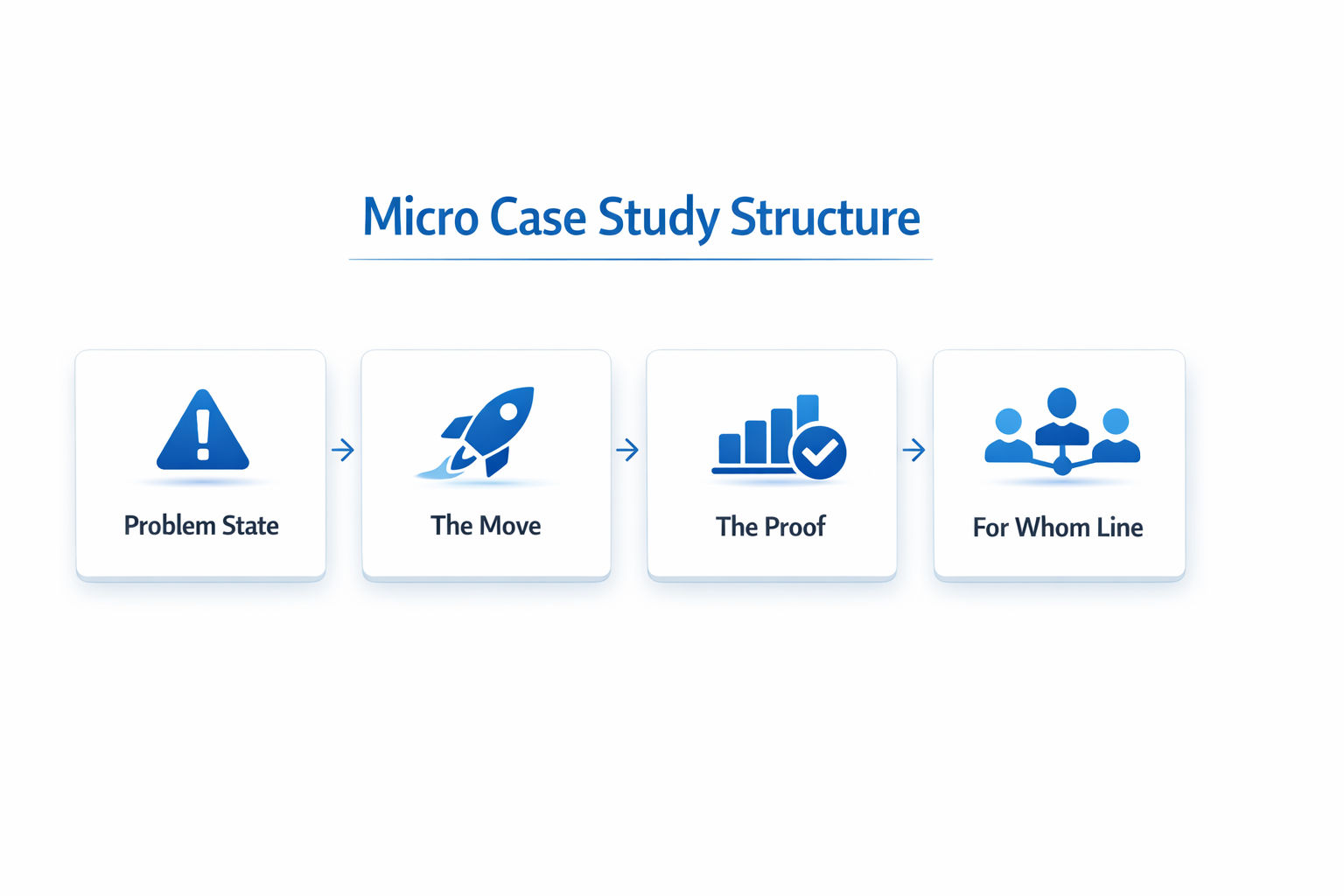
Here’s the four-part micro case study format that works:
1. The Before-State (hook) — Lead with the number and the pain. “A B2B SaaS founder was spending 8 hours/week on content that generated zero demos.”
2. The Move (what you did) — Specific change in 1-2 sentences. “We switched from generic thought leadership to ICP-targeted micro case studies, 3x per week.”
3. The Proof (the result) — Hard numbers. “In 6 weeks: 14 qualified demos, 3 closed deals, $24K in pipeline. All from LinkedIn inbound.”
4. The For-Whom Line (filter) — The highest-leverage sentence in the post. “If you’re a B2B founder with 6+ months of posting but zero pipeline to show for it — this is fixable.”
The four-slot micro case study format. Lead with the result. Close with the filter.
Notice: the result comes first, not buried in paragraph four. The product is embedded as the mechanism, not pitched. And the for-whom line sells by exclusion — if that’s not you, keep scrolling. If it is, you feel seen.
No client names needed. Anonymize to a category (“B2B SaaS founder”) and use ranges if exact numbers feel risky.
The 3-Post-Per-Week Cadence
Forget posting every day. The LinkedIn creators telling you to ship 5-7 times per week are full-time content people. You’re building a product.
Three posts per week is the data-backed sweet spot. Buffer’s analysis of 50,000+ business accounts found moving from 1 post/week to 2-5 posts/week generates ~1,182 more impressions per post and a +0.23 point lift in engagement. The curve flattens around 3 posts/week — most of the benefit, none of the burnout.
Here’s the content mix for content marketing on LinkedIn that converts:
Three posts per week, each with a specific conversion job
| Day | Post Type | Purpose |
|---|
| Monday | Micro case study / proof post | Pipeline: signals you solve real problems |
| Wednesday | Insight / contrarian take | Credibility: positions you as an expert |
| Friday | Build-in-public update (ICP-framed) | Relatability: framed as a lesson, not a milestone |
Batch-write all three posts in one session. Schedule for mornings. Spend 10-15 minutes daily on comments — where the real conversion engine lives.
LinkedIn Comments Are Your SEO-Adjacent Discovery Engine
Here’s something most founders missed: LinkedIn posts are now indexed by Google. Regular feed posts — not just Articles — show up in search results and AI-generated answers.
Josh Spilker at AirOps tested this: he wrote a LinkedIn post targeting “content refresh vs rewrite.” It now ranks in Google’s sidebar — ahead of his company’s blog post for the same term.
LinkedIn ranks #1 for professional queries across all six major AI platforms (Profound, 2026). Feed posts contribute over 28% of LinkedIn citations on ChatGPT. Your founder thought leadership isn’t just social content — it’s search real estate.
But comments matter even more. Richard van der Blom’s 2025 Algorithm Insights report found comments over 15 words carry 2x the weight of shorter interactions. One operator reported getting 3x more inbound from commenting than from posting (Ayush Poddar, StartupGTM).
The playbook:
- Build a target list of 30-60 ICP decision-makers
- Comment within 60 minutes of their posts (3x higher response rate)
- Use Sam Szuchan’s formula: “Affirm their point + add new data + ask an open question”
- Move to DM within 24 hours when they engage back
This turns comments into a systematic pipeline channel — and feeds both LinkedIn’s algorithm and Google’s with relevance signals.
Comments as SEO Assets
When your comments demonstrate expertise on topics your ICP searches for, you're building two things at once: social proof for humans and keyword-rich content for search engines. LinkedIn for indie hackers at its most practical — a two-way discovery channel.
Your Swipe-Worthy Post Template
Fill in the brackets and post this week:
[Specific ICP] was stuck on [specific problem] despite [effort they were making].
They were [doing X] but [painful outcome Y].
Here’s what we changed:
- [Specific move 1 — keep it concrete]
- [Specific move 2 — show the mechanism]
- [Specific move 3 — name the time frame]
[Number] weeks later:
📈 [Metric 1]
📈 [Metric 2]
📈 [Metric 3]
The lesson: [One-sentence insight that positions your approach as the differentiator.]
If you’re [ICP description] and [pain they relate to] — this is solvable. DM me “[keyword]” and I’ll share the exact [resource].
No hashtag stuffing. No “thoughts?” Just a specific story, hard numbers, and a clear next step for the right person.
Measure What Matters
Stop tracking impressions and likes. Start counting:
- Qualified DMs per week that reference your content
- Meetings booked where LinkedIn was the first touchpoint
- Pipeline dollars with LinkedIn as the attributed source
The founders making real money from build in public LinkedIn aren’t the ones with the most followers. They figured out LinkedIn is a direct-response channel disguised as a social network.
Want to Actually Execute This Without It Becoming a Second Job?
We built Vibeblogger because we hit the exact problem in this post — content matters for acquisition, but writing it isn't sustainable alongside building product. Vibeblogger handles research, writing, and publishing so you can focus on engaging with customers.
See How It Works