You’re about to commit real time and money to SEO. Before you do, you want to know: how long until this actually works?
Fair question. If you’re figuring out how to get organic traffic for your startup, you need honest numbers — not some agency telling you to “trust the process” while they bill you monthly.
Here’s what the data actually says. And more importantly, here’s the month-by-month roadmap so you know whether your SEO is on track or broken.
The Honest Answer: What the Data Shows
Google’s own guidance to business owners says it takes 4 to 12 months for SEO improvements to show measurable benefits. That’s straight from Google — not an agency trying to lock you into a retainer.
But let’s go deeper. An Ahrefs study of 2 million pages found that only 5.7% of pages reached the top 10 results within one year. The average age of a page ranking in the top 10? Over 2 years. Pages sitting at position #1 average nearly 3 years old.
That sounds grim. But here’s the nuance most people miss: those stats include every random page on the internet — including ones with zero strategy behind them. Pages with intentional SEO for startups — proper keyword targeting, solid technical foundations, consistent publishing — beat those averages by a wide margin.
The 5.7% Stat in Context
Ahrefs found only 5.7% of pages reach Google's top 10 within a year. But the pages that do make it share common traits: they target specific keyword intent, come from sites with growing authority, and have proper on-page optimization. Random publishing doesn't work. Strategic SEO does.
Month-by-Month: What Organic Traffic for Startups Actually Looks Like
Here’s the part most SEO guides skip — concrete benchmarks at each stage. If you’re a startup founder building your first real content engine, this is what to expect.
The Startup SEO Timeline
Months 1–2Months 1–2: Foundation (Nothing Visible Yet)
Technical audit, keyword research, site architecture, first content published. You'll see: pages indexed in Google Search Console, impressions starting from zero. Traffic impact: essentially none. This is where most founders get nervous. Don't bail.
Months 3–4Months 3–4: First Signs of Life
Long-tail keywords start ranking on pages 2-4. Impressions climb in Search Console. You might see first-page rankings for low-competition terms. Organic sessions: 10-50% above baseline. Track keyword position movement — it matters more than traffic right now.
Months 5–6Months 5–6: Measurable Traction
First-page rankings for long-tail keywords. Organic traffic up 50-185% from baseline. First conversion-quality visitors arrive. One case study showed a startup hitting 60+ first-page keywords by month 6 with 185% organic traffic growth.
Months 7–9Months 7–9: Compounding Kicks In
New content ranks faster because your domain authority is growing. Mid-competition keywords enter the top 10. Organic-attributed signups and demo requests become a meaningful number. A SaaS AI tool hit 60,000 monthly visits from zero in 7 months using content clusters.
Months 10–12Months 10–12: The Flywheel
Competitive keywords enter top 10. Organic traffic compounds month over month (15-25% monthly growth is typical). SEO becomes your most cost-effective acquisition channel. One B2B SaaS startup hit 40K monthly visitors with a 55% reduction in CAC by month 12.
The pattern is clear: months 1-3 feel like nothing is happening. Months 3-6 show early proof. Months 6-12 is where the compounding effect makes SEO the best channel in your stack.
This is why founders who quit at month 3 never see the payoff. They’re leaving the table right before the cards turn.
Why the Wait Is Worth It: SEO vs. Paid Ads by the Numbers
The reason to care about how to get organic traffic — instead of just running paid ads forever — comes down to simple math.
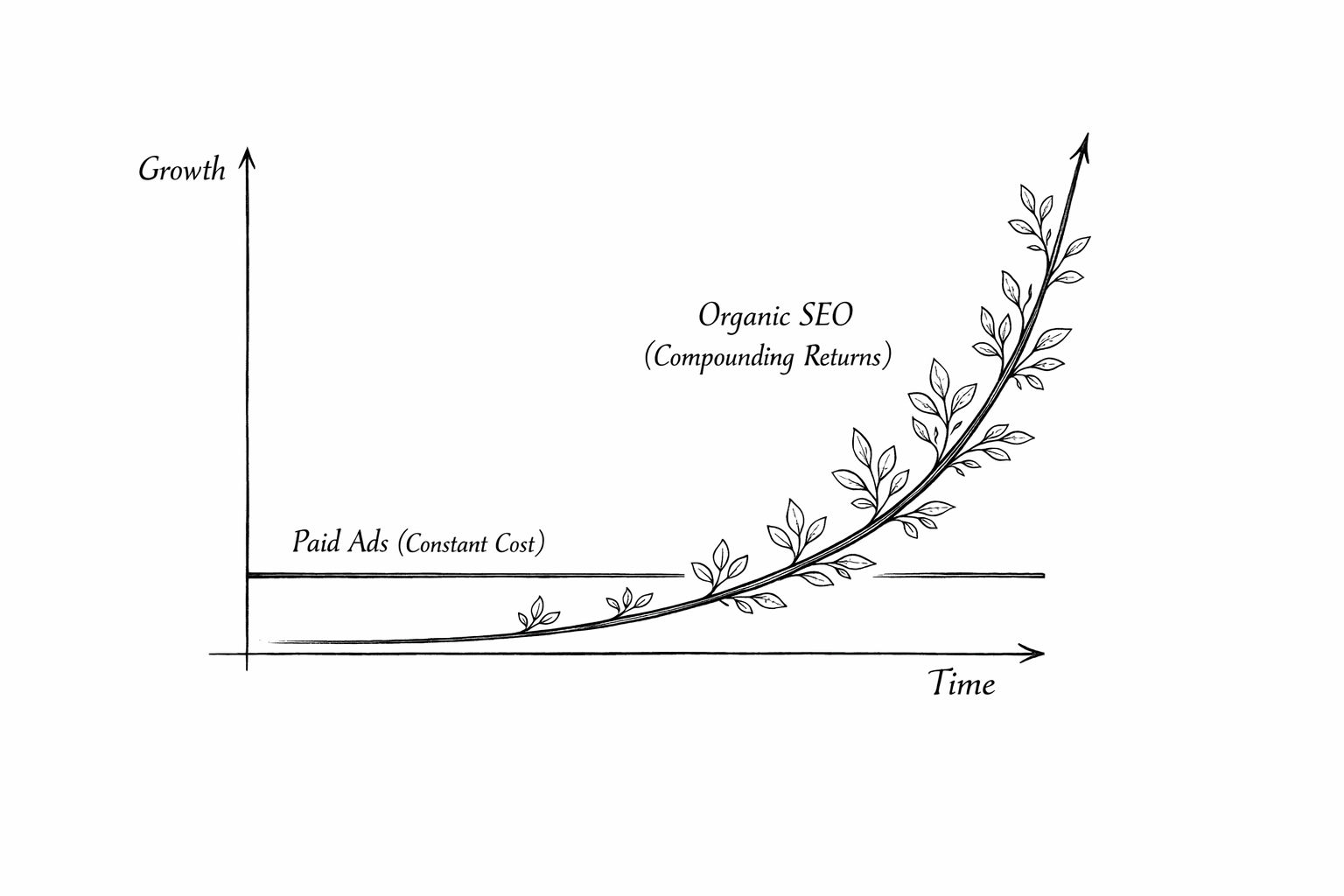
Paid ads give you a straight line. SEO gives you a compounding curve.
SEO vs. Paid Search: Key metrics for B2B SaaS. Sources: Click Vision, SEOProfy, Oliver Munro SaaS marketing data.
| Metric | Organic SEO | Paid Search (PPC) |
|---|
| Average ROI | 702% | 200-400% |
| Cost per customer | $205–$560 | $341–$802 |
| Cost per lead | $31 | $181 |
| Conversion rate | ~14.6% | ~10% |
| Break-even timeline | ~7 months | Immediate (but resets monthly) |
| Long-term trend | Compounds over time | Flat — stops when you stop paying |
The numbers are stark. SEO for SaaS delivers 5.8x more leads per dollar than PPC. Organic search generates 44.6% of all B2B revenue — more than paid, email, and social combined.
And here’s the kicker: a $10K/month SEO investment might generate $2K in equivalent traffic value in month 1. But by month 12, that same investment produces $30K–$50K worth of equivalent traffic. Your content keeps working without additional spend. Paid ads? The moment you stop paying, your traffic hits zero.
The Most Common Startup SEO Mistake
Measuring SEO by revenue before it has time to produce revenue. If you're evaluating organic traffic ROI at month 3, you're checking the oven 20 minutes into a 2-hour roast. Track leading indicators first: impressions, keyword position movement, pages indexed. Revenue metrics become meaningful around month 6-9.
What to Track So You Know It’s Working
The scariest part of SEO for startups isn’t the timeline. It’s not knowing whether you’re on track or wasting money. Here are the leading indicators at each stage — the metrics that predict success before traffic arrives.
Months 1-3 (track these weekly):
- Pages crawled and indexed in Google Search Console
- Impressions trending upward (even without clicks)
- Target keywords appearing in positions 20-50
- Technical health score improving (Core Web Vitals green)
Months 3-6 (add these):
- Keywords moving from page 3-4 to page 1-2
- Click-through rate improving for ranked terms
- Organic sessions growing 10-30% month over month
- First bottom-of-funnel pages getting organic clicks
Months 6-12 (now measure business impact):
- Organic-attributed trial signups or demo requests
- Customer acquisition cost trending down vs. paid channels
- New content ranking faster than older content did (authority building)
- Share of voice growing against competitors on target keywords
How to Speed Up the Timeline
You can’t hack Google’s crawling schedule. But you can avoid the mistakes that slow most startups down.
Start with long-tail keywords. High-competition head terms take 12-18 months. Long-tail keywords with clear intent can rank in 3-4 months. A topical authority strategy built on clusters of related long-tail content is the fastest path for new domains. For a step-by-step breakdown of how to map and execute a 20-post cluster from scratch, check out our guide to topical authority SEO for indie hackers.
Fix your technical foundation first. If your site has crawl errors, broken links, or slow load times, nothing else matters. Spend weeks 1-2 on technical SEO before publishing a single blog post. Our lean SEO stack guide covers the 5 tools under $50/month you need to handle audits, rank tracking, and keyword research without overspending.
Publish consistently, not sporadically. Sites that publish 2-4 posts per week build authority faster than those dropping one post per month. Google rewards fresh, consistent signals. A blog automation workflow makes this possible without burning your weekends.
Target bottom-of-funnel content early. Comparison pages, “alternative to” posts, and use-case content convert at higher rates and often face less competition. One SaaS case study showed hub pages moving from page 4 to page 1 in just 4 months, tripling qualified leads.
The Real Question Isn’t “How Long” — It’s “Can I Afford Not To”
Here’s what happens if you skip SEO and rely on paid channels: your CAC stays flat (or rises), your margins get squeezed, and the day you cut ad spend is the day your pipeline disappears.
Meanwhile, 68.7% of all Google clicks go to the top 3 organic results. The #1 organic position gets 19x more clicks than the top paid ad. Every month you delay is a month your competitors are building the organic moat you’ll eventually need to cross.
SEO for SaaS isn’t a quick win. It’s a compounding asset. The founders who start now — even with a small cluster of 10 intentional posts — will be the ones collecting organic traffic while their competitors are still feeding the paid ads machine.
The best time to start was 6 months ago. The second best time is today.
Want Your SaaS to Rank on Google Without the Busywork?
Vibeblogger handles the entire SEO content pipeline — keyword research, writing, images, and publishing — so you can focus on building your product. Every post on this blog was researched, written, and published by Vibeblogger itself.
See How Vibeblogger Works