Programmatic SEO for SaaS: How to Build 1,000 Pages Without Writing Each One
Programmatic SEO lets you generate hundreds of search-optimized pages from a single template and a database. Here's the solo founder's playbook — with real case studies, tech stack options, and the Google risks you need to know.
Rori Hinds··9 min read
You know the math doesn’t work.
You’ve got a SaaS product with 200 integrations, or you serve 50 cities, or your tool covers 300 use cases. Writing a unique blog post for each keyword variation would take you two years of full-time work. And you’re supposed to be building a product.
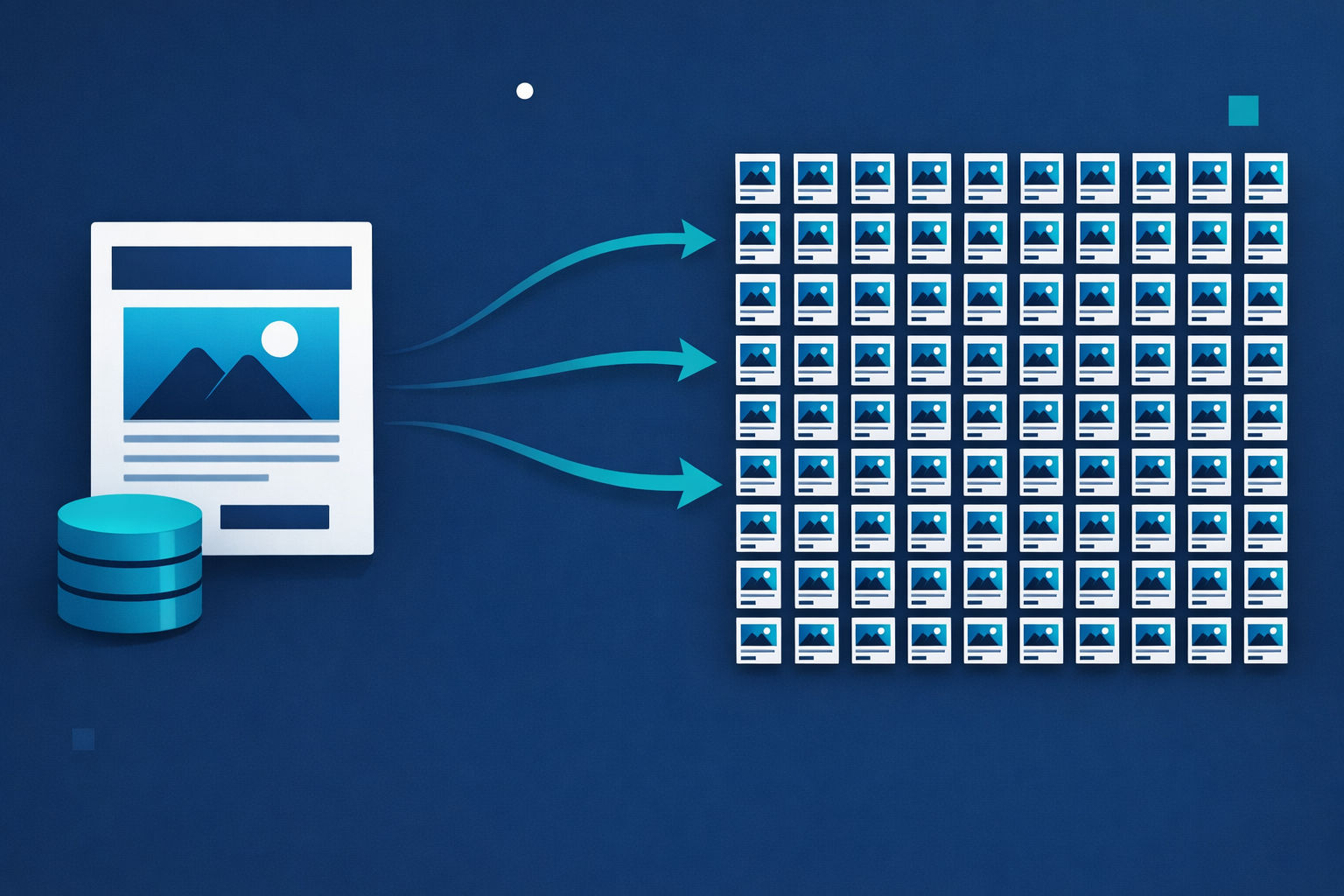
This is exactly the problem programmatic SEO solves. Instead of writing each page by hand, you build one template, connect it to a database, and generate hundreds or thousands of pages — each targeting a specific long-tail search term.
Zapier does this with 60,000+ integration pages. Wise does it with 260,000+ currency conversion pages. Nomad List does it with 1,000+ city pages. And they’re pulling millions of monthly organic visits because of it.
The difference between those companies and most guides you’ll read? Those guides assume you have a dedicated engineering team. This one assumes you’re a solo founder or a small team who can actually build this yourself.
Let’s break down how it works, when it’s worth your time, and how to avoid getting slapped by Google.
What Programmatic SEO Actually Is
Programmatic SEO is dead simple in concept. You take a page template, connect it to structured data, and let your code generate unique pages at scale. Each page targets a different long-tail keyword.
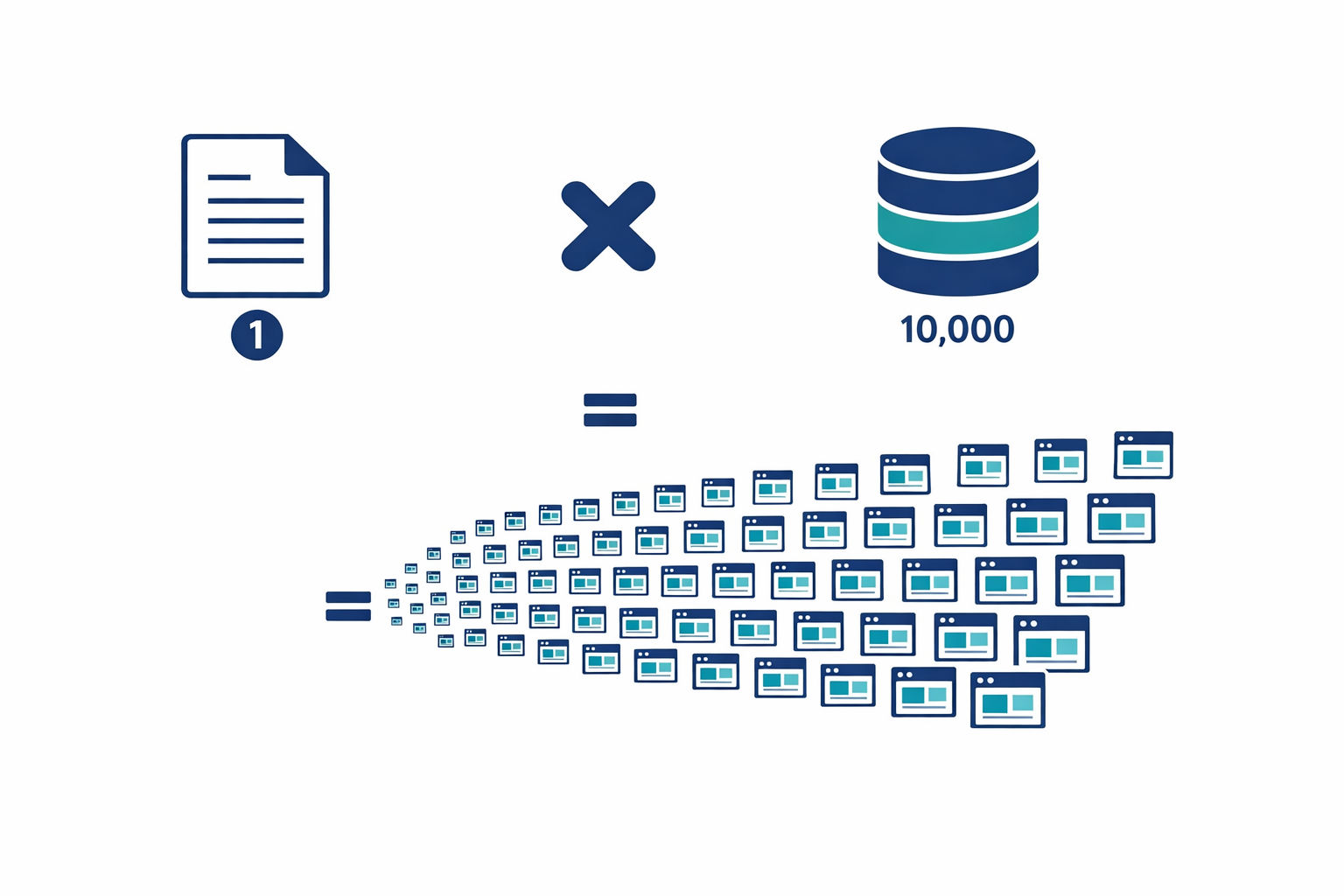
The formula looks like this:
The core pSEO formula: 1 template × your data = thousands of pages
Take Zapier as a concrete example. They support 7,000+ apps. Every combination of two apps gets its own integration page — “Connect Slack to Google Sheets,” “Connect Notion to Gmail,” and so on. That’s 50,000+ pages, each targeting a specific search query that someone is actually typing into Google.
The result? Over 8.6 million monthly organic visitors, with 48% of all site traffic coming from organic search. Their programmatic pages grew site traffic by 196% over four years.
Or look at Wise (formerly TransferWise). Every currency pair gets a page — “USD to EUR,” “GBP to INR,” etc. They’ve generated 260,000+ pages this way. Those pages drive 60 million monthly organic visits, accounting for roughly 90% of their total organic traffic.
And here’s the one that should get indie hackers excited: Nomad List. Built by Pieter Levels — one person. Over 1,000 city pages with cost of living, internet speed, weather, and community data. Each page ranks for terms like “cost of living in Chiang Mai” or “best cities for remote workers in Europe.” That’s 50,000+ monthly organic visits from a site built and maintained by a solo founder.
The long-tail math that makes this work
91.8% of all search queries are long-tail (3+ words). These keywords represent over 70% of all organic traffic. Each individual page might only get 20-50 visits per month — but 1,000 pages × 30 visits = 30,000 monthly visitors from a single template.
When Programmatic SEO Works (And When It’s a Waste of Time)
Here’s where most guides get vague. They’ll say “it depends.” I’ll be direct.
Programmatic SEO works when three conditions are true:
You have structured data. A database, spreadsheet, or API with consistent fields across hundreds of entries. Integrations, locations, tool comparisons, pricing data, feature lists — anything you can organize into rows and columns.
Each page variation has real search intent. People are actually searching for “USD to EUR” or “Slack Gmail integration.” If nobody is searching for the specific variation, the page is dead weight.
You can add unique value per page. This is the make-or-break factor. If the only difference between 1,000 pages is swapping out a city name in the H1 tag, Google will (rightly) treat them as thin content. Each page needs unique data points — real pricing, actual reviews, live metrics, specific instructions.
If you’re missing any of these three conditions, don’t bother. You’ll burn time building pages that either get no traffic or get penalized.
Is Programmatic SEO Right for Your SaaS?
Good fit for pSEO
You have 100+ data entries (integrations, locations, tools, use cases)
Each variation has provable search volume (check Ahrefs or Google Keyword Planner)
You can populate unique data per page (live metrics, real descriptions, actual comparisons)
Your product naturally connects to a combinatorial keyword pattern
You can build and maintain the template yourself
Good fit for pSEO
You have fewer than 50 meaningful variations
The keyword variations have near-zero search volume
Pages would just be the same content with a swapped keyword
You don't have a structured data source to pull from
You'd need to hire someone to build and maintain the system
Picking Your Keyword Template Pattern
The keyword template is where your strategy lives or dies. You need a repeatable pattern where each variation represents genuine search intent.
Here are the patterns that work best for SaaS:
Common programmatic SEO keyword patterns for SaaS companies
Pattern
Example
Best For
Data Source
[Tool A] vs [Tool B]
"Notion vs Coda", "Slack vs Teams"
SaaS with known competitors
Competitor list + feature data
[Tool A] + [Tool B] integration
"Connect Slack to Google Sheets"
Integration platforms, APIs
Supported integrations database
[City] + [Service]
"Bookkeeping in Austin", "Coworking in Berlin"
Location-based SaaS, directories
City database + service offerings
[Use Case] + [Software Type]
"Project management for law firms"
Vertical SaaS, B2B tools
Industry list × feature categories
[Currency A] to [Currency B]
"USD to EUR", "GBP to INR"
Fintech, currency tools
Currency pairs + live rates
[Template/Resource] for [Role]
"Invoice template for freelancers"
Productivity tools, design tools
Template library × user segments
The “[Tool A] vs [Tool B]” pattern is particularly powerful for early-stage SaaS. If you’re building a project management tool, you can create comparison pages for every competitor pair in your space — even if your product isn’t one of the tools being compared. You’re capturing research-stage buyers who are actively evaluating options.
Zapier’s “[App A] + [App B] integration” pattern generated 50,000+ pages. Athenic used the same approach and hit 250K monthly visitors from 12,000 integration pages, with 68% of all traffic coming from those programmatic pages and a 24% visitor-to-signup conversion rate.
The key validation step: before building anything, check 20-30 keyword variations in Ahrefs or Semrush. If the average monthly search volume per variation is above 50 and competition is low to medium, you’ve got a viable pattern. If most variations show zero volume, pick a different pattern.
The Solo Founder Tech Stack
You don’t need a team of engineers. You need a CMS or framework that can generate pages from data. Here are your realistic options:
Tech Stack Options for Programmatic SEO
Stack
Skill Required
Page Limit
Best For
Cost
**Next.js + DB** (Vercel/Supabase)
JavaScript/React
Unlimited (ISR)
Technical founders, custom data
$0-20/mo to start
**Webflow CMS**
No-code (visual builder)
10,000 items (CMS plan)
Non-technical founders, design focus
$29-49/mo
**Framer + CMS**
Low-code (visual)
1,000 items (free), 10K paid
Quick prototyping, landing pages
$0-15/mo
**Astro + Markdown/JSON**
HTML/JS basics
Unlimited (static)
Developers who want speed
$0 (static hosting)
**WordPress + ACF/Pods**
PHP basics
Unlimited
Existing WP sites
$10-30/mo hosting
My recommendation for most solo founders: If you can write JavaScript, go with Next.js on Vercel + a database (Supabase, PlanetScale, or even a JSON file for smaller datasets). You get generateStaticParams for static generation, automatic sitemaps, and zero limits on page count. Deploy on Vercel’s free tier to start.
If you’re non-technical, Webflow CMS is the move. You design one collection template, import your data via CSV, and Webflow generates the pages. The 10,000-item CMS limit is fine for most SaaS use cases. One founder built a brewery directory with Webflow pSEO and hit 1 million organic impressions in a year — barely touching it after launch.
Whichever stack you pick, the architecture is the same: one template, dynamic routes pulling from your data source, and auto-generated sitemaps so Google can find everything.
Launch Your First Programmatic SEO Pages in a Weekend
Step 1
Validate your keyword pattern
Check 20-30 variations in Ahrefs or Google Keyword Planner. You need average monthly volume above 50 per variation and low-to-medium competition. If the numbers aren't there, try a different pattern.
Step 2
Build your data source
Create a spreadsheet or database with at least 5 unique data fields per entry — not just the keyword variable. Think descriptions, stats, metadata, categories, and any dynamic data you can pull from APIs.
Step 3
Design one great template
Build a page template with dynamic title tags, unique H1s, 2-3 sections of variable content, a data table or comparison, internal links to related pages, and a clear CTA. Every section should pull different data.
Step 4
Start with 50 pages, not 5,000
Generate your first 50 pages and submit them to Google Search Console. Monitor indexing and rankings for 2-4 weeks. Look for 'Crawled - Currently Not Indexed' warnings — that's Google telling you the pages are too thin.
Step 5
Scale after validation
Once your first 50 pages are indexing and getting impressions, scale to your full dataset. Add new data entries as they become available. Monitor for indexing issues in Search Console weekly.
The Risk: Google’s Scaled Content Policies
Let’s talk about the elephant in the room. In March 2024, Google updated its spam policies to explicitly target “scaled content abuse” — generating large volumes of pages primarily to manipulate search rankings.
This is real. Sites have received manual actions for publishing thousands of thin, AI-generated pages with swapped keywords and no real substance. Google’s policy is clear: it doesn’t matter whether humans or AI created the content. What matters is whether the pages exist to help users or to game rankings.
Here’s what triggers penalties:
Red flags that get programmatic pages penalized
Pages where the only difference is a swapped keyword in the title and H1
No unique data, descriptions, or value per page
Publishing thousands of pages overnight without any indexing history
Pages targeting locations or services you don't actually serve
Content-to-ad ratio below 60% (more ads/CTAs than actual content)
No internal linking structure between programmatic pages
And here’s what keeps you safe:
Unique data per page. Wise doesn’t just swap currency names — each page has live exchange rates, historical charts, fee breakdowns, and transfer speed data. That’s real value.
Genuine search intent match. Every page should answer a question someone is actually asking. If nobody searches for “connect App A to App B,” don’t create the page.
Gradual rollout. Start with 50 pages. Scale to 200. Then 1,000. Don’t dump 10,000 pages on Google overnight.
Internal linking. Connect your programmatic pages to each other and to your main site. An orphaned page with no links signals low quality to Google.
Human oversight on templates. Review a sample of generated pages before going live. If they all look the same, your template needs more dynamic sections.
The companies doing programmatic SEO right — Zapier, Wise, Nomad List — have been at it for years without penalties because each page genuinely serves the searcher. That’s the bar you need to clear.
When to use programmatic SEO vs. traditional blog content
Programmatic SEO
Blog Content
**Scale**
Hundreds to thousands of pages
1-4 posts per week
**Effort per page**
Low (template + data)
High (research + writing)
**Keywords targeted**
Long-tail, high volume of low-volume terms
Mid-to-high volume head terms
**Content type**
Data-driven, structured, bottom-of-funnel
Editorial, narrative, top/mid-funnel
**Time to build**
1-2 weekends for v1
Ongoing, never "done"
**Risk**
Thin content penalties if done poorly
Lower risk, but much slower to scale
**Best for**
Capturing specific intent at massive scale
Building authority and brand
The smartest play is both. Use programmatic SEO for your long-tail keyword foundation — the hundreds of specific queries your audience is searching for. Use your blog for the bigger, editorial pieces that build authority and brand trust. We’ve written about how we published 100 blog posts using our own product — that’s the editorial side working alongside a scalable strategy.
One SaaS case study showed 68% of traffic coming from programmatic pages and the remaining 32% from editorial blog content. Together, they generated £840K in pipeline over 12 months.
Start This Weekend, Not Next Quarter
Programmatic SEO isn’t a six-month project. If you have a structured dataset and a clear keyword pattern, you can have your first 50 pages live by Sunday night.
Here’s the honest truth: most of those pages will get modest traffic individually. Maybe 20-50 visits per month each. That’s fine. The power is in the aggregate.
50 pages × 30 visits = 1,500 monthly visitors. Scale to 500 pages and you’re at 15,000. Get to 1,000 quality pages and you’re pulling in 30,000+ monthly organic visitors — all from a template you built once.
The window for lazy pSEO is closing. Google’s scaled content policies are getting stricter. But the window for quality pSEO — pages with real data, genuine utility, and actual search intent — is wide open. The companies doing it right are still seeing massive results in 2025 and beyond.
You don’t need a content team. You don’t need a six-figure SEO budget. You need a database, a template, and the discipline to make every page worth someone’s click.
Too busy building your product to write blog posts?
Programmatic SEO handles your long-tail pages. Vibeblogger handles your blog. Get researched, written, and published posts on autopilot — so you can focus on building.