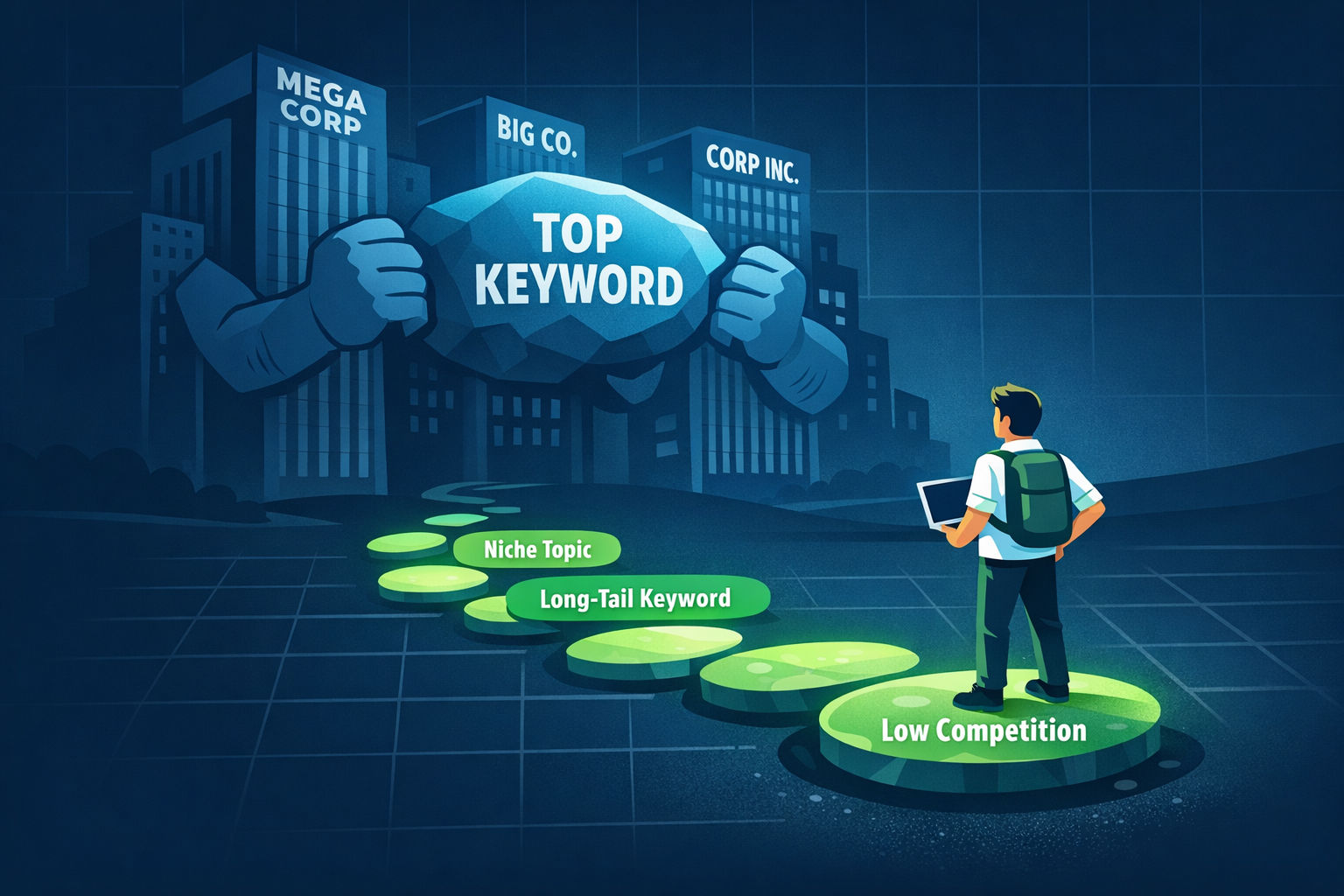
You type your dream keyword into Google. “SaaS content marketing.” “Email automation tool.” “Project management software.”
Positions 1 through 5: HubSpot, Ahrefs, Zapier, Monday.com, Salesforce. All DA 80+ sites with content teams bigger than your entire company.
This is the moment most indie hacker SEO strategies die. You see the competition, assume organic search isn’t for you, and go back to posting on Twitter hoping for the algorithm’s mercy.
But here’s what those top-ranking giants won’t tell you: they’re only competing for about 2% of all searchable keywords. The other 98%? That’s the long tail — and it’s wide open for bootstrapped founders who know where to look. A solid long-tail keyword strategy is often the difference between never ranking and hitting page one within 90 days.
Why Head Terms Are a Mathematically Losing Battle
Let’s look at the actual numbers. A study analyzing 2,000+ keywords found that the #1 position on Google averages DA 77, with a median of 86. Position #2 averages DA 75. Position #3: DA 74.
Your brand-new SaaS blog? Probably DA 10-20.
That’s not a gap you close with “better content.” It’s a structural disadvantage baked into how Google’s algorithm weights domain authority, backlink profiles, and topical authority. You’d need hundreds of quality backlinks and years of consistent publishing to compete on terms like “CRM software” or “project management tool.”
But this isn’t actually bad news. It’s clarifying.
The Long-Tail Math That Changes Everything
Long-tail keywords (3+ words, specific intent) convert at 2.5x the rate of head terms and require 36% fewer backlinks to rank. Keywords with a difficulty score under 20 have a 40% higher chance of ranking in the top 10 for sites with under 1,000 monthly visitors. You're not settling for scraps — you're targeting the keywords that actually drive signups.
ModelsLab, an AI inference API platform, scaled to $1M ARR almost entirely through long-tail SEO. Their founder’s thesis: “10,000 easy keywords beat 10 hard ones.” They built 50,000+ pages targeting queries like “{model name} API” and “{style} checkpoint” — terms the big players never bothered with.
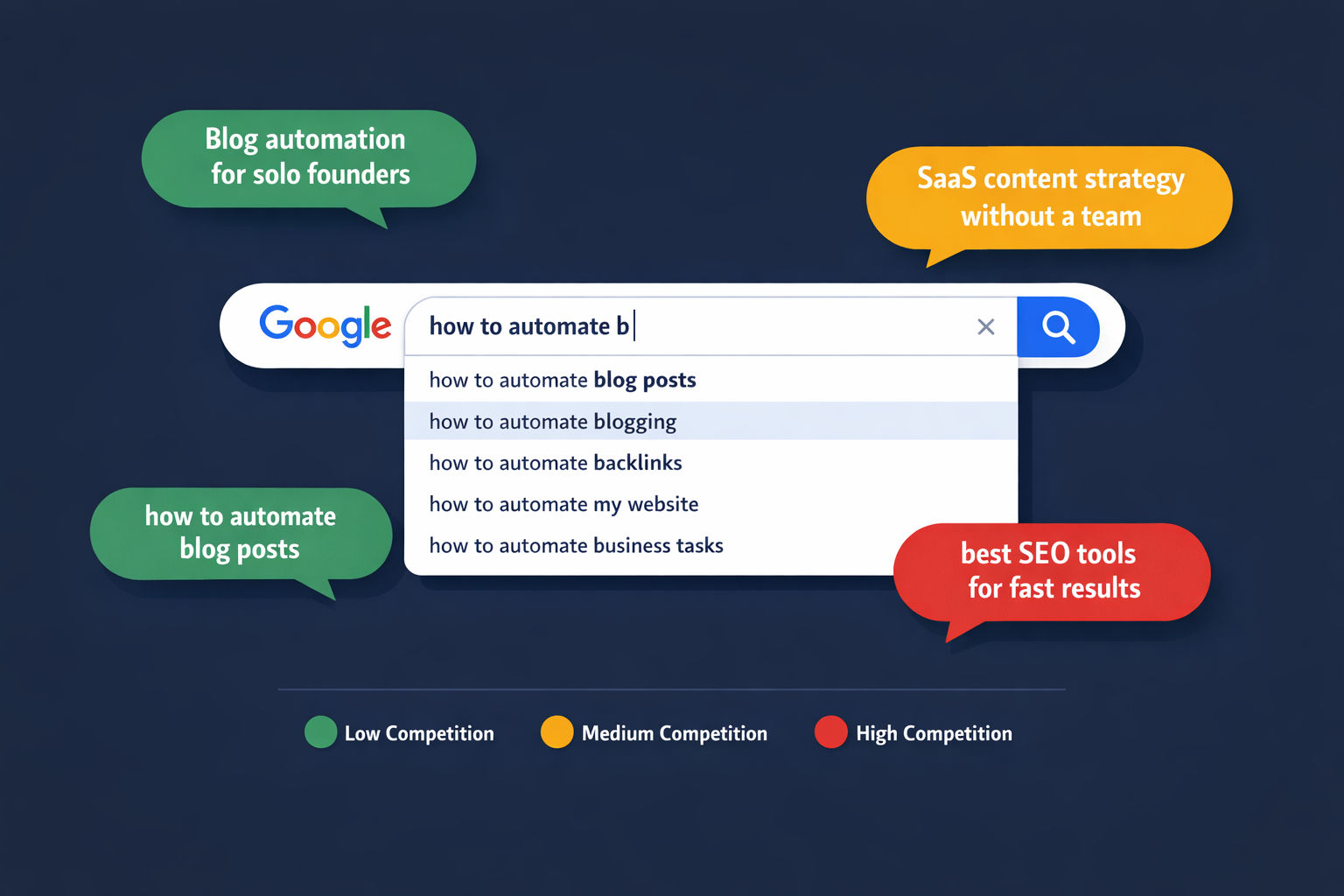
Another case: a LinkedIn automation SaaS ranked on Page 1 in 90 days with $0 ad spend. Instead of targeting “LinkedIn automation” (impossible), they targeted “best LinkedIn automation tool for agencies” (150 searches/month) and “how to automate LinkedIn messages for free” (200 searches/month). Low competition, high intent, actual signups.
The playbook is clear. Stop fighting for the keywords everyone wants. Start finding the keywords nobody else is targeting.
Here’s the exact system to do it — for free.
The $0 Keyword Research System for Bootstrapped Founders
This is the process I’d use to find low competition keywords for any SaaS. It takes about 60-90 minutes per batch and consistently surfaces winnable terms that paid tools often miss entirely.
The core insight: tools like Semrush and Ahrefs frequently show “zero search volume” for keywords that actually get 50-200 searches per month. Google Keyword Planner confirms many of these have real traffic. The tools just can’t measure queries below their threshold — which means these terms are invisible to everyone relying solely on paid software.
The 5-Step Free Keyword Discovery System
Step 1
Start With Seed Terms From Your Audience's Language
Don't brainstorm keywords in a vacuum. Go to Reddit (r/SaaS, r/startups, r/EntrepreneurRideAlong), Indie Hackers, and Hacker News. Search for your product category and read how people describe their problems. A customer might never search "email marketing automation" — they search "how to send follow-up emails without it feeling spammy." Collect 5-10 seed phrases in their exact language.
Step 2
Mine Google Autocomplete for Real Queries
Take each seed phrase and type it into Google. Try variations: "how to [seed]", "best [seed] for", "why does [seed]", "[seed] without". Write down every autocomplete suggestion. Google only suggests terms people actually search — this is free demand validation. Repeat in YouTube search (different algorithm, different suggestions). You should have 30-50 candidates after this step.
Step 3
Expand With People Also Ask
Search your seed terms on Google and click into the People Also Ask boxes. Each click generates new questions. You can cascade 3-4 levels deep. These are pure-intent gold — real questions from real people that most content doesn't answer well. Map these into a spreadsheet. You're looking for questions where the current top answers are thin, outdated, or buried in massive generic articles.
Step 4
Validate Competition With Manual SERP Analysis
This is the critical step most guides skip. For each candidate keyword, Google it in incognito mode and study the top 10 results. You're looking for weak signals: Reddit or Quora threads ranking (means no one has written dedicated content), forum posts from 2+ years ago, thin content under 500 words, results that don't actually answer the query well. If you see 3+ weak results in the top 10, that keyword is winnable.
Step 5
Cross-Check With Google Keyword Planner (Free)
Create a Google Ads account (you don't need to run ads). Plug your top candidates into Keyword Planner. Look for keywords showing 10-100 or 100-1,000 monthly searches. Filter for terms with year-over-year search growth. This catches the keywords that Semrush shows as 'zero volume' but actually have real traffic — your competitors are literally blind to these.
Google autocomplete is the most underrated free keyword research tool. Every suggestion is a validated search query.
How to Tell If a Keyword Is Actually Winnable (Without Ahrefs)
Paid tools give you a “keyword difficulty” score. But those scores are often wrong for the keywords that matter most to small SaaS companies. Here’s what to check manually instead.
Open an incognito window. Search your keyword. Now audit the first page:
Manual SERP signals that indicate a keyword is winnable for low-authority sites
| SERP Signal | What It Means | Your Move |
|---|
| Reddit/Quora threads in top 5 | No one has written dedicated content for this query | Write the definitive answer — you'll likely outrank forums |
| Top results are 2+ years old | Existing content is stale; Google is hungry for fresh takes | Publish an updated, comprehensive post |
| Top results don't match search intent | Someone searches 'how to' but gets product pages | Write the actual how-to guide they're looking for |
| DA <40 sites ranking in top 3 | Low authority sites can compete here | You're in the right weight class — go for it |
| Fewer than 3 exact-match title tags | Competitors aren't specifically targeting this term | Optimize your title and H1 for the exact keyword |
If 3 or more of those signals are present, you’ve found a keyword worth writing for. This takes about 2 minutes per keyword once you get the hang of it.
You can also install the free MozBar browser extension to see DA scores directly in search results. It’s not perfect, but it gives you a quick proxy for competitive strength without paying for a subscription.
The key mindset shift: you’re not looking for the “best” keyword with the highest volume. You’re looking for the keyword where your content can realistically be the best result on the page. That’s a completely different filter.
Cluster Your Keywords So Every Post Helps the Others
Finding individual keywords is step one. Turning them into a content strategy is where the compounding happens.
Here’s how: group your keywords into topic clusters. One pillar topic, 5-8 supporting articles, all internally linked.
This isn’t just organizational niceness. Businesses using topic clusters see 2-3x increases in organic traffic over isolated posts. Google explicitly rewards topical depth — so a cluster of 6 related posts on “blog automation” will outrank a single brilliant post on the same topic.
If you want to go deeper on how this works, we broke down the exact signals Google uses to measure topical authority in our guide to topical authority for SaaS blogs.
The rule of thumb for keyword research for bootstrapped founders: publish at least 2-3 pieces per cluster each quarter. That’s one post every two weeks focused on a single topic area. Manageable for a solo founder. Devastating for SEO over 6-12 months.
Real Example: Finding 5 Winnable Keywords in 30 Minutes
Let me walk through the actual process for the “blog automation for SaaS founders” niche. This is exactly how small SaaS keyword research works in practice.
Seed phrase: “blog automation”
I typed variations into Google autocomplete and People Also Ask, scanned Reddit threads in r/SaaS and r/startups, and checked SERPs manually. Here’s what I found:
5 winnable keywords found in 30 minutes using only free tools
| Keyword | Where I Found It | SERP Weakness | Estimated Volume |
|---|
| how to automate blog posts for SaaS | Google autocomplete | Top 3 are generic listicles, none SaaS-specific | 50-100/mo |
| blog content calendar for solo founders | Reddit r/startups thread | Reddit + Notion templates ranking; no dedicated guide | 10-50/mo |
| automated blog publishing workflow | People Also Ask cascade | Only 1 exact-match result in top 10 | 50-100/mo |
| do I need a blog for my SaaS startup | Indie Hackers thread | Top results are 2021-era; stale advice | 100-200/mo |
| SaaS blog post frequency for small teams | People Also Ask | Quora + thin content in top 5; no data-backed answer | 10-50/mo |
Notice the pattern. None of these are high-volume head terms. But every single one represents a real person with a real question — and the current search results aren’t answering it well.
These five keywords form a natural cluster around “blog automation for SaaS founders.” Write all five posts, interlink them, and you’ve built a topic cluster that Google will reward with increasing authority over time.
That’s the long tail SEO strategy in action. Not one moonshot keyword. Five achievable ones that compound.
The Compounding Effect Is Real
A bootstrapped AI SaaS (TubeOnAI) went from 500 to 6,000+ monthly organic clicks by identifying which 36 of their 250 pages actually drove paid signups — then scaling those content types. They grew MRR 65% in 5 months. The lesson: find what works with long-tail content, then double down ruthlessly.
Your Repeatable Weekly Workflow
Here’s the system distilled into a workflow you can run in under 90 minutes per week. Bookmark this.
90-Minute Weekly Keyword Workflow
Step 1
Monday: 20 Minutes of Community Mining
Scan Reddit, Indie Hackers, and Hacker News for questions in your niche. Save any real user question that could be a blog topic. Aim for 5-10 raw candidates.
Step 2
Tuesday: 20 Minutes of Autocomplete + PAA Mining
Take your best 3-5 candidates and expand them through Google autocomplete and People Also Ask cascades. Build your spreadsheet to 15-20 potential keywords.
Step 3
Wednesday: 30 Minutes of Manual SERP Validation
Check each keyword in incognito. Score them against the SERP weakness table above. Kill anything with DA 60+ sites dominating the top 5. You should end up with 3-5 validated winners.
Step 4
Thursday: 20 Minutes of Clustering and Planning
Group your validated keywords into topic clusters. Decide which one you'll write this week. Map the internal links to existing content. Queue the rest for future weeks.
That’s it. Four focused sessions. No paid tools. A growing pipeline of winnable keywords you can publish against every week.
If you want to track whether this content is actually working, check out our content ROI framework for bootstrapped founders. No point publishing if you’re not measuring.
Stop Waiting for Permission to Win at SEO
The biggest lie in indie hacker SEO is that you need expensive tools, a big team, or a high-DA site to compete.
You don’t. You need specificity.
Every head term is a battlefield where VC-funded companies throw money at content. But three layers deep in Google autocomplete — where a founder is asking “how do I automate blog posts for my SaaS without hiring a writer” — there’s nobody home.
That’s your opportunity. Not 50,000 monthly searches. Maybe 50-200. But 50-200 people who are exactly your customer, asking exactly the question your product answers.
Go find those keywords. Write the best answer on the internet. Link your posts together into clusters. Repeat weekly.
In six months, you’ll have a content engine that works while you sleep — built on keywords your competitors never even knew existed.
Too Busy to Run This Workflow Yourself?
Vibeblogger automates the entire process — keyword research, content writing, image generation, and publishing — so your SaaS blog grows on autopilot while you build your product.
See How It Works